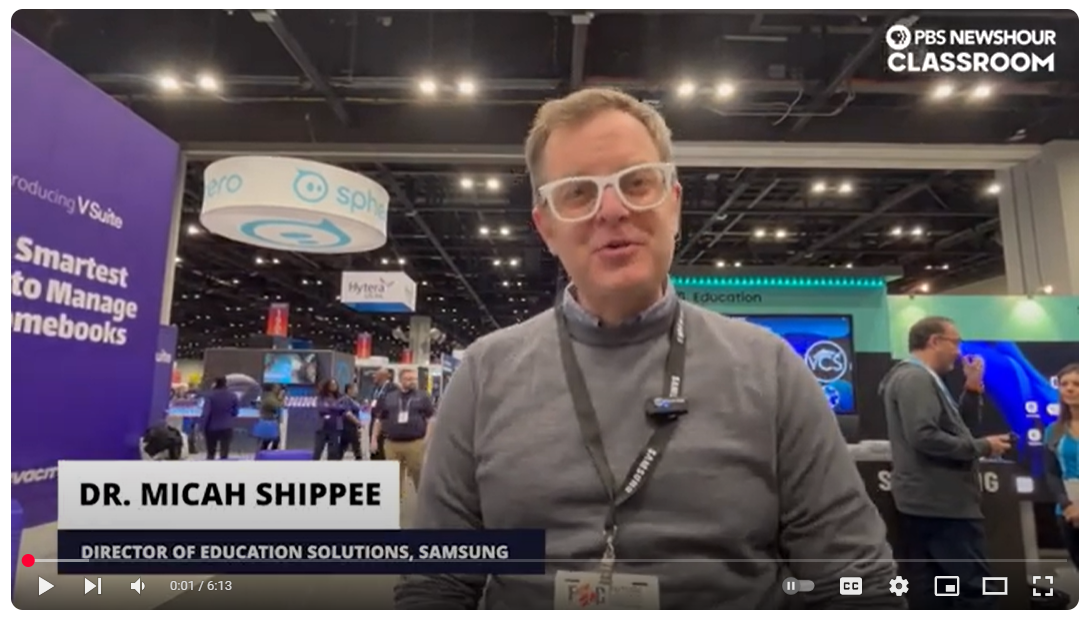
Interview with PBS NewsHour Classroom discussing ed tech integration in a social studies classroom and its impact on work at Samsung, focusing on transforming teaching, demonstrating adaptability, and Samsung’s Solve for Tomorrow competition.
Here is a summary of key interview themes:
Early Adoption of EdTech: discussion on embracing educational technology early, using tools like computers, tablets, and interactive displays to enhance learning retention.
EdTech Builds Confidence: leveraging technology to enable quieter, introverted students to participate via tools like digital parking lots, backchanneling, and microblogging, eventually building confidence to share more openly.
Timeless Teaching Practices + Tech: emphasis on effective traditional methods (like apprenticeship models) remaining valuable, but tech, like AI assistants, have the potential to enhance a teacher’s ability to support more students individually.
Teaching AI Use Responsibly: Students should first develop foundational skills (reading, writing, critical thinking) in class, then use AI tools at home for co-creation and editing—mirroring thoughtful instructional practices.
Our “Pencil Moment” Analogy: Just as past educators questioned how to integrate pencils, today’s teachers are asking similar questions about AI. Technology adoption is a long-standing part of education.
Samsung’s “Solve for Tomorrow” Program: Celebrated as a philanthropic initiative where students tackle local issues connected to global challenges, guided by the UN Sustainable Development Goals.
Modeling Innovation and Agency: Teachers trying new tech should model vulnerability and perseverance, showing students the value of taking risks, learning through failure, and pushing through uncertainty.
Teaching Life Skills Through Struggle: Letting students witness real-time problem-solving and failure (e.g., tech not working) helps teach adaptability, resilience, and critical life skills that transcend academic content.
As I reflect on our recently concluded 2025 Honduras Education Conference at Gran Comission Academy in San Pedro Sula, I am struck by the profound impact that emerges when educators gather with shared purpose. What began as a workshop series evolved into something far more meaningful—a community of practice bound by mutual commitment to educational excellence.
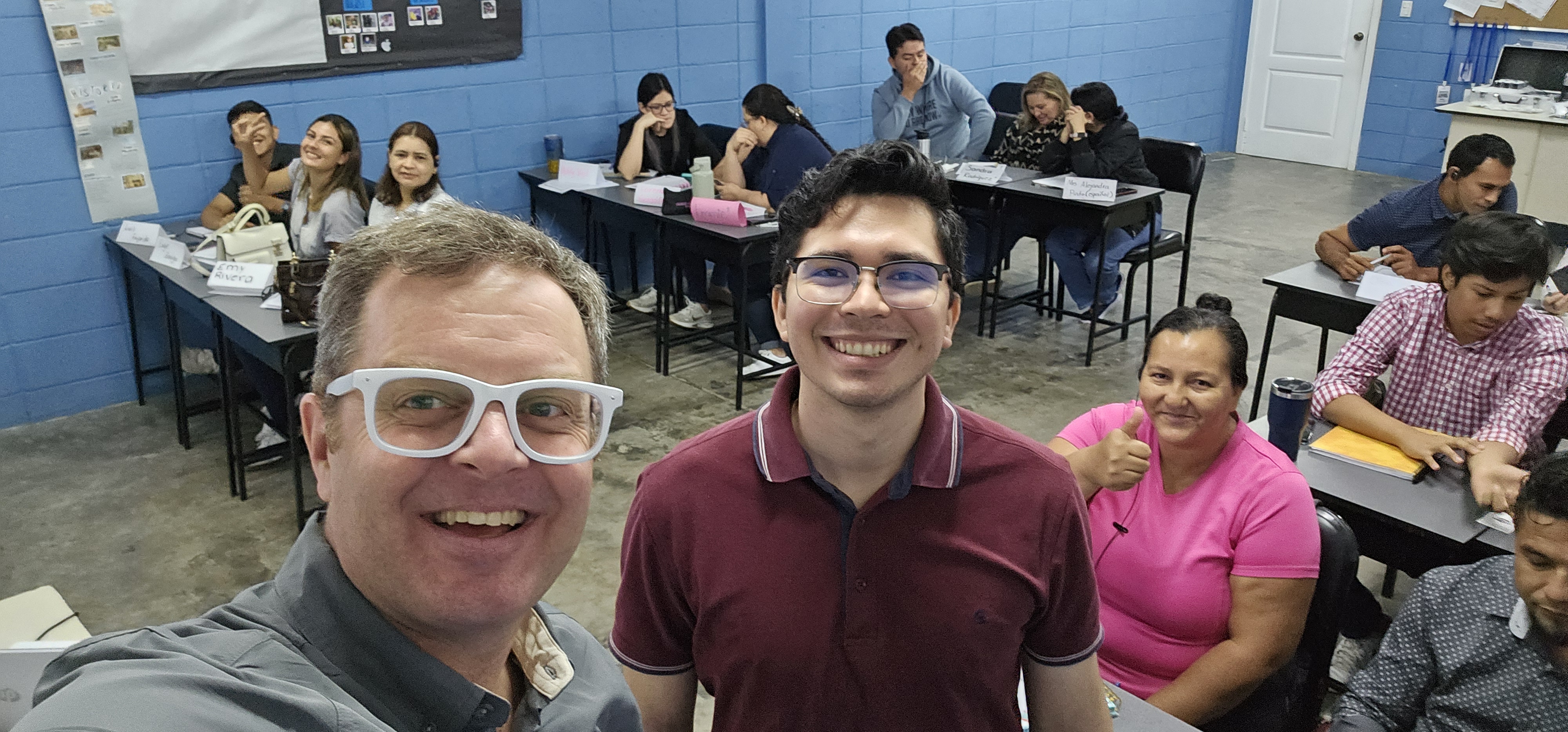
The conference theme, “Effective Solutions in the Classroom,” served as more than just a title; it became our collective mission. Over three intensive days, my colleagues Renee Foisy Kleiner, Laura Shippee, and I had the privilege of working alongside 55 dedicated educators representing three different schools. The commitment of these teachers was exemplified by one group who traveled 3.5 hours each way to participate—a testament to their dedication to their craft and their students.
Responsive Design: Meeting Educators Where They Are
What made this conference particularly effective was our approach to design. Rather than imposing a pre-packaged curriculum, we worked closely with our hosts to develop a responsive program addressing the specific needs of Honduran classrooms. This collaborative approach ensured that our sessions on Design Thinking, Mobile Learning, Positive Behavior Management, Classroom Organization, and Digital Resources resonated with local educational contexts.
The educators’ enthusiasm was palpable as they engaged with these frameworks not as abstract concepts, but as practical tools they could implement immediately. I observed countless moments of recognition as teachers connected new ideas with their existing practice, creating that essential bridge between theory and application.
From Group Learning to Individualized Growth
Perhaps the most transformative aspect of our program was the transition from group workshops to one-on-one coaching on our final day. This personalized approach allowed us to address specific challenges teachers were facing in their unique classroom environments.
Walking through classrooms, meeting students, and witnessing the educational environment firsthand brought a richness to our discussions that wouldn’t have been possible otherwise. These coaching sessions evolved into collaborative problem-solving, with teachers bringing their contextual expertise and we offering methodological insights.
What struck me most was how quickly these sessions transcended the traditional consultant-teacher dynamic. Instead, they became genuine exchanges between professionals united by a shared commitment to student success. The teachers’ openness to vulnerability—sharing both challenges and aspirations—created space for authentic growth.
Sustainable Impact Beyond Conference Days
As educational consultants, we often grapple with questions of sustainability: What happens after we leave? Will these new approaches take root? The eagerness of Honduran educators to maintain ongoing connections offers hope for lasting impact.
This conference reinforced my belief that the most effective professional development is not about one-time knowledge transfer, but about building relationships that sustain continuous improvement. When teachers expressed their desire to continue our professional journey together, I recognized that we had succeeded in fostering something more valuable than content delivery—we had helped cultivate a community of practice that will continue evolving long after our departure.
Cultural Exchange as Professional Development
While our primary purpose was to share educational strategies, I found myself learning as much as I was teaching. The resourcefulness, creativity, and dedication of Honduran educators offered powerful lessons about doing more with less and maintaining unwavering commitment despite challenges.
These cross-cultural exchanges remind us that educational excellence takes different forms across contexts. The innovative adaptations these teachers have developed to address local needs demonstrate that best practices emerge from diverse settings, not just from educational research centers in wealthy nations.
Looking Forward: Seeds Planted for Future Growth
As I return home, I carry with me images of engaged teachers brainstorming solutions, of classrooms transformed into more effective learning environments, and of students who will benefit from their teachers’ enhanced practice. The seeds planted during these three days will continue growing through the dedicated work of these remarkable educators.
Our conference theme—”Effective Solutions in the Classroom”—was realized not through prescription but through partnership. By working together across cultures and contexts, we strengthened education in Honduras “one classroom at a time,” while simultaneously enriching our own understanding of what effective education truly means.
The journey continues, the connections remain, and the impact expands through the daily work of teachers committed to creating better futures for their students.
Interested in seeing what’s next and perhaps how you might join or support a future teacher conference like this? Subscribe to my website feed.
💡 This podcast challenges educators and policymakers to embrace change, fostering a culture of innovation beyond technology. Explore cutting-edge methods, theories, and policies that transform classrooms into launchpads for adventure. Join our conversation to cultivate a mindset of continual learning and turn challenges into opportunities for growth.
✨ In full transparency, I want to share that this podcast is based on my work (cited in the show notes) and amplified by AI Podcasters (from Google NotebookLM) to generate an audio overview. I recognize this seems like an odd way to podcast, but I hope you will give it a try… you will likely be as surprised as I was at how engaging the podcasters are!
I trust that this podcast makes my work approachable and accessible to a larger audience. Thank you for giving it a try… looking forward to your feedback!
A conversation about navigating the evolving landscape of education and work, a human-centered approach to integrating AI, fostering global awareness, and equipping students with future-ready skills is paramount. By addressing the ethical considerations, leveraging AI’s potential strategically, and continually adapting our understanding of essential skills, we can prepare students to thrive in a rapidly changing world.
Note: This conversation was created by using Google NotebookLM and 5 original sources to generate a podcast feel.
Shippee, Micah, Beyond the 4c’S: Framing Our Understanding of Future Skills in the Era of the Fourth Industrial Revolution (January 11, 2024). http://dx.doi.org/10.2139/ssrn.4692130
With Additional content drawn from sources (see below) discussed on www.micahshippee.com (accessed 9.22.24)
NOTE: cover image created with Adobe Firefly. Prompt: create a image about the future of education
Full Conversation References:
Akerson, V. L., Burgess, A., Gerber, A., Guo, M., Khan, T. A., & Newman, S. (2018). Disentangling the meaning of STEM: Implications for science education and science teacher education. Journal of Science Teacher Education, 29(1), 1–8. https://doi.org/10.1080/1046560X.2018.1435063
Bybee, R. W. (2013). The case for STEM education: Challenges and opportunities. National Science Teachers Association.
Carpenter, E., Regassa, L. B., & Watson, C. L. (2020, January 24). Accelerating discovery: Educating the future STEM Workforce | NSF – National Science Foundation. Nsf.gov. Retrieved December 14, 2020, from https://www.nsf.gov/funding/pgm_summ.jsp?pims_id=505552
Collins, A. (2006). Cognitive apprenticeship. In R. K. Sawyer (Ed.), The Cambridge handbook of the learning sciences (pp. 47–60). Cambridge University Press.
Collins, A., Brown, J. S., & Newman, S. E. (1989). Cognitive apprenticeship: Teaching the crafts of reading, writing, and mathematics. In L. B. Resnick (Ed.), Knowing, learning, and instruction: Essays in honor of Robert Glaser (pp. 453–494). Erlbaum.
Cuban, L. (1986). Teachers and machines: The classroom use of technology since 1920. Teachers College Press.
Freeman, B., Marginson, S., & Tytler, R. (2019). An international view of STEM education. In Globalisation and STEM Education (pp. 349–371). Brill Sense. https://doi.org/10.1163/9789004405400_019
Frick, K. T. (2017). The cost of the technological sublime: Daring ingenuity and the new San Francisco-Oakland Bay Bridge.
Haviland, W. A., Prins, H. E. L., Walrath, D., & McBride, B. (2005). Cultural anthropology: The human challenge.
Lahav, R. (1973). Futurology and education: Four futurologists and their theories of education. The Journal of Educational Thought (JET) / Revue De La Pensée Éducative, 7(1), 48–64. https://www.jstor.org/stable/pdf/23768782.pdf
Lubinsky, J., & Shippee, M. (2021). Esports and strategic organizational adoption of innovation. In S. Andrews & C. Crawford (Eds.), Pathways and Opportunities Into the Business of Esports. IGI Global.
Merrill, D. M. (2002). First principles of instruction. Educational Technology Research and Development, 50(3), 43–59. https://doi.org/10.1007/BF02505024
Muhammad Anshari, & Hamdan, M. (2022). Understanding knowledge management and upskilling in fourth industrial revolution: Transformational shift and SECI model. VINE Journal of Information and Knowledge Management Systems, 52(4), 625–640. https://doi.org/10.1108/vjikms-09-2021-0203
National Academy of Sciences, National Academy of Engineering, & Institute of Medicine of the National Academies. (2007). Rising above the gathering storm: Energizing and employing America for a brighter economic future. National Academies Press.
Shippee, M. (2016). mLearning in the organizational innovation process [Doctoral dissertation, Syracuse University]. https://surface.syr.edu/etd/452
Shippee, M. (2019). WanderlustEDU: An educator’s guide to innovation, change, and adventure. Dave Burgess Consulting, Inc.
Shippee, M. (2020). No brainer AI in the classroom. Teach Magazine, September/October 2020.
Shippee, M. (2021). A globalized curriculum: The next evolution of education. In Mobile Learning 2021 and Educational Technologies 2021. IADIS Press. https://doi.org/10.34190/ml.21.001
Stohlman, M., Moore, T. J., & Roehrig, G. H. (2012). Considerations for teaching integrated STEM education. Journal of Pre-College Engineering Education Research, 2(1), 28–34. https://doi.org/10.5703/1288284314636
Assessing knowledge and skill acquisition has been a top priority in every form of education from early philosophers questioning their audience, to master craftsman coaching their apprentices, to today’s formalized education systems. As we know, the industrial revolution had a profound impact on the later driving for summative, or end-product, deliverables to demonstrate mastery. This focus treats the learners as a product themselves, that is, a worker crafted to deliver predefined end results. Here was industry’s attempt at creating a viable workforce (societal demand) during what we might call the first three industrial revolution eras, yet now we are in a fourth (see image). (1,2)
In our fourth industrial revolution era our workforce needs have dramatically shifted, a shift which should inform our educational assessment practices. Here we find our workforce co-collaborating with technology as end-results are produced. The new skills for this workforce are significantly more process than product oriented, demanding a formative assessment focus on the learning process to help foster critical thinking and a growth mindset (3). The end result will prepare our learners to be Editors of products rather than widget/cog focused assembly line workers thinking solely on the product in front of them. The fourth industrial revolution will lead to the rise of editors, are we ready?
Sources 1. Zaman, R. (2020, July 15). Unfolding Fourth Industrial Revolution – THE WAVES. THE WAVES. https://lnkd.in/ejyASN2D 2. Shippee, M. (2023, December 22). Beyond the 4C’s: Framing our Understanding of Future Skills in the era of the Fourth Industrial Revolution. https://lnkd.in/e28Ck2Zc 3. Shippee, M. (2023, November 30). AI in Education: a focus on pedagogy. https://lnkd.in/eV3xT4-s
What will it take for AI to become so fully adopted that it is an unnamed part of our routine? Will AI have its Pencil Moment?
At some point over 100 years ago teachers were saying “Today we are going to learn math with our pencils.” Math WITH our pencils? Would we have it any other way today?
It is fascinating to think of a classical school tool, the pencil, as being an innovation and spoken about as independent of the normal learning process: learning with a pencil. But at some point we dropped the “with a pencil” part of the statement and now we simply say “Today we are going to learn math” (so to speak)… we do not need to include naming the pencil, the innovation, which became part of our routine in learning. Each innovation, if meaningfully adopted, is destined to have a Pencil Moment.
Think about it: the real power in an innovation is not in naming it, rather, it is in not having to name it at all! OR that it becomes the Kleenex-brand, a brand originating product name (for facial tissues). How can this be the case? A Pencil Moment occurs when an innovation not only solves a problem (the WHAT) but it does so effectively because it is powered by its relation to the WHY (a question of practice).
The post-pandemic education prefix of choice is AI. As they say “There is nothing new under the sun” decades ago, with the advent of the Internet, we were excited to add an “i” in front of product names or solutions seeking to attach our efforts to the latest and greatest tech. Now, with the ubiquity of the Internet the power of that little “i” is fleeting. This is an excellent example of the adoption of innovation as it relates to our popular naming conventions.
There are 5 steps to the adoption of innovation in education:
First we discover the innovation and try it within our existing learning efforts
If we see value in enhancing our practice we use it more regularly and with more users
When we have decided the innovation is worthy of widespread use we integrate the innovation in order to Learn WITH it.
To achieve full adoption we then establish best practices and coach/train others to leverage a new best practice where the innovation is integral.
Full adoption is achieved when we stop naming the innovation as an integrated tool and it becomes a critical part of our teaching routine.
(for more see the Fusion Model) Note: An innovation can include, but is not solely equated to, technology. An innovation can be a shift in practice as well.
Rogers, E.M. (2003). Diffusion of innovations (5th ed.). New York: Free Press.
Shippee, Micah (2016) “mLearning in the organizational innovation process.” Dissertation. https://surface.syr.edu/etd/452. Note: In this original work, The Fusion Model is generically titled “Activity in the organizational innovation process.”
Shippee, M. (2019) WanderlustEDU: An Educator’s Guide to Innovation, Change, and Adventure. San Diego: Dave Burgess Consulting, Inc.
In 2002, the National Education Association (NEA) formed the Partnership for 21st Century Skills (P21). P21 developed the “Framework for 21st Century Learning,” which highlighted 18 essential skills for learning in the 21st century. However, it became evident that 18 skills were too broad, so in 2004, the “Four Cs” were introduced: Critical Thinking, Communication, Collaboration, and Creativity and Innovation.(1,2) 2004, as a frame of reference, that was when Facebook was launched. Needless to say our society has changed dramatically since then, now 20 years later we must revisit our understanding for what our students need for the next 20 years and beyond.
One way of framing our reflection is through the context of industrial revolution eras. These eras strive to organize the historical processes of change from an agrarian and handicraft economy to one dominated by industry and machine manufacturing and beyond (3). The changes innovations have brought to us have introduced novel ways of working and living and fundamentally transformed our society. We an loosely define these eras as (4):
Era
Century
Realization
First
18th Century
Mechanization: Steam, Water, Mechanical production equipment
Second
19th century
Mass Production: Division of Labor, Electricity, Mass Production, Assembly Line
Third
20th Century
Automation: Electronics, Computers, Automated Production
Fourth
21st Century
IOT and AI: Cyber-physical systems
We now find ourselves well into the 4th industrial revolution (4IR) characterized by the convergence of digital, biological, and physical technologies, which is creating new opportunities and challenges for businesses and society. One of the most significant impacts of 4IR is the rise of artificial intelligence (AI). AI is already being used in a variety of ways, from automating tasks to powering self-driving cars. As AI continues to develop, it will have an even greater impact on our lives and work. How then do we begin to reframe our thinking about education?
While our teaching and learning environments are changing, our motivation to prepare students for a successful future remains steadfast. Our perspective on the knowledge and skills required for success will become more clear as we struggle through necessary iterations of our thinking. Knowledge for example, as framed by curriculum, must increasingly be more globalized in its objectives and less hyper-focused on regional needs.
The very nature of an educational curriculum is to serve as a dynamic, iterative cultural artifact. Historically, educational curricular shifts have gone from Socratic dialogue, to expert-apprentice programs, to humanities enrichment, to STEM focus, each with varying degrees of equitable access. Gaps in equity have led to economic-driven curricular designs (ex. STEM/STEAM). With ever increasing access to learning we must refocus our curricular priorities to address the needs of our global society. With this in mind we need a globalized curriculum that is culturally responsive and iterative in nature seeking the good of humanity over governmental initiatives. (5)
What are the skills of the future workplace? How are we to prepare our students now in 4IR? As discussed, we often talk about future-ready skills as related to the 4C’s
Communication
Collaboration
Critical Thinking
Creativity
4IR skill demand requires an unpacking and reframing of these skills to appear more focused on (6):
Upskilling: becoming an expert in changing with new demands is a critical skill for our future.
Intuitive Decision Making: retaining the human-ness in decision making as a form of auditing AI output.
Rational Decision Making: when leveraging AI support in decision making, we must be prepared to ask: Does that data really lead to that conclusion logically? Is this how we humans operate?
Collaborative Innovation: Peer to Peer as well as Human to AI. Our capacity to work with other human beings to solve problems and understand every diverse perspective is critical. Furtherm, it is critical that our learners are prepared to collaboration with AI and future innovation. We can find help in this area from our understanding of Human Computer Interaction (HCI) research in the design and the use of computer technology, which focuses on the interfaces between people (users) and computers. Including, but not limited to,: Human-Centered Artificial Intelligence: Human-robot interaction, Explainable AI, Interactive Machine Learning, Responsible AI, Multimedia retrieval and understanding, Recommender Systems (7)
Societal Systems: While an AI might direct us to a more effective and efficient societal structure (from an algorithmic perspective) we must pause and leverage both the intuitive and rational decision making that is uniquely human, to assess whether these recommendations are truly what is best for our society asking: Is this how people really want to live? Have we retained our sense of community? Belongingness… a trait not computationally logical.
The conversation about knowledge and skill development is never settled, nor should it be. We must continually ask questions about the status quo and challenge ourselves to prepare our learners for a successful future.
Shippee, M. (2021) A Globalized Curriculum: The Next Evolution Of Education. International Conferences Mobile Learning 2021 (ML 2021) and Educational Technologies 2021 (ICEduTech 2021) ISBN: 978-989-8704-28-3
Muhammad Anshari, & Hamdan, M. (2022). Understanding knowledge management and upskilling in Fourth Industrial Revolution: transformational shift and SECI model. VINE Journal of Information and Knowledge Management Systems. https://doi.org/10.1108/vjikms-09-2021-0203
AI is here to stay. The promise of streamlined workflows, a shorter workweek, and overall convenience in our daily lives has solidified AI’s place in our world. In education, we strive to backwards design curriculum and the codification of necessary skills from the future world our students will find themselves in. Preparing our students for their future is the critical focus of education and has always been our North Star.
Assessment
The growth of AI tools is both challenging the processes by which we engage our students and providing opportunities to effectively and efficiently scale well-established instructional practice (pedagogy). Instructional assessment processes, that is, how we measure knowledge and skill acquisition, have always been a central component of education. Traditionally, educators have worked to balance summative assessment and formative assessment.
The goal of summative assessment is to evaluate student learning at the end of instruction, often leveraging pre-existing benchmarks. This is an end-product, rather than process focused, area of assessment. What does this matter for AI? One example that illustrates AI’s relevance is if the summative assessment in a class is a take-home essay, can an educator truly trust who, or what, is doing the work? When responses were copy/pasted off of a website educators learned how to flag the work but AI tools are increasingly unique responses that are challenging to identify for authenticity.
The exciting contribution AI brings to assessment is in the formative assessment realm. Here the goal is to monitor ongoing student learning and to provide meaningful feedback. It is difficult for an individual educator to give this type of ongoing feedback consistently for large groups of students. AI can be a powerful tool to personalize learning for students with rapid, in-the-moment feedback to nurture their comprehension during their learning process.
Instruction
AI, like all technology, is an amplifier, in an educational setting, AI amplifies both good practice and strategies that need improvement. The Apprenticeship Model, at it’s core, is arguably the most natural, effective form of teaching and learning, and has remained amongst modern humankind’s greatest scalability challenges. We have filled auditoriums with eager learners, designed self-paced courses, and explored countless feedback systems, all to replicate the painfully obvious: a human touch in learning is incredibly powerful but horribly unscalable. Here an expert works individually with a learner to model, guide, provide feedback, challenge, and validate the learners progress.
Although apprenticeship can differ widely from one context to another, they typically have some or all of the following features1:
MODELING – the educator carries out the task, simultaneously thinking aloud about the process, while the learner observes and listens.
COACHING – as the learner performs the task, the educator gives frequent suggestions, hints, and feedback.
SCAFFOLDING – the educator provides various forms of support for the learner, perhaps by simplifying the task, breaking it into smaller and more manageable components, or providing less complicated equipment.
ARTICULATION – the learner explains what they are doing and why, allowing the educator to examine the learner’s knowledge, reasoning, and problem-solving strategies.
REFLECTION – the educator asks the learner to compare their performance with that of experts, or perhaps with an ideal model of how the task should be done.
INCREASING COMPLEXITY AND DIVERSITY OF TASKS – as the learner gains greater proficiency, the educator presents more complex, challenging, and varied tasks to complete.
EXPLORATION – the educator encourages the learner to frame questions and problems on their own, and in doing so to expand and refine acquired skills.
While this tried and true method of learning is effective in a 1:1 scenario, it has historically proven a challenge to scale to a larger student audience. AI has the potential to make the apprenticeship model a highly effective pedagogical practice. The ai-apprenticeship model finds the educator MODELING a task for their students (while explaining their thought process) then directing their students to a self-guided, AI-powered, series of tasks which are responsively-enabled to appropriately challenge the learner to achieve expertise (COACHING, SCAFFOLDING, ARTICULATION, REFLECTION, and INCREASING COMPLEXITY AND DIVERSITY OF TASKS). The educator has been enabled to work 1:1 with students requiring support beyond what the AI is offering. Finally, with developments in AI students now have a new set of tools that they can use to produce AI generative products, via question prompts, that represent their content-area expertise (EXPLORATION).The entire time an authentic discourse is imperative to humanize the process with front of classroom check-ins and student led summary dialogue.
Further, we are hearing of innovative educators modeling AI applications through transparent examples with their students, identifying the pros and cons of the technology as it exists today. The modeling approach, where the educator speaks openly about how they use AI, and even explain their reservations, is a life-skill lesson on having grit, or agency, to persevere in overcoming a new challenge. By demonstrating a level of stick-to-it-tiveness that we all need in life, educators are using AI as a use case that has provided opportunities for their students to have clear access to the skill of agency in action.
Safety and Security
AI is not a replacement for teachers. Teachers are essential for providing students with the guidance and support that they need to succeed. AI can be a valuable tool for teachers, helping them scale good practice and effectively reach more students. But we need to proceed with care when deploying emergent technologies into schools, here we are appropriately hyper-sensitive on how these technologies will impact our students. Regarding AI, the pedagogy will get worked out, teachers are masters of change, that’s not to undermine the significance of the instructional shift, but it can be done. The challenge we need to resolve is centered on safety and security. Data privacy is a fundamental concern that has to be resolved and better understood. Learners need to ask questions, work through problems, and create less than perfect solutions, all of which are not meant for the public stage, their privacy matters and must be protected.
Change is uncomfortable and sometimes scary but change whether forced (ex. COVID teaching), or by choice, has the potential to guide us to make the world a better place for our children.
Collins, A. (2006). Cognitive apprenticeship. In R.K. Sawyer (ed.), The Cambridge handbook of the learning sciences (pp. 47-60). Cambridge, England: Cambridge University Press.
Collins, A., Brown, J.S., & Newman, S.E. (1989). Cognitive apprenticeship: Teaching the crafts of reading, writing, and mathematics. In L.B. Resnick (Ed.), Knowing, learning, and instruction: Essays in honor of Robert Glaser (pp. 453-494). Hillsdale, NJ: Erlbaum
Ormrod, J. (2019). Human learning (8th ed.). Upper Saddle River, NJ: Pearson.
A positive educational experience leveraging agency helps to ensure that students are ready for the challenges and opportunities of the future.
Key points:
Agency is about having a desire, making plans, and carrying out actions
Edtech tools and resources should support student and teacher agency
Education is changing because the world is changing. During the pandemic, teachers and students rapidly adopted new tools to pivot to remote and hybrid learning. With the recent advent of ChatGPT and other generative AI technologies, conversations in education are now abuzz about AI’s potential to redefine lesson delivery, homework and formative assessments. The emergence of AI comes at an interesting time, when educators are looking for solutions to close the gap of pandemic-era learning loss and prepare their students for an increasingly technology-driven world.
As educators introduce new technologies in their classrooms, successful adoption and improvements to student outcomes will hinge on thoughtful strategies and intent to embrace change.
Advancements in education technology
History has taught us that innovation is inevitable. For instance, in classroom instruction, we have evolved from yesterday’s chalkboards and overhead and LCD projectors to cutting-edge interactive displays. While educators can’t predict the next breakthrough technology, we can anticipate the adoption process–by relating our past experiences to a positive path forward.
Instructional design and product development teams should consider the adoption process when designing products to meet the current needs of educators. Designers often pull from personal experiences and observations of how educators delivered lessons from the front of the classroom and created meaningful dialogue with students. For example, displays need to be simple and relatable for educators. The technology should augment what the teachers are already doing in the classroom and amplify their impact on student learning outcomes.
Teachers and school leaders adopting new technologies – whether AI or hardware like interactive displays – need to understand their purpose. Do not purchase new technology because it is the hottest trend. Think about how you will leverage it to enrich the learning experience. For example, an LCD projector may have helped present lesson materials, but an interactive whiteboard can provide students with a new hands-on experience. They can understand the information more deeply, making connections they never would have before by looking at a static image. Innovation in technology and strategies can provide new opportunities to meet the diverse needs of our students.
Successful adoption also requires defining the measure of success. Higher test scores are often used to measure student achievement, but we know true meaning-making and application of skills are measured in different ways. A successful classroom has engaged students who are inspired to take ownership of their learning and become contributing members of their learning community. Teachers attuned to their classroom culture understand when their students are engaged, and they seek to activate more and more of those coveted light-bulb moments–indicators of high motivation to learn more. The adoption of new technology will amplify instructional practice when used strategically to make a positive impact on students.
Access to agency
How should educators approach adopting a technology like AI where there is no past experience to serve as precedence? Teachers look for instructional leadership from their district, state or the Department of Education (DOE). In fact, the DOE’s “Artificial Intelligence and the Future of Teaching and Learning” report recommends keeping humans in the loop with AI: “We envision a technology-enhanced future more like an electric bike and less like robot vacuums. On an electric bike, the human is fully aware and fully in control, but their burden is less, and their effort is multiplied by a complementary technological enhancement.” This high-level thinking is helpful, but more direction is needed.
However, guidance remains limited at the state level. The State Education Technology Directors Association (STEDA) reported in its 2023 State EdTech Trends that there is an “increased demand for guidance relating to artificial intelligence” and its use in K–12 schools, yet most states reported no efforts to meet that increased demand. Survey results showed that 55 percent of respondents indicated an increased interest in AI policy development – yet only two percent reported that their state has an AI initiative in place.
How then are educators to adopt new technology like AI when AI’s usage in education is not a question of “if” but “when.” The technology is only going to permeate more of our everyday lives. We must equip students with valuable skills, such as how to write effective generative AI prompts, to prepare them for their future careers. Seek forward-thinking educators online, where professional development, webinars, blogs and videos on AI are abundant. Importantly, do not be afraid of safely and thoughtfully experimenting with AI directly in front of your students. This is a difficult direction but remember: Young minds can be shaped by seeing trial and error. Rather than appear like we are the experts and already have all the answers, we can give our students visibility into the adoption process, including the struggles. This is called access to agency.
Agency is about having a desire, making plans, and carrying out actions. Agency is stick-to-it-tive-ness in action. The sense of agency plays a pivotal role in cognitive development and includes recognizing oneself as the agent of behavior and an empowered independent. We exercise the power of agency when looking for how to do things. We use YouTube videos to figure out how to repair a refrigerator or dishwasher. This is us embracing our sense of agency, and we should adopt that methodology into our classrooms. Empowering students with access to our agency helps to instill critical skills of the future, such as problem-solving, project management, and collaboration. These skills will be necessary to prepare our students for an increasingly technology-driven and AI-infused world.
As the world continues to change, education will continue to evolve. Yet educators need to take a moment to reflect on teaching methods, rekindle their passion for learning, and embrace change. We must cultivate the courage to stay relevant by acknowledging that technology is an evolving journey. By nurturing essential attributes of success, including motivation, environmental consideration, skills, and knowledge, we will empower ourselves and our students to adapt to breakthroughs.
The courage to make change is at the heart of success. We must explore, adapt, and inspire change to support a positive educational experience, ensuring that our students are ready for the challenges and opportunities of the future.