Category: Home

  • Innovation Without Intent: From Phone Bans to AI, Reclaiming the Soul of the Classroom

    Innovation Without Intent: From Phone Bans to AI, Reclaiming the Soul of the Classroom

    In March 2020, education systems around the world made a decision that felt inevitable at the time. When schools closed, we decided that technology would replace classrooms. Laptops became desks, platforms became pedagogy, and screens became the connective tissue of schooling. At the moment, it felt like a rescue mission. But years later, UNESCO would name it something else entirely: a tragedy.

    In their report An Ed-Tech Tragedy?, UNESCO documents exactly what happened when the world mistook technological capability for educational readiness. The result was not the transformation we were promised, but a distortion—of learning, equity, teacher agency, and the human purposes of schooling.

    Today, we stand at a similar crossroads. We face a quieter but equally revealing policy moment: the rapid global move to ban smartphones in schools. Simultaneously, we are rushing headlong into the adoption of Artificial Intelligence. These two trends—banning one technology while uncritically embracing another—might seem contradictory, but they are symptoms of the same underlying failure. We are letting the tools define the rules, rather than letting good teaching and learning practice lead the way.

    If we want to secure the future of education, we must stop confusing decisiveness with wisdom. The adoption of innovation, whether it is a mobile device or a Large Language Model, must be done with thoughtfulness and intentionality. We must build a system where technology amplifies the teacher, rather than displacing them. Or else we fulfill Bill Gates techno-prophetic utterance: “AI will replace teachers within 10 years” severely damaging the naturally human practice of both teaching and learning.

    The Pendulum Swings: What Phone Bans Reveal

    Unlike the pandemic-era mandates for educational survival that forced screens in front of students, the current wave of phone bans is framed as a corrective—a return to focus, attention, and deep learning. And this time, at least, policymakers are pointing to research.

    There is growing empirical evidence that restricting smartphone use can improve educational outcomes. A quasi-experimental study of Florida school districts by economists David Figlio and Umut Özek found that after an initial adjustment period, student test scores improved and unexcused absences declined. Similarly, research from England by Beland and Murphy found improvements in standardized test performance following bans, particularly for lower-achieving students.

    Cognitive science supports these policy shifts. Controlled experiments consistently show that the mere presence of a device, along with its constant stream of notifications, fragments attention and reduces cognitive performance even when the device is not in use.

    However, the evidence is not unanimous. A large peer-reviewed study across 30 UK secondary schools found no measurable improvement in grades or well-being from bans alone. This suggests that while removing the distraction helps, it is not a silver bullet. The “ban” is a blunt instrument. It addresses the symptom—distraction—but it does not solve the deeper problem of how we govern the relationship between human attention and digital tools.

    The risk today is not that phone bans are misguided. The risk is that we treat them as a solution rather than a signal. If we are not more cautious, what’s next? Banning 1:1 devices? They are individual screens after all leading to screen time. If we simply ban the “bad” tech (phones) while rushing to adopt the “new” tech (AI) without a deeper strategy, we are destined to repeat the mistakes of 2020.

    The AI Rush: Repeating the Mistake?

    While we lock phones in magnetic pouches, Artificial Intelligence is quietly embedding itself into every layer of the education system—from classroom tools and learning platforms to workforce analytics.

    In 2021, UNESCO released AI and Education: Guidance for Policy-Makers, a landmark report issuing a sober warning: AI adoption in education has outpaced evidence, policy, and ethical guardrails. Five years later, the insight remains pragmatic and echoes the lessons of the pandemic: technology that arrives before we are “ready” for it often does more harm than good. The insight of 2021 has evolved into a moral imperative in the 2025 report “UNESCO’s AI and the Future of Education: Disruptions, dilemmas and directions” which concluded that we must stop confusing technological capability with educational progress. It argues that the gap between technological adoption and educational readiness has not just persisted—it has widened into a “historical rupture.”

    But we need to define “readiness” correctly. True readiness is not about bandwidth, software licenses, or how many chatbots we can deploy per district. It is about ensuring that innovation serves the biological necessity of social learning. We must ask the fundamental question: Does this technology amplify the teacher, or displace them?.

    The Biological Case for the Teacher

    The cost of ignoring the human element in favor of technological efficiency is not hypothetical; it is already visible in the data. In a recent address to C-SPAN, cognitive neuroscientist Dr. Jared Cooney Horvath highlighted a disturbing trend: for the first time in modern history, the current generation (Gen Z) is underperforming their parents on cognitive measures ranging from literacy to IQ.

    Horvath grounds this claim in three distinct data sets that should serve as a wake-up call for every educator and policymaker:

    • The Reversal of the Flynn Effect: The long-standing historical trend of rising IQs has broken. Gen Z is scoring lower on attention, memory, and executive function.
    • International PISA Data: Across 80 countries, data shows that students using computers for 5+ hours a day in school significantly underperform compared to those with low-tech usage.
    • US NAEP Scores: State-level “one-to-one” device adoption often correlates with a plateau or drop in National Assessment of Educational Progress scores.

    This data validates what every great educator knows intuitively: learning is a social process. When we pause and acknowledge that learning is not just knowledge acquisition rather it is the successful, ethical, and meaningful application of knowledge, we understand that human beings learn best from other human beings, not devices. The “teacher presence” is not a nostalgic nice-to-have; it is the biological mechanism of cognitive development. When we prioritize efficiency over this human connection, we do not just lose the “soul” of the classroom; we break the mechanism of learning itself.

    Governing Change: The Fusion Model

    As someone who taught middle school in New York State before, during, and immediately after the COVID-19 school closures, I lived the consequences of unexamined policy firsthand. I saw technology sustain some students while leaving others behind. I saw teachers adapt heroically, only to burn out under the weight of tools that demanded more than they supported.

    That experience pushed me back into my academic roots—change management, diffusion of innovation, and Activity Theory. Together, these frameworks point to a singular conclusion: Systems fail not because tools are bad, but because adoption ignores context, readiness, and human activity.

    The future of education will not be decided by banning phones or adopting AI. It will be decided by how thoughtfully systems learn to govern change.

    This is the core premise of the Fusion Model, which I unpack in my book 2059: The Future of Education. The model argues that we cannot surrender to the tool, redefining education to suit the technology. Instead, we must navigate the adoption of innovation with purpose. We need a framework where technology is the engine, but human connection remains the steering wheel.

    Conclusion: Moving Forward with Intentionality

    The phone bans we see today are not the story; they are a test. They are a test of whether education has learned to move forward with humility, evidence, and human-centered design—or whether it will continue to mistake urgency for insight.

    UNESCO’s An Ed-Tech Tragedy? ensures we do not forget what went wrong in 2020. 2059: The Future of Education exists to ensure we do not repeat it.

    We must adopt AI and other emerging tools not just efficiently, but ethically—ensuring they protect and amplify the critical presence of the teacher. If we can do that, we will not just be banning distractions or buying software; we will be building a future where innovation finally fulfills its promise to education.

    Ready to lead change with intention? The Fusion Model offers a research-based framework for adopting innovation, and Micah leads keynotes and workshops that put it to work for your team.


    References

    • Beland, L.-P., & Murphy, R. (2016). Ill communication: Technology, distraction & student performance. Labour Economics, 41, 61–76.
    • Figlio, D., & Özek, U. (2023). The effects of banning cell phones in schools (Working paper). National Bureau of Economic Research.
    • Horvath, J. C. (2025, January 15). Doctor on How Screen Time Hurts Kids’ Cognitive Development [Video]. C-SPAN. https://youtu.be/Fd-_VDYit3U?si=Hd2Qfxsi3yJZ97tJ
    • Lancet Regional Health – Europe. (2024). The impact of school smartphone policies on adolescent mental wellbeing and academic outcomes.
    • Miao, F., Holmes, W., Huang, R., & Zhang, H. (2021). AI and education: Guidance for policy-makers. UNESCO Publishing.
    • Shippee, M. (2025). 2059: The Future of Education. https://a.co/d/fKWBl2t
    • UNESCO. (2023). An Ed-Tech Tragedy? Educational technologies and school closures in the time of COVID-19. Paris: UNESCO.
    • AI and the future of education. Disruptions, dilemmas and directions. (2025). Unesco.org. https://www.unesco.org/en/articles/ai-and-future-education-disruptions-dilemmas-and-directions
  • The Future of Education Depends on What We Choose to Prioritize Today

    The Future of Education Depends on What We Choose to Prioritize Today

    I am very excited about the future of education. The challenges ahead are not simply technological; they are deeply human. Our greatest hurdle will be the need to re-understand and re-prioritize what truly matters in learning. The future will demand that we cultivate a culture where learners feel empowered to fail forward, grow through struggle, and develop a lifelong love of learning driven by agency, not compliance.

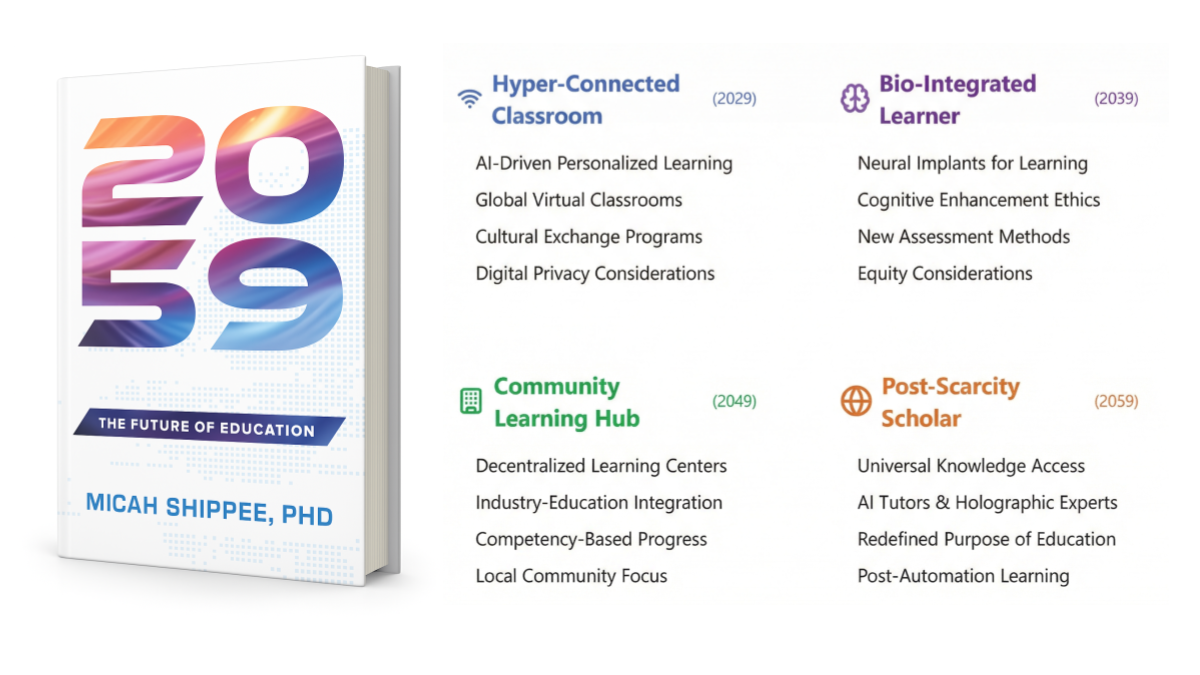
    This shift is not abstract speculation. In my book 2059: The Future of Education, I outline four possible futures, each emerging in its own decade-long transformation (see Four Futures for Education image). These scenarios illustrate how learners, classrooms, and communities will evolve as new technologies reshape what it means to learn, to teach, and to thrive.


    Four Futures: A Look Ahead At Coming Decades

    The diagram of the four chapters demonstrates how education may unfold across four key eras:

    • The Hyper-Connected Classroom (2029)
    • The Bio-Integrated Learner (2039)
    • The Community Learning Hub (2049)
    • The Post-Scarcity Scholar (2059)

    Each future builds on the last, layering technology integration, human enhancement, community focus, and knowledge democratization. Although the tools evolve, the heart of education remains constant: enabling human growth.

    Yet across every scenario, one trend becomes unmistakable.


    Why Skills and Motivation Matter More Than Ever (Image: Skills & Motivation Highlighted)

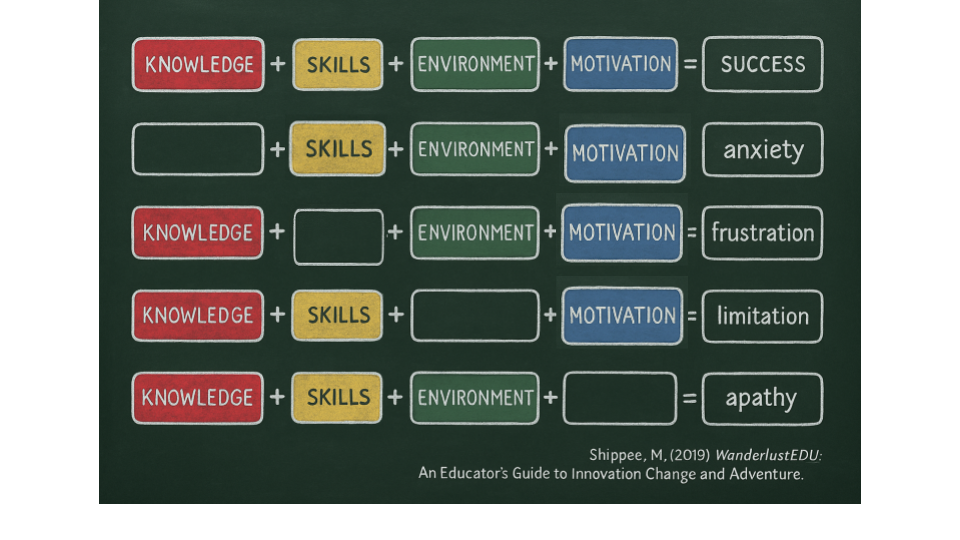
    Using the Success Model (Knowledge + Skills + Environment + Motivation → Success), we can evaluate what learners will need most in a rapidly changing world.

    While knowledge will remain important, ubiquitous access to information means that knowledge alone will not define a successful learner. Likewise, improved environments—physical, digital, and hybrid—will support learning but will not guarantee it.

    The two most critical elements will be:

    1. Skills

    The future belongs to learners who can acquire new skills, adapt quickly, solve unstructured problems, communicate effectively, and collaborate across cultures and systems.
    Skills development must include:

    • Curiosity
    • Critical thinking
    • Creativity
    • Resilience
    • Digital fluency
    • Emotional intelligence

    At the center of all of these sits one essential human trait:

    A love of learning.

    The ability to self-direct, self-evaluate, and self-correct will be the defining skill of the 2059 learner.


    2. Motivation

    Motivation is the engine of all progress. The future demands learners who are not only capable but willing—willing to explore, to experiment, and to try again when they fall short.

    The Success Model graphic shows what happens when motivation is absent:

    • High knowledge + low motivation = frustration
    • High skills + low motivation = limitation
    • Strong environment + low motivation = apathy

    In a world of constant technological change, motivation will be the determining factor in whether learners persist through challenge or withdraw from it.

    And that is where fail forward becomes essential.


    Fail Forward: The Core Motivational Competency of 2059

    Failing forward is more than a strategy. It is a mindset of resilience, experimentation, and personal agency. It teaches learners to see setbacks as signals, not verdicts. When students understand that mistakes are a natural part of learning, motivation grows.

    In the future learning ecosystems outlined in 2059, failing forward is not optional. It is the cultural expectation:

    • In the Hyper-Connected Classroom, learners navigate rapid iteration through AI-supported feedback.
    • In the Bio-Integrated era, new cognitive tools require constant adjustment and recalibration.
    • In Community Learning Hubs, students solve authentic problems where ambiguity is real and outcomes are unpredictable.
    • In the Post-Scarcity era, human creativity and intrinsic motivation become the most valuable forms of capital.

    Fail forward is the motivational backbone of the future learner.


    Reframing Education for 2059 and Beyond

    When we combine the future scenarios with the Success Model, the message is clear:

    Knowledge will be abundant.
    Environments will be enhanced.
    Skills and motivation will define who succeeds.

    To prepare our learners for 2059, we must shift from a system that prioritizes correct answers to one that prioritizes adaptive learners. We must elevate curiosity, perseverance, and agency as central outcomes of schooling.

    The future of education will not be built by technology alone. It will be built by humans who are equipped to learn continuously, think courageously, and act with purpose.


  • Map to the Future

    Map to the Future

    Our map to the future of education, The Fusion Model, explains how systems responsibly move through change —so they do not mistake technological possibility for educational readiness.

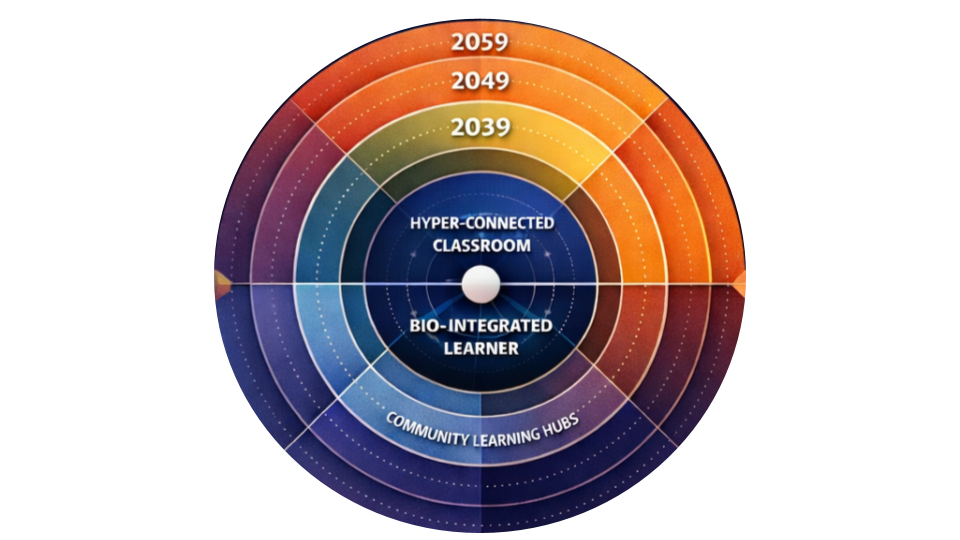
    Within the 2059 Trend Radar, the Fusion Model provides the underlying logic that governs how emerging technologies move from early signals of change to culturally stabilized educational practice. Each ring represents not simply a future state, but a distinct phase of human-centered adoption.


    The 2059 Education Trend Radar, visualizing the phases of human-centered adoption and the technologies shaping future learning.

    Understanding the future with the Fusion Model

    Critically, the Fusion Model is grounded in two fields of study: 

    1. Organizational Adoption of Innovation: the intentional, staged process by which an organization collectively recognizes a need, evaluates a novel idea, practice, or tool, restructures its activity systems to support it, and ultimately embeds that innovation into routine operations and culture.
    2. Activity Theory, which provides the analytic lens for understanding how a system (activity system) is engaged at each phase—including shifts in roles, tools, rules, community, and outcomes. 

    While the radar visualizes what is changing over time, Activity Theory explains how learning activity itself is reorganized as innovations move through the adoption process. (The integration-to-adoption process is developed more fully in the broader Fusion Model).

    Radar Center → Agenda-Setting

    Hyper-Connected Classroom (2029)

    Fusion Phase: Agenda-Setting

    At the center of the radar are technologies that surface the need for change rather than resolve it. AI-augmented learning, global virtual classrooms, and data-informed instruction function primarily as signals—making inefficiencies, inequities, and new possibilities visible.

    From an Activity Theory perspective, this phase primarily destabilizes the object of activity, prompting systems to question existing goals and contradictions without yet altering core structures.

    In Fusion Model terms, these innovations:

    • Establish why change is necessary
    • Create shared awareness without requiring immediate structural overhaul
    • Generate urgency while preserving existing instructional identities

    This phase is less about transformation and more about collective sense-making.


    Inner Ring → Matching

    Bio-Integrated Learner (2039)

    Fusion Phase: Matching

    As technologies mature, schools begin evaluating fit rather than novelty. XR learning, human-AI collaboration, and early neuro-responsive interfaces are tested against:

    • instructional goals
    • pedagogical beliefs
    • cultural norms and constraints

    Here, innovation adoption becomes selective and contextual. Organizations ask:

    “Does this align with who we are and what we value?”

    Through an Activity Theory lens, this phase examines alignment between tools, rules, and division of labor, preventing premature scale and protecting against solutionism.


    Middle Ring → Redefining / Restructuring

    Community Learning Hubs (2049)

    Fusion Phase: Redefining / Restructuring

    At this stage, innovation reshapes the institution itself. Distributed learning ecosystems, credential disruption, and automation-resilient pedagogy no longer sit alongside school—they redefine it.

    Structural shifts include:

    • learning decoupled from time and place
    • credentials tied to demonstrated capability
    • schools operating as nodes within broader learning networks

    Here, Activity Theory makes visible deep reconfigurations of the activity system itself, including changes to community boundaries, authority, and outcomes.

    This is the most disruptive Fusion phase, requiring leadership, trust, and adaptive capacity.


    Outer Ring → Clarifying

    Post-Scarcity Scholar (2059)

    Fusion Phase: Clarifying

    Speculative and visionary technologies—BCIs, post-scarcity knowledge access, space-based education—force systems to clarify purpose, not just practice.

    Rather than asking how to implement, institutions must answer:

    • What does it mean to be educated?
    • What is uniquely human?
    • What outcomes truly matter in a world of abundance?

    At this stage, Activity Theory foregrounds the motive of the activity, ensuring that technological capacity does not eclipse educational meaning.

    Clarifying is an ethical and philosophical phase as much as a technical one.


    Beyond the Radar → Routinizing (Societal Scale)

    Learner Agency as Infrastructure

    Fusion Phase: Routinizing

    While not confined to a single ring, routinization occurs when:

    • learner agency becomes expected, not exceptional
    • human-centered AI norms are embedded
    • adaptation is continuous rather than episodic

    Importantly, in 2059, routinization is not technological—it is cultural. Through an Activity Theory lens, this reflects stabilization of new activity systems around shared values rather than tools.

    What’s next?

    Here we have explored how emerging technologies—from AI-powered classrooms to post-scarcity learning futures—can be understood not as isolated innovations, but as part of a human-centered process of educational change. Using the 2059 Trend Radar, we see how we can move responsibly through future possibilities by aligning technology adoption with purpose, culture, and readiness rather than hype. For readers interested in going deeper, 2059: The Future of Education expands this framework into a comprehensive roadmap for navigating the decades ahead and designing learning systems built for change, agency, and human flourishing.

  • 2025 – A Year In Review

    2025 – A Year In Review

    Why the Future of Education Became the Conversation

    Some years are defined by activity.
    Others are defined by attention.

    In 2025, conversations about the future of education accelerated dramatically—not because of a single technology or trend, but because educators, leaders, and institutions are actively searching for clarity in a moment of profound change.

    Across my blog and LinkedIn presence, the data tells a consistent story:

    People are reading, sharing, and engaging

    not out of curiosity, but out of necessity.

    This year was not about publishing more.
    It was about responding to a question many educators are already asking:

    How do we move forward thoughtfully, without mistaking technological possibility for educational readiness?


    🚨A Clear Signal: The Topic Is Resonating

    In 2025, interest in future-focused education thinking grew sharply:

    • Blog readership increased by more than 85% year over year, reaching nearly 15,000 views
    • 9,400 unique readers engaged with long-form writing on change, AI, leadership, and learning
    • Readers from 10+ countries returned to the site, underscoring that these questions are global in scope

    This level of growth does not happen accidentally. It reflects a growing demand for sense-making, not speculation.

    Educators are not looking for predictions.
    They are looking for orientation.


    ⚙️From Tools to Meaning: What Readers Are Seeking

    Earlier years of the site were dominated by utility-focused content—posts designed to solve immediate, tactical problems.

    In 2025, the most-read pages shifted decisively toward:

    • Essays on the future of teaching and learning
    • Frameworks for understanding AI in education
    • Leadership reflections on change and adoption
    • Work connected to 2059: The Future of Education

    One future-focused page alone received 6,000+ views, signaling a broader transition:

    The audience is no longer searching for tools.
    They are searching for perspective.

    This mirrors what I consistently heard in conference sessions and workshops: educators are less interested in what is new and more interested in what is wise.


    🔎LinkedIn: Evidence of an Expanding Dialogue

    That same pattern emerged on LinkedIn.

    During 2025:

    • 66,671 impressions, an 84% year-over-year increase
    • 19,000+ professionals reached
    • 2,060 engagements, including comments, reactions, and reposts

    Importantly, this engagement was sustained, not episodic. Multiple posts exceeded 1,000–3,000 impressions, with one surpassing 15,000 impressions, reflecting consistent resonance across formats—conference reflections, leadership insights, global education work, and research-informed commentary.

    The takeaway is clear:

    When educators and leaders are given language to think clearly about the future, they respond.


    🤝Reaching the People Who Shape Systems

    By the end of the year, LinkedIn followers grew by more than 52%, with notable concentration among:

    • Senior-level professionals
    • Education administrators and system leaders
    • Decision-makers in small-to-mid-sized organizations

    These are not passive audiences. They are the people actively shaping policy, practice, and adoption.


    🧭 Futurist Perspective
    What an Education Futurist Does in Moments of Change
    The role of an education futurist is not to predict the future, but to help educators interpret change responsibly. My work focuses on translating emerging trends—currently AI—into human-centered, actionable understanding, grounded in how real educational systems adopt innovation. The goal is clarity, not hype; orientation, not prediction.


    💡An Integrated Ecosystem of Ideas

    In 2025, ideas moved fluidly across platforms:

    • LinkedIn surfaced questions publicly and in real time
    • Blog posts slowed those questions down and deepened the thinking
    • 2059: The Future of Education provided a long-form conceptual anchor

    Together, these spaces formed a single, coherent conversation—one that continues to grow because the topic itself demands attention.


    📆What This Year Confirmed

    • The future of education is no longer a niche interest—it is a professional imperative
    • Educators want clarity, not certainty
    • Hope, when grounded in systems thinking, is a responsibility
    • Thought leadership is built through steadiness, not volume

    ⏩Looking Ahead

    If 2025 revealed anything, it is this:

    The future of education is not coming—it is already here, and people are actively seeking ways to navigate it well.

    The work ahead is not about louder predictions, but clearer thinking.

    That conversation will continue.


  • The Map We Need for the Future of Learning

    The Map We Need for the Future of Learning

    How We Navigate Change — Even When the Road Ahead Is Unclear

    Introduction: Finding Clarity in the Fog

    As educators, leaders, and parents, we often find ourselves navigating rapid and unpredictable change. Technology evolves faster than we can adopt it. Expectations shift. Systems transform. The future can feel foggy not because we are unprepared, but because the world is demanding something new from us — something deeper than simply learning the next tool.

    In my work studying educational futurism and organizational adoption of innovation, I have learned that uncertainty is not chaos. It signals a need for a different kind of compass, one rooted not in prediction, but in mindset.

    One of the most powerful lessons about navigating uncertainty comes from an unlikely source: a single map that absolutely should not have worked.

    1. The Map Matters Less Than the Mindset

    In WanderlustEDU, I share a story that has shaped my understanding of innovation and human agency.

    During World War II, a Gurkha rifleman escaped a Japanese prison in Burma. Alone, unarmed, and deep within hostile jungle, he walked more than 600 miles across some of the most dangerous terrain on earth. The journey took five months. He never asked the way. He never lost the way. The only tool he depended upon was a map he checked constantly.

    When he finally crossed into India and reached safety, intelligence officers made a startling discovery:

    His map was not of Burma. It was a simple street map of London.

    The soldier’s success had nothing to do with the accuracy of his map. It came from his inner resources: innovation, courage, adaptability, and perseverance. His mindset, not his tools, carried him through.

    This story provides a blueprint for how we prepare learners for an uncertain future. Students do not need perfect guidance or flawless tools. They need what that Gurkha soldier had:

    Agency

    The capacity to act, adapt, and persist even when the path ahead is unclear.

    If students develop that mindset, they can navigate any future, even one as unpredictable as the landscape we are facing now.

    And while this story highlights the power of individual agency, it also leads directly into a second insight: innovation itself is not as mysterious as it often feels.

    2. Innovation Is Not Chaos — It Follows a Predictable Path

    In my dissertation research, I developed the Fusion Model, a framework demonstrating that every innovation, regardless of scale, moves through the same predictable five-phase journey:

    1. Agenda-Setting – We recognize a challenge worth solving.

    2. Matching – We identify an innovation that might fit.

    3. Redefining/Restructuring – We adapt the innovation and adjust our systems.

    4. Clarifying – Understanding grows as the innovation takes shape in practice.

    5. Routinizing – The innovation becomes simply “how we do things.”

    Whether adopting artificial intelligence, a new curriculum, or a simple practice change, these phases repeat again and again. When schools understand this pattern, they stop feeling as though they are stumbling through chaos. They gain a roadmap.

    Once we understand that roadmap, we are better prepared to recognize that the future always echoes the past.

    3. The Past Shows Us the Future — If We Know Where to Look

    Whenever a transformative technology enters education, the same core challenges arise:

    – Uncertainty about how to integrate it

    – Pressure to adopt quickly

    – Gaps between access and meaningful use

    – A need for new teaching practices

    – The critical role of professional development

    These patterns repeat across decades of educational technology, from overhead projectors to learning management systems to artificial intelligence.

    Recognizing these patterns allows us to breathe. We realize:

    We have experienced this before.

    We know more than we think we know.

    The human factors have always mattered more than the technology itself.

    Understanding this frees us to focus on something more important and far more actionable: how we model learning ourselves.

    4. Agency Grows When We Model Our Imperfections

    If students need agency to thrive in the future, how do we help them develop it?

    We give them Access to Agency — access to our thinking, our process, and our struggles.

    Students develop agency not from a flawless adult, but from a transparent one. They need to see us:

    – try and fail

    – try again with a new strategy

    – search for answers we do not yet know

    – narrate our thinking

    – show curiosity and persistence

    In a world filtered through curated perfection, authenticity becomes a teaching strategy. When we let students witness how we work through uncertainty, they learn how to work through it themselves.

    This leads to the most important lesson of all.

    5. The Human Role in Learning Is Irreplaceable

    As artificial intelligence becomes increasingly integrated into learning environments, the question naturally emerges:

    What is the role of the educator now?

    My answer is clear:

    Technology can enhance learning, but it cannot replace the human conditions that make learning possible.

    Teachers are:

    – mentors

    – connectors

    – designers of learning experiences

    – sources of belonging

    – catalysts for curiosity

    – steady forces in a changing world

    Our humanity is not an add-on. It is the foundation.

    Artificial intelligence may change how we work, but the emotional, relational, and meaning-making dimensions of learning will always require us.

    Conclusion: The Journey Is the Curriculum

    The five lessons — agency, process, history, transparency, and humanity — form a powerful compass for navigating the fog of educational change.

    Instead of asking,

    “What tool should we adopt next?”

    we can ask:

    “How can we give students more meaningful access to our agency?”

    Innovation is not a destination. It is a journey, full of experimenting, adapting, trying, failing, and connecting.

    If we model that journey, our learners will be prepared for theirs. Together, we can help them prepare not for the future we predict, but for the future they will create.


    Do not wait for the future — prepare for it.

    Get some your copy of 2059: The Future of Education and begin leading learning with clarity, confidence, and purpose.

  • Finding Success in the Human Performance Equation: Knowledge, Skills, Environment, and Motivation

    Finding Success in the Human Performance Equation: Knowledge, Skills, Environment, and Motivation

    What makes people thrive? Why do some teams achieve breakthrough results while others—equally talented—struggle with frustration, anxiety, or even apathy?

    The answer is rarely one thing. Human performance is the outcome of several interlocking factors: knowledge, skills, environment, and motivation. The graphic above captures it perfectly—when all four align, success follows. But when one piece is missing, the result isn’t just a slowdown; it changes the emotional experience entirely.

    The Four Elements of Performance

    • Knowledge – the “what.” Without a foundation of knowledge, individuals are left anxious, unsure of what is missing but feeling the pressure to perform.
    • Skills – the “how.” Skills transform information into action. Lacking skills can lead to frustration: you know what needs to be done, but not how to do it.
    • Environment – the “where.” Even the most talented people struggle in environments that do not support growth. Without the right structures, tools, or culture, people feel trapped.
    • Motivation – the “why.” Without motivation, knowledge, skills, and environment become wasted potential. This absence often results in apathy—the most dangerous state of all because it erodes not just performance but purpose.

    When all four are present, people find themselves in the flow of success.

    Emotional Outcomes of What is Missing

    • No Knowledge → Anxiety
    • No Skills → Frustration
    • No Environment → Feeling Trapped
    • No Motivation → Apathy
    • All Four → Success

    This is not just a framework—it is a diagnostic tool for leaders, educators, and innovators. When someone on your team struggles, instead of assuming “lack of effort,” ask: Which of the four is missing?

    —

    Real-World Stories

    We have seen this pattern again and again across history and innovation cycles:

    The Smartphone: Early mobile devices demanded deep knowledge just to navigate menus. With each generation, the blend of knowledge, skills, environment (networks, app stores), and motivation (personal and professional needs) brought us to the intuitive, seamless devices we now take for granted. Success emerged when all four factors aligned.

    Education Systems: In classrooms, students with motivation and supportive environments but without the right skills face frustration. Others with knowledge and skills but no supportive environment feel trapped. Recognizing which piece is missing changes how we design interventions.

    Teams in Transition: In corporate settings, new initiatives often fail not because of resistance, but because one of these four factors has been overlooked. A team may be motivated but lack clarity (knowledge). Or they may have skills and knowledge but feel the environment is stacked against them.

    Looking Ahead: The 2059 Connection

    In 2059: The Future of Education, I argue that the future of learning and work is human-centered. Technology will accelerate what is possible, but people will remain at the core. This framework shows why: success in the future will not depend on just mastering new tools but on balancing all four elements.

    By 2059, learning systems will be able to dynamically adjust to provide just-in-time knowledge, scaffold skills development, create equitable learning environments, and ignite personal motivation. The challenge today is to start building these systems with intentionality—so we can avoid the anxiety, frustration, and apathy that come from missing pieces.

    A Positive Future

    The beauty of this framework is that it reminds us: human performance is not mysterious. It is not luck. It is the result of getting the right elements in place.

    As leaders, educators, and innovators, our job is to spot the gaps and fill them. Do that, and we unlock not just success, but human flourishing.

    👉 A question for you: Which of the four do you find is most often missing in your team, classroom, or organization?

  • What We Get Wrong About Innovation in Schools: 4 Eye-Opening Lessons

    Conversations about the future of education are often filled with a mix of excitement and anxiety. With the rapid rise of artificial intelligence and constant technological change, it is easy to feel uncertain about how to best prepare students—and ourselves—for what is next. We are flooded with buzzwords, new tools, and competing visions of the classroom of tomorrow.

    But what if our most common assumptions about preparing for the future are wrong? What if the path forward is not about mastering every new piece of technology, but about a more fundamental shift in how we think?

    In my work as an educational futurist, I have spent years studying how innovation truly works in schools and organizations. The four takeaways I share below challenge conventional wisdom and move past the hype. They offer a more durable, human-centered way to think about technology, leadership, and the essential roles of educators and learners in an ever-changing world.


    The Takeaways: Four Surprising Truths

    1. The Ultimate Goal of EdTech is Invisibility

    In education, when we introduce a new tool, our first impulse is to name it. We launch “1:1 initiatives,” design “AI-powered learning” modules, and highlight the technology in our plans. Although well-intentioned, this instinct misses the deeper point of true innovation.

    Naming conventions signal a tool’s newness. Decades ago, products leaned on an “i” prefix to ride the wave of internet excitement. Today, many tools reach for “AI” to communicate their novelty. But the real goal of innovation is to reach a point where we no longer need to label the tool at all. A great learning tool becomes so naturally embedded in teaching that it simply becomes part of the background. We never talk about a “pencil-based writing program,” we just teach writing. The pencil is invisible.

    This shift moves our attention exactly where it belongs: onto learning. The true goal is not the adoption of a tool, but the amplification of excellent teaching. When technology fades into the background, that is when we know we have succeeded.

    The real power of an innovation is not in naming it. It is found in the moment we no longer need to name it at all.


    2. We Often Look to the Wrong People to Lead Change

    When many people picture an innovator in a school, they imagine a maverick—someone who eagerly experiments with new gadgets, takes risks, and thrives on trial and error. These individuals are important, but they are rarely the ones who lead successful large-scale change.

    According to the Diffusion of Innovations framework, Innovators make up about 2.5 percent of a group. They are often too far ahead of the mainstream to bring others with them.

    The real drivers of change are the Early Adopters. These individuals observe Innovators, weigh risks and benefits, and then validate promising ideas for the broader community. They cultivate the social and emotional trust that allows colleagues to step into unfamiliar territory.

    For leaders, this means that I must not only celebrate the creative few at the bleeding edge. I must intentionally identify and empower the respected Early Adopters who can become the organization’s “innovation champions.” They bridge the gap between possibility and practicality. They reduce perceived risk, build confidence, and help colleagues move forward together.

    While Innovators demonstrate what is possible, Early Adopters show what is believable. They are essential co-leaders in any meaningful change effort.


    3. The Most Important Future Skill Is Not What You Think

    Much of today’s conversation about “future-ready skills” focuses on coding, data analysis, AI prompt engineering, or other technology-driven abilities. Although valuable, these skills change rapidly. The more fundamental skill—the one I believe is most durable—is agency.

    Agency is the capacity to act independently, solve problems, persist through challenges, and take ownership of one’s learning. But we cannot simply teach agency; we must provide access to agency.

    This happens when educators make their own learning processes transparent. When we reveal our struggles, our attempts, our failures, and our strategies for overcoming challenges, we show students what agency looks like.

    In my own life, I learned agency by watching my father work on our family cars. I stood nearby, covered in grease, handing him tools. I was not learning auto mechanics, but something far more important: that problems could be solved. I watched him read manuals, experiment, and persist. My father’s example was a gift to me, the gift of agency, the belief that “I can do it.”

    When educators become lead learners—modeling persistence, transparency, and resilience—we give students the most future-proof skill available. We show them that they can navigate uncertainty because they have seen us do it.

    In a world filtered through social media’s highlight reels, we must be real about how meaningful work happens. We must provide students with access to our agency so that they can build their own.


    4. Why AI Will Never Replace Great Teachers: A Lesson from Wolves

    One of the most persistent fears in education is that artificial intelligence will replace teachers. To counter this fear, I often reference an ecological concept called a trophic cascade, coined by zoologist Robert Paine in 1980.

    When wolves were reintroduced to Yellowstone National Park, the effects rippled far beyond their prey. Deer changed their grazing habits, which allowed vegetation to regenerate, which changed soil composition, which altered the course of rivers. A single keystone species reshaped the ecosystem.

    Although this story is sometimes romanticized, I believe it illustrates a critical truth: ecosystems depend on certain key influences that impact everything else.

    A great teacher is a keystone species in the learning ecosystem.

    Teachers do far more than deliver content. They shape the emotional climate, the norms of collaboration, the quality of discourse, and the culture of persistence. If we removed the teacher, the foundational human elements that support learning would erode. No algorithm can replicate the trust, presence, encouragement, and adaptive judgment that a great teacher provides.

    If you have felt discouraged, undervalued, or reduced to a cog in a machine, I encourage you to rediscover your “why.” You matter. Your influence is deep, interconnected, and irreplaceable.


    Conclusion: The Human Side of Innovation

    From making technology invisible to recognizing the pivotal role of Early Adopters, each of these truths reveals the same conclusion: the most effective path to the future of education is built on the most human elements of learning.

    When I provide students with access to my agency, I am not simply modeling a skill. I am fulfilling my role as a keystone species—the irreplaceable human node that makes the ecosystem function. This is why our best technologies must become invisible. They should support teachers, not overshadow them.

    And it is why lasting change is never driven by tools alone but by respected people who build trust, model learning, and help others grow.

    As you prepare for a future of constant change, which of these truths most challenges your own assumptions, and how might it reshape the way you learn, teach, or lead?


    If these insights resonate with you, I share a much deeper exploration in my new book 2059: The Future of Education. I hope it inspires your next steps.

  • Choosing Change: Three Cautionary Tales through the Lens of Activity Theory

    Choosing Change: Three Cautionary Tales through the Lens of Activity Theory

    Innovation is not just about tools. It is about people, communities, and the rules that govern how we live. That is why some innovations thrive while others fail—or worse, cause harm. Activity Theory gives us a lens to understand this: every activity system is made up of tools, subjects, rules, community, division of labor, and objects pointing to a goal. Change in one part inevitably ripples through the others.

    By keeping our end goal in sight—not just the new tool—we can better anticipate how change will reshape society.

    1. The Samurai and the Gun: Tools without Alignment

    In 16th-century Japan, firearms arrived with European traders. At first, the Samurai elite experimented with guns, but many soon turned away from them. Guns were seen as dishonorable compared to the sword, which embodied the Samurai code of honor and skill.

    Through an Activity Theory lens:

    Tool: Firearms

    Rules: Bushido honor code, valuing swordsmanship

    Community: Feudal Japan

    Outcome: Tradition preserved, but power lost

    By refusing to integrate firearms, the Samurai tried to protect their identity. But when modernization came, they had little influence in shaping the new order.

    Lesson: Tools must align with rules and community values—or risk rejection and irrelevance.

    2. The Yir Yoront and the Steel Axe: Tools that Disrupt Balance

    The Yir Yoront people of Australia traditionally crafted stone axes, tools deeply woven into their social, spiritual, and hierarchical roles. When missionaries introduced steel axes, they seemed like a gift—lighter, sharper, and easier to use.

    But the shift was destabilizing:

    Tool: Steel axes

    Rules: Access to stone axes mediated by elders

    Community: Kinship-based society

    Outcome: Authority eroded, imbalance spread

    By bypassing the authority of elders, the steel axe disrupted cultural rules and social balance. What looked like an upgrade in efficiency led to disintegration of traditional structures.

    Lesson: Change without respect for meaning and rules can destabilize society.

    3. The Lucky Iron Fish: Tools that Resonate with Meaning

    In rural Cambodia, anemia plagued communities. Aid workers tried distributing a proven solution: iron tablets and iron ingots (to add to boiling water) but they were ignored. The breakthrough came with the Lucky Iron Fish: an iron ingot shaped like a local fish considered a symbol of health and good fortune.

    Through an Activity Theory view:

    Tool: Fish-shaped iron ingot

    Rules: Folklore associating fish with luck and health

    Community: Cambodian villagers

    Outcome: Anemia rates dropped, tool embraced

    Within nine months of adoption, anemia was reduced by 50%. The fish shape resonated with culture and identity, turning a medical intervention into a meaningful practice.

    Lesson: The best innovations honor cultural meaning while achieving functional goals.

    Reflection: Keeping the End Goal in Sight

    The Samurai, the Yir Yoront, and the Cambodian villagers illustrate three different ways innovation interacts with society.

    Resist too much → risk irrelevance.

    Adopt without foresight → risk destabilization.

    Design with meaning → achieve lasting, positive outcomes.

    Activity Theory reminds us that tools are never neutral. They reshape rules, communities, and roles. To be successful, innovation must:

    1. Define the true outcome (health, empowerment, equity).

    2. Anticipate ripple effects across rules and communities.

    3. Design tools that resonate with local meaning and values.

    When we keep the end goal in sight, change becomes more than a swap of tools—it becomes transformation that lasts.

    Interested in learning more? Check out my book 2059: The Future of Education!

    References

    Borgen Project. (2015, June 15). Lucky Iron Fish reduces anemia in Cambodia. The Borgen Project. https://borgenproject.org/lucky-iron-fish/

    Engeström, Y. (1987). Learning by expanding: An activity-theoretical approach to developmental research. Orienta-Konsultit.

    Engeström, Y. (2001). Expansive learning at work: Toward an activity theoretical reconceptualization. Journal of Education and Work, 14(1), 133–156. https://doi.org/10.1080/13639080020028747

    Howell, D. L. (2009). The social life of firearms in Tokugawa Japan. Japanese Studies, 29(1), 65–80. https://doi.org/10.1080/10371390902780530

    Langley, L. (2019, March 13). 6 surprisingly lucky animals around the world. National Geographic. https://www.nationalgeographic.com/animals/article/lucky-animals-world-ireland-saint-patricks-day

    Morillo, S. (1995). Guns and government: A comparative study of Europe and Japan. Journal of World History, 6(1), 75–106.

    Romanchev, D. D. (2024). Guns for the Samurai: Spreading and use of Western small arms in Japan during the Bakumatsu period (1853–1868). Восточная Азия: факты и аналитика, (3), 31–49. https://doi.org/10.24412/2686-7702-2024-3-31-49

    Sharp, L. (1952). Steel axes for stone-age Australians. Human Organization, 11(2), 17–22. https://doi.org/10.17730/humo.11.2.q4v6k873446422g2

    Shippee, M. (2017, August 23). With so many options in #EdTech, where should we invest our time and efforts? MicahShippee.com. https://micahshippee.com/2017/08/23/with-so-many-options-in-edtech-where-should-we-invest-our-time-and-efforts/

    Shippee, M. (2018, March 21). Innovativeness is the pedagogy for the future. MicahShippee.com. https://micahshippee.com/2018/03/21/innovativeness-is-the-pedagogy-for-the-future-wanderlustedu/

    Shippee, M. (2018, September 16). Teacher: Know thyself – School culture shift is about the people. MicahShippee.com. https://micahshippee.com/2018/09/16/teacher-know-thyself-school-culture-shift-is-about-the-people/

    Shippee, M. (2020, May 4). The Fusion Model for organizational adoption of innovation. MicahShippee.com. https://micahshippee.com/2020/05/04/the-fusion-model-for-organizational-adoption-of-innovation/

    Shippee, M. (2019). WanderlustEDU: An educator’s guide to innovation, change, and adventure. Dave Burgess Consulting.

    Shippee, M. (2025). 2059: The future of education. The Farm.

  • 5 Reasons to Rethink Education Before 2059

    What will the world look like in 2059? More importantly, how will we prepare our children for it?

    In my book, 2059: The Future of Education, I explore the forces shaping tomorrow and what they demand from us today. Here are five foundational ideas to guide our vision for learning:

    1. A Glimpse into 2059: The Orwellian Leap
    Thirty-five years from now, society will look fundamentally different. We must begin planning with intention, not prediction.

    2. Work Shapes School: A Historical Connection
    Throughout history, education has followed the needs of the workplace. The next evolution will be no different.

    3. Tomorrow’s Workplace: Key Trends from Futurists
    AI, automation, flexible work, shorter work weeks, and lifelong learning are already reshaping the world. Education must keep pace.

    4. The Uniquely Human: Beyond the Technology
    Our greatest future advantage will not be technical. It will be human. Creativity, ethics, identity, and agency must remain at the center.

    5. Our North Star: A Shared Responsibility
    Preparing the next generation is not the job of schools alone. It is a responsibility we all share as a society.

    The future will not simply happen to us. We will build it.

    👉 If you believe our children should be architects of the future rather than passengers of it, I invite you to read 2059: The Future of Education.

    📘 Link to the book: https://amzn.to/4oP6Pn0

  • 🧩 The Curb-Cut Phenomenon and the Fusion Model: Why Designing for the Few Improves Learning for Everyone

    🧩 The Curb-Cut Phenomenon and the Fusion Model: Why Designing for the Few Improves Learning for Everyone


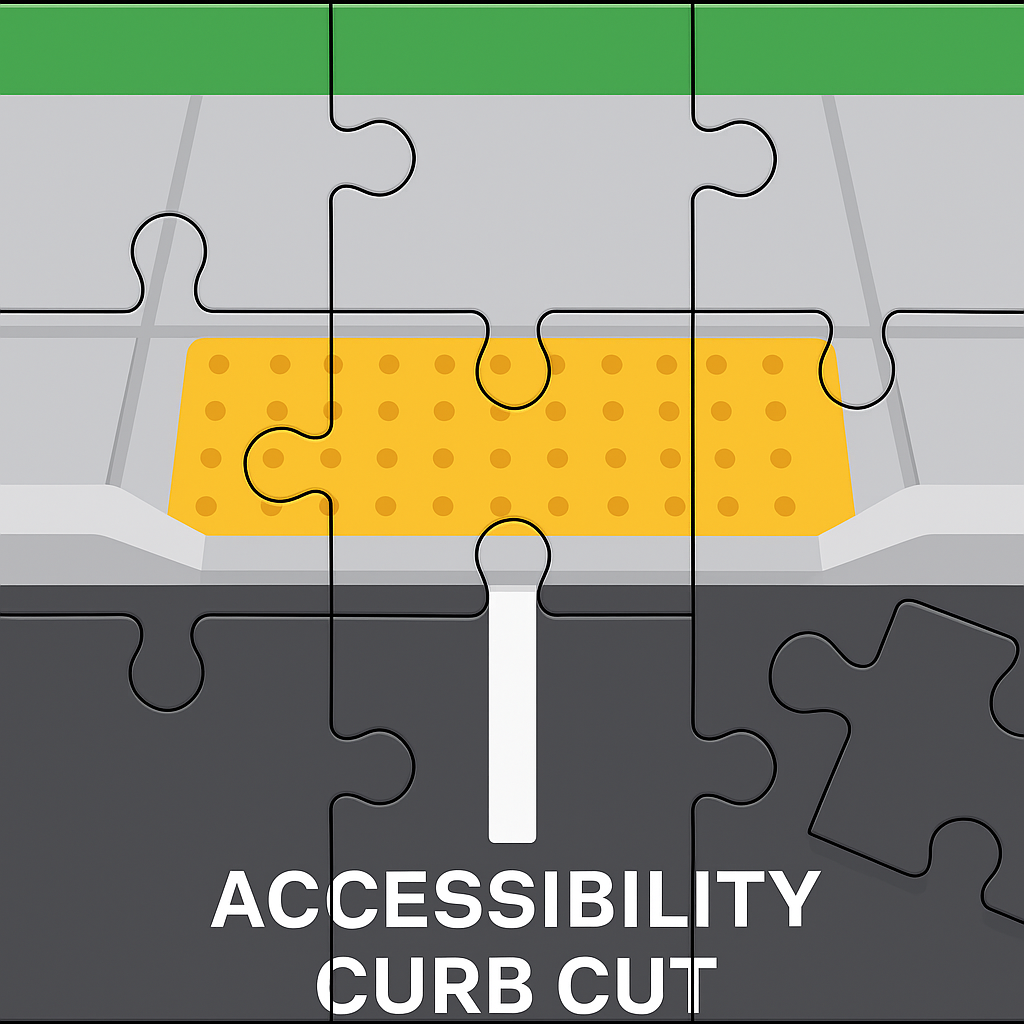
    Walk through any city and you will notice the small ramps at every street corner — “curb cuts.” They were originally created to help wheelchair users move safely from sidewalk to street. What no one predicted was how universally useful they would become. Parents with strollers, travelers with rolling suitcases, delivery workers — everyone benefits.

    That is the curb-cut phenomenon: when we design with empathy for those at the margins, we end up creating better systems for all.

    This same idea runs at the heart of my Fusion Model, a framework that helps schools and organizations adopt innovation in ways that are human-centered, inclusive, and lasting.


    💡 Why Fusion?
    Change is hard — not because people resist technology, but because new tools disrupt old patterns. The Fusion Model is my way of helping organizations navigate that disruption. It combines two powerful ideas:
    • Diffusion of Innovation (Rogers, 2003): how new ideas spread.
    • Activity Theory (Engeström, 1987): how people, tools, and culture interact to shape learning and work.

    Put them together, and you get a roadmap for how innovation actually takes root — from early awareness to lasting transformation.

    🔁 The Five Phases of Fusion

    1. Agenda-Setting (Awareness): We notice the problem. Like seeing someone struggle at the curb, this phase is about recognizing barriers — inequities, inefficiencies, or opportunities we have ignored too long.
    2. Matching (Alignment): We connect the problem to a possible solution. The team explores new ideas, asks what fits our culture, and aligns the solution with our goals.
    3. Redefining/Restructuring (Integration): We adapt the solution to make it our own. The “innovation” starts to fit into our workflows and structures. Tools reshape roles and processes — and people begin to see their place in the change.
    4. Clarifying (Expansion): We scale what works. As more people experience success, understanding deepens. The innovation becomes less “new” and more “normal.”
    5. Routinizing (Transformation): We reach a new equilibrium. The change disappears into the culture — just like curb cuts on a street corner. Inclusion becomes invisible because it’s expected.


    🔍 How Activity Theory Fits In
    At each stage, Activity Theory helps us analyze what is really happening. It asks:
    • Who is involved?
    • What tools are being used?
    • What rules or norms shape the process?
    • How does the community respond?
    • How are roles and responsibilities shifting?

    By studying these moving parts, we can see where friction — or breakthrough — is happening. In other words, we can measure transformation as it unfolds.


    🏫 The Classroom of the Future as a Living Curb Cut
    In 2059: The Future of Education, I explore how the next generation of classrooms will fuse human creativity with intelligent technology.

    When we think about interactive displays on every wall, AI-powered captioning, or flexible furniture, we are not just imagining futuristic gadgets — we are imagining curb cuts for learning.

    Each feature removes friction:
    • AI captions support hearing-impaired students and improve focus for everyone.
    • Mobile seating empowers students with mobility challenges and sparks collaboration.
    • Teacher dashboards help personalize learning for every student, not just a few.

    When inclusion drives innovation, everyone wins.

    🚀 Why It Matters
    The curb-cut phenomenon reminds us that inclusive design is not charity — it is strategy. The Fusion Model gives us a process for making that strategy repeatable. It turns empathy into a system, innovation into culture, and change into something measurable and sustainable.

    When we design for the edges, we build a better center. That is the future of education — not just more technology, but smarter, more human innovation.


    References

    • Blackwell, A. (2016). The curb-cut effect: Designing for inclusion benefits everyone. Journal of Inclusive Design, 8(2), 45–59.
    • Engeström, Y. (1987). Learning by expanding: An activity-theoretical approach to developmental research. Helsinki, Finland: Orienta-Konsultit.
    • Rogers, E. M. (2003). Diffusion of innovations (5th ed.). New York, NY: Free Press.
    • Shippee, M. (2016). mLearning in the organizational innovation process [Doctoral dissertation, Syracuse University]. Syracuse University Surface. https://surface.syr.edu/etd/452
    • Shippee, M. (2019). WanderlustEDU: An educator’s guide to innovation, change, and adventure. San Diego, CA: Dave Burgess Consulting.
    • Shippee, M. (2024). 2059: The Future of Education. Syracuse, NY.