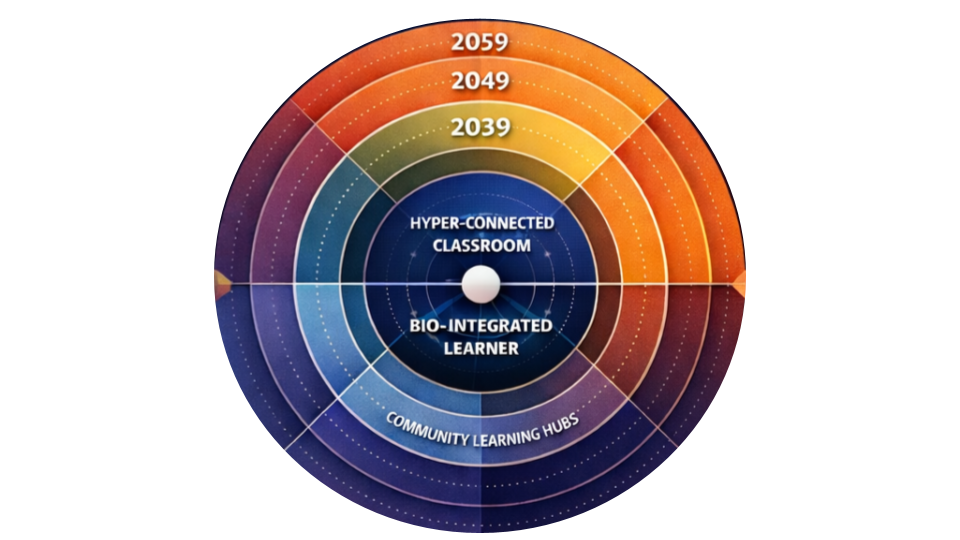
Our map to the future of education, The Fusion Model, explains how systems responsibly move through change —so they do not mistake technological possibility for educational readiness.
Within the 2059 Trend Radar, the Fusion Model provides the underlying logic that governs how emerging technologies move from early signals of change to culturally stabilized educational practice. Each ring represents not simply a future state, but a distinct phase of human-centered adoption.

Understanding the future with the Fusion Model
Critically, the Fusion Model is grounded in two fields of study:
- Organizational Adoption of Innovation: the intentional, staged process by which an organization collectively recognizes a need, evaluates a novel idea, practice, or tool, restructures its activity systems to support it, and ultimately embeds that innovation into routine operations and culture.
- Activity Theory, which provides the analytic lens for understanding how a system (activity system) is engaged at each phase—including shifts in roles, tools, rules, community, and outcomes.
While the radar visualizes what is changing over time, Activity Theory explains how learning activity itself is reorganized as innovations move through the adoption process. (The integration-to-adoption process is developed more fully in the broader Fusion Model).
Radar Center → Agenda-Setting
Hyper-Connected Classroom (2029)
Fusion Phase: Agenda-Setting
At the center of the radar are technologies that surface the need for change rather than resolve it. AI-augmented learning, global virtual classrooms, and data-informed instruction function primarily as signals—making inefficiencies, inequities, and new possibilities visible.
From an Activity Theory perspective, this phase primarily destabilizes the object of activity, prompting systems to question existing goals and contradictions without yet altering core structures.
In Fusion Model terms, these innovations:
- Establish why change is necessary
- Create shared awareness without requiring immediate structural overhaul
- Generate urgency while preserving existing instructional identities
This phase is less about transformation and more about collective sense-making.
Inner Ring → Matching
Bio-Integrated Learner (2039)
Fusion Phase: Matching
As technologies mature, schools begin evaluating fit rather than novelty. XR learning, human-AI collaboration, and early neuro-responsive interfaces are tested against:
- instructional goals
- pedagogical beliefs
- cultural norms and constraints
Here, innovation adoption becomes selective and contextual. Organizations ask:
“Does this align with who we are and what we value?”
Through an Activity Theory lens, this phase examines alignment between tools, rules, and division of labor, preventing premature scale and protecting against solutionism.
Middle Ring → Redefining / Restructuring
Community Learning Hubs (2049)
Fusion Phase: Redefining / Restructuring
At this stage, innovation reshapes the institution itself. Distributed learning ecosystems, credential disruption, and automation-resilient pedagogy no longer sit alongside school—they redefine it.
Structural shifts include:
- learning decoupled from time and place
- credentials tied to demonstrated capability
- schools operating as nodes within broader learning networks
Here, Activity Theory makes visible deep reconfigurations of the activity system itself, including changes to community boundaries, authority, and outcomes.
This is the most disruptive Fusion phase, requiring leadership, trust, and adaptive capacity.
Outer Ring → Clarifying
Post-Scarcity Scholar (2059)
Fusion Phase: Clarifying
Speculative and visionary technologies—BCIs, post-scarcity knowledge access, space-based education—force systems to clarify purpose, not just practice.
Rather than asking how to implement, institutions must answer:
- What does it mean to be educated?
- What is uniquely human?
- What outcomes truly matter in a world of abundance?
At this stage, Activity Theory foregrounds the motive of the activity, ensuring that technological capacity does not eclipse educational meaning.
Clarifying is an ethical and philosophical phase as much as a technical one.
Beyond the Radar → Routinizing (Societal Scale)
Learner Agency as Infrastructure
Fusion Phase: Routinizing
While not confined to a single ring, routinization occurs when:
- learner agency becomes expected, not exceptional
- human-centered AI norms are embedded
- adaptation is continuous rather than episodic
Importantly, in 2059, routinization is not technological—it is cultural. Through an Activity Theory lens, this reflects stabilization of new activity systems around shared values rather than tools.
What’s next?
Here we have explored how emerging technologies—from AI-powered classrooms to post-scarcity learning futures—can be understood not as isolated innovations, but as part of a human-centered process of educational change. Using the 2059 Trend Radar, we see how we can move responsibly through future possibilities by aligning technology adoption with purpose, culture, and readiness rather than hype. For readers interested in going deeper, 2059: The Future of Education expands this framework into a comprehensive roadmap for navigating the decades ahead and designing learning systems built for change, agency, and human flourishing.
Leave a Reply