UNESCO’s AI and the Future of Education: Disruptions, dilemmas and directions is a landmark work that frames artificial intelligence as one of the most urgent forces reshaping learning globally. It asks powerful questions about what it means to learn, to teach, and to be human in an AI-driven age. Reading through this work, one cannot help but identify how closely it aligns with the themes in 2059: The Future of Education. Here are three key areas of alignment—and how 2059 takes the conversation further.
1. Shared Foundations
Both UNESCO and 2059 stress that education must remain human-centered, ethical, and equitable. UNESCO calls for “ethics of care by design,” while I highlight agency, teacher irreplaceability, and human-AI collaboration as non-negotiable anchors for the future.
2. Complementary Perspectives
UNESCO = The Global Policy Lens
Frames AI in education as a matter of ethics, governance, and the public good. It sets the why and what.
2059 = The Practitioner’s Playbook
Offers futurist methodologies, frameworks (like the Fusion Model), and case studies to help educators and leaders put these principles into practice.
Together, these perspectives move the field from philosophy to action.
3. Key Alignment Areas
Assessment: UNESCO warns that AI challenges traditional exams; 2059 outlines AI-powered formative assessment and blockchain credentials as practical solutions.
Teachers’ Role: UNESCO emphasizes relational anchors; 2059 declares “You cannot be replaced” and equips teachers with tools to lead innovation.
Equity & Access: Both works warn of inequalities in AI adoption, but 2059 provides strategies to amplify access and agency in classrooms.
The Next Step
UNESCO’s book sets the stage for global dialogue. 2059 is designed as the next step—a roadmap for educators, policymakers, and leaders to act on those big ideas with structured tools, scenarios, and strategies.
If UNESCO provides the scaffolding, 2059 offers the compass.
👉 I invite you to explore 2059: The Future of Education and join me in shaping a future that is not only technologically advanced but also deeply human, equitable, and sustainable.
The conversation about AI in education has often started with fear. Can students still be trusted to write their own essays? Will detectors catch misconduct? Should we return to blue books and oral exams? These questions matter, but they do not go far enough. If we remain focused only on cheating, we miss the deeper disruption at hand: the future our students are stepping into looks nothing like the workforce of the past.
The End of the Familiar Entry Point
For generations, college graduates could count on entry-level jobs as stepping stones to professional life. Those roles served as training grounds where young workers gained confidence, built skills, and earned their place in organizations.
A new Stanford study warns that this path is eroding. From late 2022 to mid-2025, entry-level positions in AI-exposed fields—software development, customer service, accounting—declined by as much as 16 percent for workers aged 22 to 25. Older professionals, meanwhile, held steady or even expanded into these same roles.
Our students are no longer stepping into waiting jobs. They are being pushed into a future where machines complete the “easy work,” leaving humans to prove their worth in roles that demand creativity, critical thinking, and ethical judgment from day one.
Rethinking Assessment as Preparation
If the workforce has changed, then our assessment must change too. Blue books and viva voce exams have returned to campus as a way of forcing authentic effort. These are not wrong. They reintroduce memory, performance, and human connection into learning. Yet they cannot be the whole answer.
The question is no longer, “How do we prevent cheating?” It is, “How do we prepare students for a world where AI is everywhere?”
Authentic assessments must emphasize the skills that AI cannot replace:
The ability to synthesize and critique ideas, not just generate them.
The practice of ethical reflection, deciding when and why to use AI.
The creativity to imagine solutions in messy, human contexts.
The resilience to adapt when traditional career ladders have been removed.
A Pathway for Change
Change is never easy for educational organizations. Faculty worry about rigor, students feel disoriented without shortcuts, and leaders fear the disruption of long-standing traditions. This is why structured models matter.
The Fusion Model, a merging of organizational adoption offers a roadmap for cultural adoption:
Agenda-Setting: Acknowledge that AI has destabilized both assessment and the workforce.
Matching: Identify solutions that align with emerging professional realities.
Clarifying: Build a shared understanding of what responsible AI use looks like.
Routinizing: Normalize these practices until they become part of the educational culture itself.
This is not about chasing the latest tool. It is about guiding people through transformation with purpose and clarity.
Lessons from the Future In 2059: The Future of Education, I share case studies of schools navigating disruptive change. One example, “School 1234,” demonstrates how deliberate progression through these stages can turn fear of AI into opportunity. Their success was not in avoiding disruption but in embracing it with structure and vision.
This is the lesson for all of us: the future cannot be managed by reaction, it must be guided by intention.
From Policing to Possibility
The AI revolution is not an exam to be monitored, it is a world to be prepared for. The role of our educational organizations is not simply to prevent misconduct but to prepare graduates who can thrive in a world where AI is a given. That means cultivating confidence, resilience, and imagination as much as competence.
Entry-level jobs may be disappearing, but that does not mean opportunity is gone. It means opportunity looks different. It begins not with the rote tasks AI can do, but with the uniquely human capacity to imagine, to question, and to create.
The Future Needs Our Students
The challenge before us is not whether students will cheat, it is whether we will prepare them for a future that is already here. Educational organizations must lean into this moment with optimism, courage, and clarity.
We cannot offer students the careers of yesterday, but we can equip them to lead in the world of tomorrow. By remembering the future—and designing learning experiences that prepare students for it—we ensure that education remains not just relevant, but transformative.
In education, it is easy to get swept up in the waves of FUD—Fear, Uncertainty, and Doubt. Headlines warn of artificial intelligence replacing teachers. Edtech trends move faster than professional development days can keep up. And the pace of change? Exhausting.
We feel fear of innovations like AI taking over classrooms. We feel uncertainty about how to prepare students for jobs that do not yet exist. We feel doubt about our capacity to adapt.
These feelings are real, but they are not the full story.
FUD is a powerful tool used across industries to manipulate behavior through apprehension. But in education, we are not passive consumers. We are active builders. We have agency. And it is time we reclaim that agency by shifting our mindset from fear to futurism.
What if we chose to reframe the narrative?
What if the future of education were not something to fear—but something to design?
Change Is Not the Enemy
Educators are not change-averse—we are professionals at pivoting. What we struggle with is predictable, supported change. That is where the challenge lies—and where opportunity begins.
In my work with educators around the globe, I have seen that it is not emerging technologies or shifting standards that wear us down. It is being asked to sprint without a map.
But change can be mapped.
Enter the Fusion Model—a framework I explore in my book 2059: The Future of Education. The Fusion Model helps us understand and lead change in our schools by focusing on people first. It is a way to future-proof our practice without burning out.
We often mislabel our challenge. It is not change itself that causes our anxiety—it is poor change management. Change can be energizing, but only when it is predictable, purposeful, and human-centered.
In the Fusion Model we recognize that innovation adoption is not about plugging in new technology and hoping for transformation. It is about intentionally aligning our people, our process, and our goals. This alignment enables us to move from reactive adaptation to proactive transformation.
We do not need to fear the future—we need tools to navigate it.
Becoming Futurists: The Future Is Bright (Seriously)
We are preparing students for a future we can barely imagine—but that is not a crisis. That is a calling.
In Chapter One of 2059, I argue that educators must become futurists. We must use tools like scenario planning, trend analysis, and impact assessment to imagine the possible so that we can act with clarity in the present. These are not corporate strategies—they are human strategies. They help us ask: What future are we preparing students for? And are we truly equipping them to thrive in it?
The Fusion Model guides this preparation. By identifying the stages of innovation adoption—agenda-setting, matching, restructuring, clarifying, and routinizing—we can guide schools and systems through predictable patterns of change.
Four Futures to Prepare For
In the book, I explore four plausible futures for education:
The Hyper-Connected Classroom (2029): AI-driven personalization, virtual collaboration, and data-driven insights.
The Bio-Integrated Learner (2039): Neural enhancements and ethical questions about cognitive modification.
The Community Learning Hub (2049): Localized, project-based learning that blurs school and community boundaries.
The Post-Scarcity Scholar (2059): Instant access to all human knowledge and the need to redefine the role of education.
These scenarios are not predictions. They are prompts—challenges to think beyond today’s classroom and anticipate what students will need tomorrow.
A Better Future Needs Better Questions
We are surrounded by AI tools, algorithmic content, and automated assessments. But as educators, our power lies not in knowing all the answers—it lies in asking better questions.
Instead of asking, “Will AI replace teachers?”, we must ask, “How will AI amplify teachers?”
Instead of asking, “What will students memorize?”, we must ask, “What will students create, build, and contribute?”
Our future hinges on the types of questions we are willing to ask today.
Agency: The Human Advantage
Perhaps the most important concept in the book is Access to Agency. In a future defined by rapid change, those with agency will thrive. That includes students, teachers, administrators—all of us.
Agency is the ability to take purposeful action. It grows when we feel confident, informed, and supported. That is why we must design learning environments that are:
Flexible and inclusive
Grounded in real-world problem-solving
Supportive of failure as part of the learning process
In doing so, we help our students develop the skills they need not just to adapt to the future, but to shape it.
You Cannot Be Replaced
In 2059, I share a message I have told countless educators: You cannot be replaced.
AI cannot coach a student through loss. It cannot spot a spark of genius hidden behind behavior. It cannot create safe, nurturing classrooms where curiosity thrives.
That is your superpower.
A Call to Dream Bigger… Together
This post is not just about a book. It is a call to hope.
If you are an educator feeling overwhelmed by all the “what ifs,” let me offer this: we can choose enthusiasm over anxiety, planning over panic, and collaboration over chaos.
2059: The Future of Education is more than a title—it is a mindset. It is about taking back our agency as educators to lead meaningful change.
👉 Grab your copy here and let us build the future—together. If you are interested in upcoming audiobook access, reading guides, and book study plans, be sure to subscribe at www.micahshippee.com.
Let us build a future that excites us—not that FUD has us bracing for.
🌎 Just wrapped an incredible day of professional development at Lincoln International Academy in 📍Nicaragua!
We worked with over 100 passionate educators—from preschool through 12th grade, including their amazing coaches and staff.
Our focus? Helping teachers embrace change, leverage AI practically, and prioritize SEL (with Laura Shippee) as we prepare students for a future where artificial intelligence plays an increasingly central role in education.
We explored: ✅ AI through the lens of both teachers and students ✅ Practical classroom applications of emerging tools ✅ Why social-emotional learning is more essential than ever in a rapidly changing world
The energy in the rooms was electric all day. Huge thanks to Meindert Montenegro for the invitation and for trusting us with this opportunity to serve such a vibrant learning community.
🎉 Bonus highlight: We gave away signed copies of my new book, 2059: The Future of Education, to some lucky educators—thank you for the warm reception and excitement around the book!
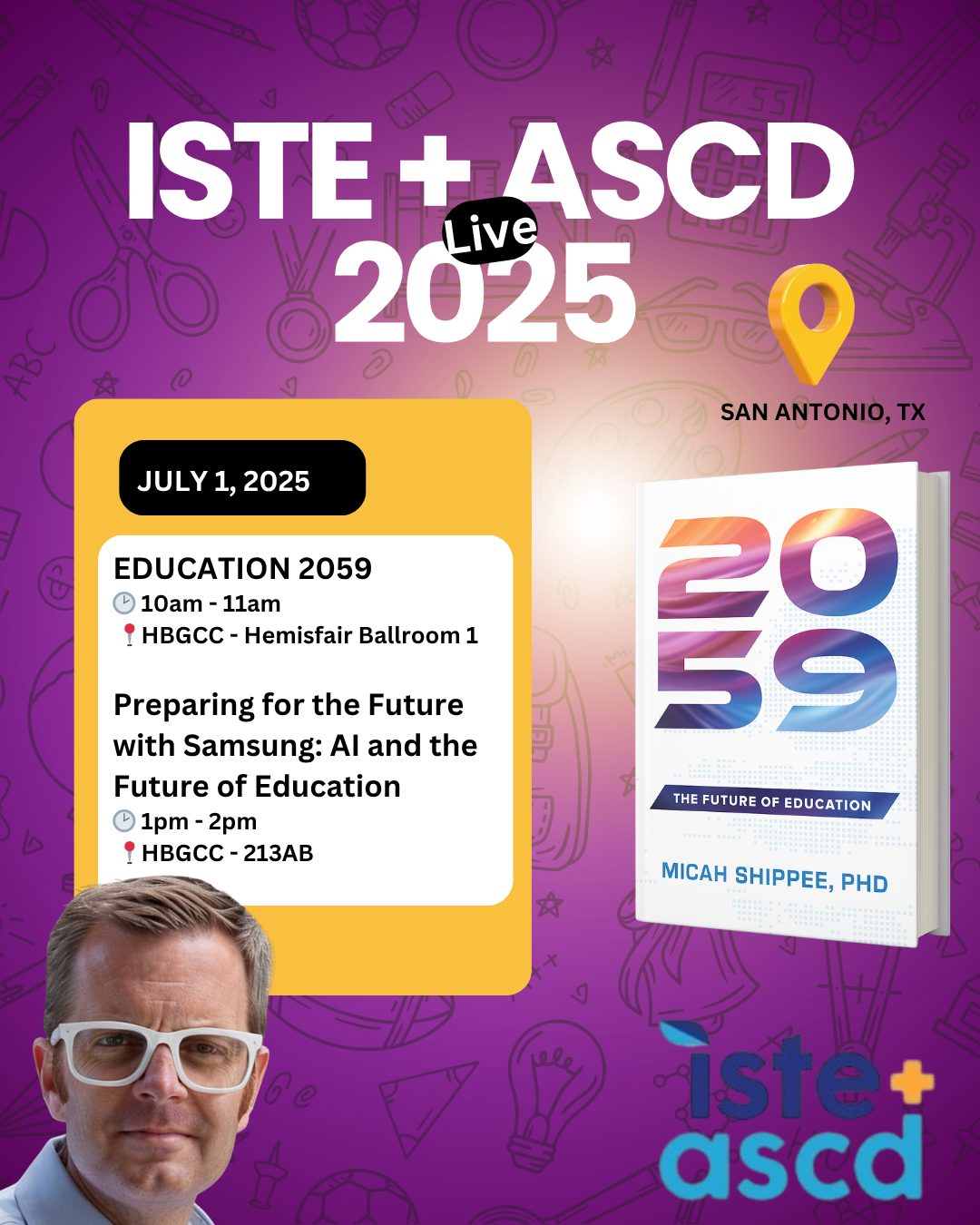
I am looking forward to speaking at ISTE and connecting with attendees. For me, the best part of ISTE is meeting with colleagues new and old, catching up, and thinking about the future for our students. With that in mind, I wanted to let you know about a few places you can find me. If you will be there please join me at these two ISTE sessions (click to add to your calendar with locations):
I have been working with the team at ElevenReader to provide the best, free audiobook experience possible for all of you. The link below will take you to their page/app where you can create a free account an begin listening to the book!
Why free as an audiobook?
Writing a book is a very special experience. I am grateful to have written several and believe my work can offer inspiration, insight, and value to many readers. But the field-of-dreams concept of if-you-build-it-they-will-read-it simply does not translate to reality? Why not? We are all very busy and life is full of distractions…. further, text is not always the most accessible way of communicating themes that I have been writing about. It is my hope that this audiobook will increase access and that readers will find it a bookshelf-worthy addition to their collection of physical books: https://micahshippee.com/2059book/
Why is ElevenReader a great option?
Have you ever listened to an audiobook just because you liked the reader? I have always enjoyed Wil Wheaton’s voice and followed him on a few audio books just because I like the genre he reads and how he sounds. What if you could PICK who read you the book? Maya Angelou? Richard Feynman? Burt Reynolds? All of these are available voices/readers on ElevenReader! Plus so many other custom voices that suite your style.
Reflecting on the Future: A Conversation on My EdTech Life with Fonz Mendoza
I recently had the privilege of joining Fonz Mendoza on My EdTech Life for Episode 321, and what an energizing and meaningful conversation it was! As a returning guest, it felt like catching up with an old friend—Fonz is not only an incredibly thoughtful host but also a passionate advocate for meaningful conversations in education. His ability to create space for deep, reflective dialogue made this episode a special one.
This conversation was inspired by the release of my new book,2059: The Future of Education, and together we explored some of the major themes that drive the book—innovation, agency, equity, and the evolving role of educators in a tech-driven future.
The Story Behind 2059
Fonz kicked things off with a fantastic question: Why 2059? The title is a deliberate nod to the kind of bold, future-focused thinking George Orwell embodied with 1984. My aim was to give ourselves 35 years to reimagine—not just react to—the future of learning. Rather than a dystopian lens, 2059 is a hopeful framework for guiding transformation in education.
Integration vs. Adoption: A Key Distinction
One highlight from our conversation was the distinction between integrating technology and fully adopting it. Integration is the testing phase—does this tool enhance learning? Adoption, on the other hand, is about ownership. It’s when a tool becomes routine, no longer needing explanation—what I call the “pencil moment.” We don’t announce we’re teaching math “with a pencil,” and I believe we’ll eventually get there with AI too.
Human-Centered Innovation
As we discussed the implications of AI, I stressed that teachers cannot—and should not—be replaced. Human connection, empathy, and the ability to model struggle and growth are irreplaceable components of learning. Fonz and I touched on the ecological concept of trophic cascade to illustrate how removing one essential element from an ecosystem—like teachers—can cause unseen disruptions elsewhere. Education is no different.
Future Scenarios and Critical Caution
The book outlines four future scenarios for education:
The Hyperconnected Classroom (2029)
The Bio-Integrated Learner (2039)
The Community Learning Hub (2049)
The Post-Scarcity Scholar (2059)
While the Community Learning Hub excites me most for its potential to empower local-global problem-solving, I expressed concern over the Bio-Integrated Learner—where augmentation and implants risk disconnecting students from authentic learning processes and critical thinking.
Empowering Educators Through Agency
We also explored the concept of access to agency. Inspired by moments spent learning from my dad, I shared how students benefit not just from knowledge, but from seeing struggle, persistence, and problem-solving modeled by adults. When we let students see us adapt, stumble, and reflect, we’re giving them tools to do the same.
Practical First Steps
For educators and leaders just beginning to explore AI, I offered three steps:
Try it personally—use AI to solve a home or life task.
Reflect—what was the value of using it? What time did it save?
Pilot it lightly—try a low-risk use in the classroom, like a formative check, and observe the impact.
Looking Ahead with Hope
As we imagined 2059, Fonz asked what I hope people will say about the book decades from now. My answer? That it sparked a meaningful conversation. Not that I was “right,” but that the book encouraged us all to think about how today’s choices shape the world our students will inherit.
Big thanks again to Fonz Mendoza and My EdTech Life for such a powerful platform to share ideas. If you haven’t already, I invite you to check out the episode and join the conversation. You can also grab a copy of 2059 on my website—www.micahshippee.com—with a 20% discount for new subscribers.
Let’s not just adapt to change—let’s lead it, together. 🚀
In a world often dominated by dystopian visions, we must intentionally take a different approach. Rather than dwelling on potential catastrophes, I invite you to rediscover something we seem to have lost along the way: the excitement of imagining our future.
The Lost Art of Technological Optimism
Remember when we used to dream about flying cars and robot companions? Landspeeders and R2D2 are still pretty cool…. right? There was a time when thinking about the future filled us with wonder and possibility. Somewhere along the way, our collective imagination became clouded with anxiety rather than anticipation. Have we left Lucas and Roddenberry for Orwell?
We can recapture that sense of technological optimism while still acknowledging the real challenges ahead. Exciting technology like renewable energy must become not just a necessity but a source of abundance. Distributed solar networks transform energy from a scarce resource into a democratic force, enabling communities to become self-sufficient while collaborating on shared innovation. Energy abundance fundamentally rewrites the rules of scarcity that have governed human societies for millennia. This is not just technological progress, it is a fundamental restructuring of power dynamics that ripples through society, economics, and governance. Here we see liberating joy in a cleaner, sustainable future moving us to 2059’s post scarcity world.
Learning from History’s Visionaries
History is filled with dreamers who imagined better worlds. From Leonardo da Vinci’s flying machines to the architects of the internet, visionaries have always pushed us forward by asking “what if?” There are fascinating patterns in how past societies navigated periods of rapid change helping us to draw parallels between our current technological inflection point and the Renaissance period. Much like how the printing press democratized knowledge and catalyzed societal transformation, today’s advances in artificial intelligence and biotechnology are fundamentally reshaping our relationship with information. The key difference? Renaissance pioneers had no roadmap, their “what if?” was not bound by a prescribed future from media and literature like ours’ is. What makes these visionaries different is not just their technical brilliance, but their fundamental belief that we can describe tomorrow for the better.
The Joy of Proactive Futurism
One of our core needs in approaching the future is a deliberate, proactive futurism, the idea that imagining the future is not just a passive exercise but an activity in which we have the agency, the power, in creating it. When we envision positive futures with clarity and conviction, we:
1. Create mental blueprints for innovation
2. Build psychological resilience for navigating change
3. Develop shared visions that can unite diverse communities
The concept of recursive optimism teaches us that positive visions and articulations of the future create feedback loops of innovation and collaboration. This puts the onus on each of us to create communities that collectively articulate hopeful futures, which will then naturally begin to organize their resources, talent, and policy structures toward those outcomes.
Balancing Optimism with Responsibility
Of course, blind optimism is not the answer either. In my book “2059: The Future of Education” I explore how we can balance hopeful visions with clear-eyed assessments of our challenges as we seek to prepare our children for their future. True optimism is not about ignoring problems, it is about believing in our collective capacity to solve them.
Perhaps the most powerful example is the transformation of our food systems. Rather than viewing climate change as a death sentence for agriculture, forward-thinking communities embraced it as an opportunity to reimagine our relationship with food. The great irony of the 21st century may be that the climate crisis forced us to create food systems that are more nourishing, equitable, and connected to natural cycles than anything we had built before. Vertical farming, precision fermentation, and regenerative agriculture do not just mitigate environmental damage, they create more nutritious food, restore biodiversity, and revitalize rural economies in ways that conventional systems never could have.
Practical Steps for Remembering the Future
So how do we recapture this forward-looking excitement? “2059” offers several practical approaches:
Transformational Thinking: Practice, teach, and live a life full of possibility thinking reframing, and empowered perspective where problems are possibilities and weaknesses are seen as strengths.
Cultivate wonder: Regularly engage in open conversations about hopes and questions about the future, creating a tangible dialogue with those around you. The act of articulating our hopes for tomorrow helps us recognize the agency we have today. This simple habit has been shown to counter anxiety with agency.
Engage with diverse visions: Technological solutions designed with and by diverse, global communities often solve broader problems more elegantly. The most robust visions of tomorrow emerge at the intersection of varied lived experiences.
Connect past experiences to present actions to future outcomes: Community initiatives where people commit to work that may not fully manifest in their lifetimes are incredibly powerful. The most meaningful futures require us to plant trees under whose shade we may never sit. From forest restoration to planning for a future you will never see, these projects help participants transcend short-term thinking.
The Future Needs You to Remember It
Perhaps the most powerful insight I strive to explain in “2059” is that the future quite literally depends on our ability to imagine it. As I wrote the book, I envisioned many points that colleagues in education would disagree with but I found solace in the hope that I would be serving as a catalyst for a critical conversation about the future. The future is not a foreign country we will someday visit, it is a structure we are building, brick by brick, with every choice we make. When we forget to look up from our work and remember why we are building, we risk creating monuments to our fears rather than a platform for our hopes.
When we actively remember the future… when we hold space in our minds for what could be, we are not just daydreaming. We are participating in one of humanity’s most important traits: our ability to collectively envision and then create a bright future.
Conclusion: The Joy of Tomorrow
As we face undeniable global challenges, “2059” reminds us that joy and optimism are not luxuries, they are essential tools for human progress. By remembering how to think about the future with excitement rather than dread, we unlock our greatest potential for innovation, cooperation, and growth.
The future is coming whether we are excited about it or not. But as “2059” illustrates, those who approach tomorrow with informed optimism will be best positioned to shape it.
Interview with PBS NewsHour Classroom discussing ed tech integration in a social studies classroom and its impact on work at Samsung, focusing on transforming teaching, demonstrating adaptability, and Samsung’s Solve for Tomorrow competition.
Here is a summary of key interview themes:
Early Adoption of EdTech: discussion on embracing educational technology early, using tools like computers, tablets, and interactive displays to enhance learning retention.
EdTech Builds Confidence: leveraging technology to enable quieter, introverted students to participate via tools like digital parking lots, backchanneling, and microblogging, eventually building confidence to share more openly.
Timeless Teaching Practices + Tech: emphasis on effective traditional methods (like apprenticeship models) remaining valuable, but tech, like AI assistants, have the potential to enhance a teacher’s ability to support more students individually.
Teaching AI Use Responsibly: Students should first develop foundational skills (reading, writing, critical thinking) in class, then use AI tools at home for co-creation and editing—mirroring thoughtful instructional practices.
Our “Pencil Moment” Analogy: Just as past educators questioned how to integrate pencils, today’s teachers are asking similar questions about AI. Technology adoption is a long-standing part of education.
Samsung’s “Solve for Tomorrow” Program: Celebrated as a philanthropic initiative where students tackle local issues connected to global challenges, guided by the UN Sustainable Development Goals.
Modeling Innovation and Agency: Teachers trying new tech should model vulnerability and perseverance, showing students the value of taking risks, learning through failure, and pushing through uncertainty.
Teaching Life Skills Through Struggle: Letting students witness real-time problem-solving and failure (e.g., tech not working) helps teach adaptability, resilience, and critical life skills that transcend academic content.