A positive educational experience leveraging agency helps to ensure that students are ready for the challenges and opportunities of the future.
Key points:
Agency is about having a desire, making plans, and carrying out actions
Edtech tools and resources should support student and teacher agency
Education is changing because the world is changing. During the pandemic, teachers and students rapidly adopted new tools to pivot to remote and hybrid learning. With the recent advent of ChatGPT and other generative AI technologies, conversations in education are now abuzz about AI’s potential to redefine lesson delivery, homework and formative assessments. The emergence of AI comes at an interesting time, when educators are looking for solutions to close the gap of pandemic-era learning loss and prepare their students for an increasingly technology-driven world.
As educators introduce new technologies in their classrooms, successful adoption and improvements to student outcomes will hinge on thoughtful strategies and intent to embrace change.
Advancements in education technology
History has taught us that innovation is inevitable. For instance, in classroom instruction, we have evolved from yesterday’s chalkboards and overhead and LCD projectors to cutting-edge interactive displays. While educators can’t predict the next breakthrough technology, we can anticipate the adoption process–by relating our past experiences to a positive path forward.
Instructional design and product development teams should consider the adoption process when designing products to meet the current needs of educators. Designers often pull from personal experiences and observations of how educators delivered lessons from the front of the classroom and created meaningful dialogue with students. For example, displays need to be simple and relatable for educators. The technology should augment what the teachers are already doing in the classroom and amplify their impact on student learning outcomes.
Teachers and school leaders adopting new technologies – whether AI or hardware like interactive displays – need to understand their purpose. Do not purchase new technology because it is the hottest trend. Think about how you will leverage it to enrich the learning experience. For example, an LCD projector may have helped present lesson materials, but an interactive whiteboard can provide students with a new hands-on experience. They can understand the information more deeply, making connections they never would have before by looking at a static image. Innovation in technology and strategies can provide new opportunities to meet the diverse needs of our students.
Successful adoption also requires defining the measure of success. Higher test scores are often used to measure student achievement, but we know true meaning-making and application of skills are measured in different ways. A successful classroom has engaged students who are inspired to take ownership of their learning and become contributing members of their learning community. Teachers attuned to their classroom culture understand when their students are engaged, and they seek to activate more and more of those coveted light-bulb moments–indicators of high motivation to learn more. The adoption of new technology will amplify instructional practice when used strategically to make a positive impact on students.
Access to agency
How should educators approach adopting a technology like AI where there is no past experience to serve as precedence? Teachers look for instructional leadership from their district, state or the Department of Education (DOE). In fact, the DOE’s “Artificial Intelligence and the Future of Teaching and Learning” report recommends keeping humans in the loop with AI: “We envision a technology-enhanced future more like an electric bike and less like robot vacuums. On an electric bike, the human is fully aware and fully in control, but their burden is less, and their effort is multiplied by a complementary technological enhancement.” This high-level thinking is helpful, but more direction is needed.
However, guidance remains limited at the state level. The State Education Technology Directors Association (STEDA) reported in its 2023 State EdTech Trends that there is an “increased demand for guidance relating to artificial intelligence” and its use in K–12 schools, yet most states reported no efforts to meet that increased demand. Survey results showed that 55 percent of respondents indicated an increased interest in AI policy development – yet only two percent reported that their state has an AI initiative in place.
How then are educators to adopt new technology like AI when AI’s usage in education is not a question of “if” but “when.” The technology is only going to permeate more of our everyday lives. We must equip students with valuable skills, such as how to write effective generative AI prompts, to prepare them for their future careers. Seek forward-thinking educators online, where professional development, webinars, blogs and videos on AI are abundant. Importantly, do not be afraid of safely and thoughtfully experimenting with AI directly in front of your students. This is a difficult direction but remember: Young minds can be shaped by seeing trial and error. Rather than appear like we are the experts and already have all the answers, we can give our students visibility into the adoption process, including the struggles. This is called access to agency.
Agency is about having a desire, making plans, and carrying out actions. Agency is stick-to-it-tive-ness in action. The sense of agency plays a pivotal role in cognitive development and includes recognizing oneself as the agent of behavior and an empowered independent. We exercise the power of agency when looking for how to do things. We use YouTube videos to figure out how to repair a refrigerator or dishwasher. This is us embracing our sense of agency, and we should adopt that methodology into our classrooms. Empowering students with access to our agency helps to instill critical skills of the future, such as problem-solving, project management, and collaboration. These skills will be necessary to prepare our students for an increasingly technology-driven and AI-infused world.
As the world continues to change, education will continue to evolve. Yet educators need to take a moment to reflect on teaching methods, rekindle their passion for learning, and embrace change. We must cultivate the courage to stay relevant by acknowledging that technology is an evolving journey. By nurturing essential attributes of success, including motivation, environmental consideration, skills, and knowledge, we will empower ourselves and our students to adapt to breakthroughs.
The courage to make change is at the heart of success. We must explore, adapt, and inspire change to support a positive educational experience, ensuring that our students are ready for the challenges and opportunities of the future.
Who is a leader? A leader is more than just a manager, a leader raises up those around them to help them meet their highest potential. A leader must learn to motivate and inspire those around them for the greater good. Who exactly is, or has the potential to be, a leader? YOU
Leaders are found in every industry, some are labeled as Director, or Chief, or Head, or Lead, but most others are leaders because of what they do… they transcend the plaque on their door. Leaders are athletes, coaches, consultants, educators, engineers, lawyers, politicians, professors, tradespersons, etc… just to name a few. The effectiveness of a leader weighs heavily on the strength of their relationships and their ability to maintain clear focus.
“I’ve learned that people will forget what you said, people will forget what you did, but people will never forget how you made them feel.” – Maya Angelou
Traditional relationship-building strategies to achieve these goals are becoming increasingly difficult to employ in a world that lacks as much IRL time and attempts to maximize video chats and asynchronous communications. How then do we lead in a time/place of continual disruption? Hybrid work? And a lack of good ole fashion face-time? Leaders need help.
“There are three things extremely hard: steel, a diamond, and to know one’s self.” – Ben Franklin
Globalization is here, are you prepared? Effective and efficient leadership strategy is a cycle of investing and reinvesting in people, teams, and the organization. Leaders must continuously reshape spending as they realign to social changes and market forces. A rapidly changing landscape often requires that we, as leaders, shift our focus, build the plane while flying it, and hold ourselves accountable for the end result. Leaders point to a higher purpose as a guiding light, a goal that followers will agree to as greater than any one of their individual pursuits yet very important to every individual. What is this focus? Money? Posterity? Faith? The Planet? All or some of these? Determining your goals as a leader is challenging. Leaders need help.
Asking for help and/or knowing we need it is tough. So I will provide the required guidance on that: YOU NEED HELP.
Help is on the way
I had the privilege for writing the introduction to Dr. Bruce Piasecki’s latest book: A New Way To Wealth.
This short but smart new book is based on Dr. Piasecki’s 40 years as the owner and CEO of a management consulting firm, the AHC Group. A clear message in his work is the power of doing more with less. Piasecki’s firm has helped Toyota enter the global market with their hybrid powertrain. They helped Walmart enter Africa efficiently, with strategic partners across five years. In recent years, they worked on competitive frugality with such globe-spanning giants as bp on its energy transformation, and Merck and Walgreens on their needs to flourish in a time of Covid19.
Piasecki’s career is about the art of competitive frugality. Dr. Piasecki grew up a factory kid on Long Island, made his way to Cornell as a basketball star, and up the corporate stairwells of the firms noted in his client history and ongoing membership workshops known as the Corporate Affiliates Workshop Series.
This book is the help you need to prepare for learning to lead effectively in our changing society, navigate times when intervention is required, and leverage your leadership skills to use social capital to create a culture of frugality during tough economic times.
What you are about to experience is the ultimate summary of his career: a down-to-earth, Bruce Piasecki readable, and optimistic narrative in nine chapters and a prelude that sing.
But wait, there’s more!
Dr. Piasecki’s ground-breaking work has informed the creation of a meaningful leadership learning series where we develop an understanding of the how Doing More with Less IS Success through three key principles:
#1 Social Capital: do not forget the people and the rules in the act of making money
#2 Competitive Frugality: return to a classic sense of productive restraint
#3 Competitive Advantage: only you can find your competitive advantage for creating wealth
“An investment in knowledge pays the best interest.” – Benjamin Franklin
Ask people what a good leader is and you will no doubt get many answers, a leader means many things to different people… but a leader means something to people. The call to leadership is a journey that need not be taken alone. Join us and Dr. Piasecki as we amplify your good practice and refine your areas in need of improvement. You can be an effective leader. We are here to help!
“Every man must decide whether he will walkin the light of creative altruism or the darkness of destructive selfishness.”
– Martin Luther King Jr. (1960)
Dr. Martin Luther King Jr. is often referred to as one of the most influential people in American History. The above quote (from The Three Dimensions of A Complete Life 1) embodies a choice every one must make in their own life journey… specifically a choice to work to the benefit of others (the metamessage for Dr. King’s life). His efforts have been analyzed and publicized by those seeking to, justifiably, replicate his success and impact. In my effort to explore what we can learn from Dr. King’s leadership, I chose to look at what others had to say about him… starting with a Google search “Leadership Lessons from Martin Luther King” which will yield thousands of results, I reviewed of a small fraction (see selected sources below) and found the following traits, or characteristics, emerge:
NOTE: Larger fonts represent a higher frequency of use and impact in my findings.
Upon deeper review it became clear that the subjective writings on Dr. King’s leadership teach us that good leadership is about :
Empowering others, particularly those whose voice is not heard.
Disrupting an unjust, ugly status quo.
Remaining truthful to your values.
Communicate to build relationships as well as to articulate your goals, even when they are unpopular.
Bravely accept the unknown while seeking the possible.
Opportunistically looking for ways to use what is to realize what could be.
To be fair these were the thoughts and insights of others about Dr. King’s work rather than a first hand review of his speeches and writings (such a primary source study is a worthy, yet vast, undertaking). Adding my own insights to this list (#7), and perhaps overlapping some of the lessons, Dr. King taught us about choosing to be altruistic. Meaning, it is not within our nature to be truly altruistic (perhaps inciting a philosophical debate here) but
It is within our individual capacity to work for a greater good, not only for others, but for a better future that we may not see, but future generations will reap the benefits from.
I have no doubt Dr. King’s legacy will continue to inspire for generations to come. I hope that future interpretations of his work recognize his example of creative altruism.
Do you remember setting a special ringtone for special people in your contacts list? Remember the thrill of a mobile phone call? The elation over the ping of a text message? The fun you had with video chats on your phone? And now what is the status of your phone? Mute? Vibrate? Do not disturb? Airplane mode?
Initially mobile phones simply took the place of our home phones. Then they got smart and a whole new animal was born. Which begs the questions: Is a mobile phone simply a home phone replacement? Or is it a miniature version of your laptop or desktop? Both? More?
We should start to think more about the future and speak about mobile devices. After all, Learning, Growing, Communicating, Interacting, and Playing now transcends a “phone’s” typical use case. Further, smart-watches and the rise of AR glasses, will continue to redefine the power of mobility as truly untethered engagement/productivity.
Productivity on mobile devices takes many forms… I love voice typing and I appreciate the ability to work with my synced Google Drive files while on the go. But mobile devices should be thought of as more than simply a mini-desktop workstation. To illustrate, here is a video (below) that shows the exciting past, present, and future of mobile device technology within the context of productivity and engagement. To create the video, I remixed (1) a Harvard Innovation Lab video titled the “Evolution Of The Desk” (2) and Ben Geskin’s “AR Glasses — Desk Setup — Concept 2” video (3)… watch here as the future of mobile technology comes to life! NOTE: when the first video cuts, envision the sunglasses go to your face as AR glasses:
What does this mean for training and learning?
In a recent conversation with Bill Selak, edtech guru and Director of Technology at the Hillbrook School, a very important point about learning engagement and productivity came up: Bill stated “We chose to be a 1:1 iPad school since we believe that when a learner picks up a tablet device or mobile device they are ready to CREATE… much more than if they open a laptop or sit at a desktop computer where the keyboard dominates the space and they fill things in, type, or CONSUME video.” At first I thought this was overly simplistic, but the more I kicked around the point, the more Bill’s words really resonated with me as true.
As an augmented and virtual reality enthusiast I have learned to appreciate the real power mobile technologies hold in amplifying communication and interaction efforts on a whole new scale. Mobile devices have the capacity to augment our productivity, literally to enhance or provide greater impact. For example, using LiDar technology on a mobile device, we can scan real-world images and share them with others or to our laptop/desktop devices for viewing in Virtual Reality or even 3D printing. Lidar imagery can be leveraged to more clearly communicate the intricacies of design, the impact of art, and the iteration of design.
In summary, I frequently find myself working with my mobile device as a tool to measure distance, listen to a podcast, take a course, capture a video, scan a document, etc… all of which my mobile device(s) are perfect for, perhaps more than my other devices. In fact, a text, phone call, video chat request, etc… is often received as an obstacle to my productivity as they fill my screen with new pop-up windows and alerts. My smartphone is less a phone and more a smart device.
Our daily digital interactions rely heavily on recommender systems. Netflix, Google, Amazon, Spotify, LinkedIn, etc… all watch what we do to some degree to learn about us. The data gathered is used to recommend the best fitting products, services, or persons. In effect, a recommender system simply delivers suggestions based on behavior or characteristics that have been tracked by the system. Why do companies do this? As the Spotify Research Team states “Users are overwhelmed by the choice of what to watch, buy, read, and listen to online”(1) even with the best, most helpful intentions, to some degree this leaves us feeling as though many decisions are being made for us.
If you would like to geek out a bit more on this recommender, algorithm concept, check out Spotify’s AI called BaRT (“Bandits for Recommendations as Treatments”) (2) below is an article written by a Spotify team… the title does not sound threatening at all (lol): “Explore, Exploit, and Explain: Personalizing Explainable Recommendations with Bandits.”
Recommendation systems have a place but where the LinkedIn recommender system suggests persons based on your network, working history, and interests, these may not be the people or groups you would choose for yourself. What does that leave a professional seeking growth to do? You can take control of this system by choosing to be part of a group of like minded people doing similar work with similar approaches. Our team at Ready Learner One and ChangeMaker are hard at work linking like minded people through our learning platforms. Interested in seeing if this is the rightchoice for you? Check us out:
For a Community of Corporate Learners: On going, certificated virtual professional development designed to leverage the power of learning leaders and corporate trainers from around the world.
For Educational Institutions: A global community-based approach to best-in-class professional learning for individuals, schools, and modern learning organizations.
Let’s Connect… I recommend it,
Micah (not a Bandit, a real human being reaching out)
McInerney, J., Lacker, B., Hansen, S., Higley, K., Bouchard, H., Gruson, A., & Mehrotra, R. (2018). Explore, exploit, and explain. Proceedings of the 12th ACM Conference on Recommender Systems. https://doi.org/10.1145/3240323.3240354
Remote Work, Hybrid Transitions, and Future Commuters? The Future of Work is a hot topic right now. During the pandemic people left cities where their jobs were, thinking they might be able to redefine their own future of work and be able to work from home forever. But an increasing number of employers want them back (physically) in one form or another: full time, part time, flex time, etc… (1). Longer commutes and redefined work hours/days are ripe with opportunity for mobile learning to scale.
Currently, 91% of internet users use mobile devices to go online at least some of the time (2). Mobile phones are widely considered the entry point into the digital economy, and “one of the most far-reaching technologies in history.” (3,4)
In a mobile learning (mLearning) research study (5) I conducted in 2012 we were creating mLearning experiences that would meet the needs of traditionally inaccessible groups. Our example was:
In a Tanzanian village of several thousand people lives Matthew. Africa’s electrical grid has not found its way down the unpaved roads to Matthew’s home. To access 21st-century, modern conveniences, Matthew has found creatively approached his environment with ideas of solutions, rather than thoughts of barriers. Matthew’s refrigerator runs on a kerosene engine, he collects rainwater for drinking, and he uses solar panels for some electricity. Despite these setbacks and limitations, Matthew has mobile coverage at his home. He believes training has the potential to positively impact his work in Tanzania, but time, travel, and cost will have detrimental consequences for Matthew’s work if he were to leave.
As an instructional designer on the project I sought to transform course content, for people like Matthew, into a mobile platform allowing access to meaningful content, virtually anytime, anywhere… that was 10 years ago. The cost and computing power of smartphones has changed the landscape even more, making more powerful devices more accessible (but the accessibility gap has not closed).
In 2022, the number of smartphone users in the world is 6.6 billion, meaning 84% of the world’s population owns a smartphone. And that is just the users, it is believed that there are over 10.4 billion mobile connections worldwide, surpassing the current world population of 7.9 billion. This data means there are 2.5 billion more mobile connections than people worldwide. To be fair, not every person in the world has a mobile device, some mobile connections come from people with multiple devices, and a fraction with dual SIM’s or other integrated devices like cars (6). As the number of devices grows, so does our dependence on them to fulfill daily functions and activities (7). In 2019, 2 billion smartphone users exclusively accessed the internet through their smartphone (8).
On a global level, access to mobile phones is identified as a tool to bridge the learning access gap (9,10). The experience of the on-the-go, mobile learner is increasingly recognized as important for learning traditional content, compliance training, and upskilling. Multiple elearning platforms have mobile-enabled access of content (11) while other are built for mobile first like Learner Mobile (12) which powers the architecture for K12 learning platforms like ChangeMakerEdu and corporate learning experiences like RL1 Courses.
The future is bright for mobile learning, the opportunities to grow limitless.
One of my first years teaching I was told that we could all be replaced… this was not a threat, nor was it directed at me personally, but offered as an insight into a perspective on the teaching profession. Young and full of energy, I fought this mentality believing it untrue and that I had to simply work harder to make a tangible difference. As I got older I began to resign myself to this fact: I was a replaceable cog in a machine. I could still be a good cog, maybe even a great cog, but alas… a cog. What I failed to realize was the complex level of interconnectedness each of us has. I recently had a lightbulb moment when learning about connectivity as it relates to a scientific phenomenon called a trophic cascade.
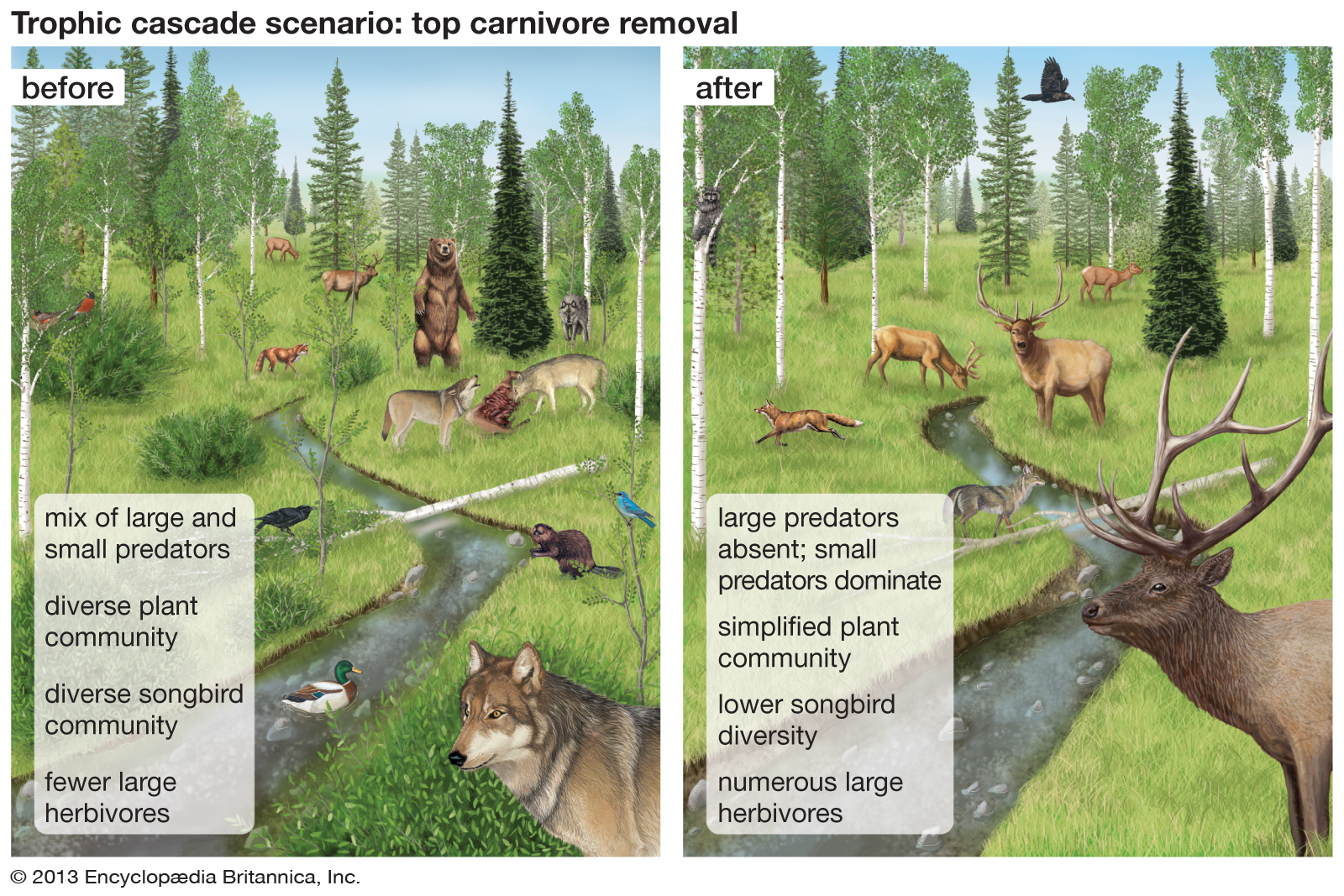
American zoologist Robert Paine coined the term trophic cascade in 1980 to describe reciprocal changes in food webs caused by experimental manipulations of top predators. A trophic cascade is an ecological phenomenon triggered by the addition or removal of top predators. This removal often results in dramatic changes in ecosystem structure and nutrient cycling. In a food chain, an increase/decrease in carnivores causes a decrease/increase in herbivores and an increase/decrease in primary producers such as plants and phytoplankton.
Look closely at all that is missing when the top carnivore is removed (after) (1)
For example, in North America the removal of wolves has been associated with an increase in white-tailed deer. Leading to a decline in plants eaten by the deer. In Yellowstone National Park, the loss of trees has been linked with the removal of grey wolves. From the 1880s-1920s wolves were the target of extermination from Yellowstone National Park. The decrease of wolves led to an increase in eating tree saplings by herds of deer and elk. A ripple effect occurred in Yellowstone leading to a decrease in trees, loosening the soil on river banks, meaning less trees for beavers to dam the rivers, meaning less pools where fish had lived… an exemplar trophic cascade. But all hope is not lost. Over the past decade, grey wolves have been re-introduced to Yellowstone National Park. The grazing patterns of elk have been re-altered allowing more saplings to grow, allowing for more trees to grow and thrive in Yellowstone.(2) (3)
Some would like to ruin my overly-romanticized view of the ecosystem’s symbiosis and how the re-introduction of wolves positively impacted Yellowstone, but we cannot deny that there is a real level of interconnectivity going on. While I do not propose each of us is a predator in the educational system, I will say we are having a real impact on those around us. Sometimes the impact is intangible and unseen, perhaps even seeming unmeasurable, but eventually these connections manifest themselves in many ways: the social media poke we get from a student we had in class decades ago or a direct message asking for help and/or reminding us of our shared experience (Sept. 11 reminders always strikes a powerful cord with me). All of which stem from a level of connection we cannot see in the moment, a level of meaningful connection which says YOU CANNOT BE REPLACED.
Perhaps you have gotten into a slump resigning yourself to a cog-like mentality (I have been there too). You may not feel relevant, appreciated, or that you are making a difference. Now the time to re-introduce yourself to your WHY. You matter, your work matters!
Also, please know, you are NOT ALONE! Wolves live and hunt in packs, these social animals cooperate and are known to roam large distances (4). Our PLN’s too are the embodiment of social cooperation that extends to the entire world! Reach out, share, collaborate…
Let’s Do This!
WanderlustEDU: An Educator’s Guide to Innovation Change, and Adventure.
Originally published: Shippee, M. (2021) A Globalized Curriculum: The Next Evolution Of Education. International Conferences Mobile Learning 2021 (ML 2021) and Educational Technologies 2021 (ICEduTech 2021) ISBN: 978-989-8704-28-3
Abstract
Curriculum is a dynamic, iterative cultural artifact. Historically, educational curricular shifts have gone from Socratic dialogue, to master-apprentice programs, to humanities enrichment, to STEM focus, each with varying degrees of equitable access. Gaps in equity have led to economic-driven curricular designs. In recent years, access to learning has increased dramatically, not just the privilege of the elite. We can now focus our curricular priorities to address the needs of our global society. With this in mind we need a curriculum that is culturally responsive and iterative in nature. This paper addresses curricular evolution at a global level with insights for the future of learning.
Keywords
Curriculum, Globalization, Sustainable Development Goals
1. Introduction
Curriculum design is an iterative, cultural process. Culture is defined as the shared beliefs, social forms, and material traits of a social group. There are five key tenets of culture (Haviland, Prins, Walrath, and McBride, 2005): Culture is learned, shared, based on symbols, integrated, and dynamic. Curriculum design is linked to culture by the way we define who we are and where we want to be from our collective shared experience. Shaping a globally-responsive curriculum takes purposeful, diligent effort in observing, selecting, and presenting experiences (Shippee, 2019).
Curriculum design requires we are cognizant of, and responsive to, the context in which we have been working. Historically, cultural forces have pressured an educational perspective that embraces newer, trending technology, specifically in regard to film, radio, television, and eventually computers (Shippee, 2016; Cuban, 1986). This is reinforced by the concept of the technological sublime, a theoretical context for interpreting underlying motivations of decision makers advocating for the pursuit of greatness (Frick, 2017). To move forward in our continued iteration of curriculum, we must first look back through a historical perspective on curriculum to examine throughlines and outliers that can serve to inform our discussion (Popkewitz, 1984).
2. A Brief History of Curriculum
For the Hellenistic period, Greek education was largely esoteric having focused on the humanities and the curation of educated people. Here students were taught to be “critical” in all or almost all branches of knowledge. The scope and sequence for instruction was based on the trivium: grammar, rhetoric, and logic and the quadrivium: arithmetic, geometry, astronomy, and music. While the names are antique, the seven “subjects” were comparable to a modern liberal curriculum of languages, philosophy, mathematics, history, and science. The education of the Roman Empire consisted of a focus on Politics and Law, influenced by aspects of Greek education that focused on philosophy and language yet, reflecting on Roman-cultural priorities, centering on oratory (speech giving) due to its political significance. (Van Doren, 1992). Formalized medieval education yielded a culturally-specific, religious focus with a temporary reprieve from Greek influence. The Renaissance, or “Rebirth,” yielded renewed interest in Greek and Roman systems that began transcending the geographic spheres of antiquity. In response, Renaissance education began a lasting shift back to curriculum guided by ancient wisdom.
Throughout the 1700s and 1800s education continued to be the luxury of the elite. Efforts were made in various pockets of the globe to increase and equity in regard to educational opportunity, yet education was elusive to many.
Contemporary education grew out of the Industrial Revolution as a form of mass production, a mass education, the product of the Industrial Age (Lahav, 1973). “The whole idea of assembling masses of students (raw material) to be produced by teachers (workers) in a centrally located school (factory) was a stroke of industrial genius” (Toffler, 1970). In this system, content was broken apart into distinct units of study, veritable silos of learning. In the Twentieth Century, even universities felt the impact of the silo-ing of content. The “uni” in university became pointless, as universities’ separate world’s ceased to talk to one another. Each college, department, etc.. began possessing more and more autonomous power as government funding for research turned them into a loose confederation of disconnected mini-states, instead of a uni-fied organization devoted to the joint search for knowledge and truth. (Van Doren, 1992). Curriculum, teaching standards, and learning objectives all became uniquely tailored to each content category. The silo-ing of education has remained in K12 classrooms systematically validating the existing Industrial Aged model where work stations (courses) were separated and meaningful curriculum-driven collaboration is lacking.
Conversations about curriculum design were deeply impacted in the United States in the Cold War and the Soviet launch of Sputnik. The Space Age became a cultural phenomenon yielding a hyper-focused approach that lauded math and science as the keys to a successful future, a technological sublime, that is, the pursuit of nationalistic greatness. From this thinking was born STEM education.
3. STEM education
A STEM education focuses on Science, Technology, Engineering, and Math with the belief that these will help prepare learners to compete in their future economy. STEM remains a curricular priority in our global education systems today (Freeman, Marginson, & Tytler, 2019). Many policymakers, economists, and futurists believe a solid foundation in STEM will make students more marketable and successful, particularly in an increasingly globalized economy with the spread of products, technology, information, and jobs across national borders and cultures.
For decades, in the United States, multiple national policy documents have asserted that global competitiveness is contingent on students being actively engaged in science, technology, engineering, and mathematics (STEM) at all levels of education (National Academy of Sciences, National Academy of Engineering, & Institute of Medicine of the National Academies, 2007). In response to growing concerns about the future workforce “STEM” was introduced in 2001 by the National Science Foundation (NSF) who stated: “A well-prepared, innovative science, technology, engineering, and mathematics (STEM) workforce is crucial to the Nation’s prosperity and security. Future generations of STEM professionals are a key sector of this workforce, especially in the critical scientific areas…To accelerate progress in these areas, the next generation of STEM professionals will need to master new knowledge and skills, collaborate across disciplines, and shape the future of the human-technology interface in the workplace.” (Carpenter, Regassa, and Watson, 2020). Critics argue STEM itself is a socially constructed label developed in response to economic and global pressure (Akerson, Burgess, Gerber, Guo, Khan, & Newman, 2018), yet one would ask: Is that not part of the role of education? To respond to changing times? After all, education is changing because the world is changing.
The truth of the matter is that the actual educational meaning and practice of STEM is not clear. Do we approach all four as siloed curricular areas with distinct course objectives to be mastered? Or, do we instead break down the silos and leverage each of these areas around a central goal or project? I would argue the latter is where the most powerful learning potential is found. Rather than focus on the individual contents of Science, Technology, Engineering, and Mathematics learners will make the most meaning by leveraging them all together with a STEM-approach to solving real world problems. Perhaps a more realistic goal is to continue the mantra of over a millenia of education, what some call “the hidden curriculum,” (The Glossary of Education Reform, 2013) that is, to motivate learners to care about the future, an empathy-driven focus to cause positive change in our world.
4. Curricular Evolution
The world is rapidly changing as a result of both wanted and unwanted disruption. The COVID19 pandemic has forced an increase in remote/distance and hybrid learning which has caused us to question our best practices for teaching and learning. While emergent technologies have afforded us the opportunity to teach and learn in new and exciting ways. Both of these disruptions will have lasting impacts on our culture and on our curriculum. One example of changes in technology is Artificial Intelligence (AI). AI is an area of computing science focused on the creation of intelligent machines that work and react like humans. The product of impressive STEM-based work, AI learns through the data we generate in our real-time efforts and many AI products impact and improve our daily lives through automation (Shippee, 2020). But then automation means “machines will become very good at being machines…so we need to be extremely good at being humans again…to dig into individual abilities, allowing people to do their best & live out their potential.” says innovator and futurist Liselotte Lyngsø (Lindzon, 2018). Herein is the need to evolve our curricular focus, one that responds to a change in our global culture as seen through our understanding of the future of work. In 2018, former LinkedIN CEO Jeff Weiner stated “Not surprisingly, there continues to be an imbalance with regards to software engineering. But somewhat surprisingly, interpersonal skills is where we’re seeing the biggest imbalance. Communication is the No. 1 skill gap.” (Mautz, 2018).
Our planning and strategizing in education has often been a means to an ends approach rather than understanding that the ends would shape the means. Our focus must be on the world that our students will face. To plan without having a clear idea of what one is planning for is seemingly futile as setting out on a journey without a map, future thinking “can serve the same role for the educational planners as did the geographers for the explorers of the Renaissance!” (Lahav, 1973).
5. Real-World Focused Curriculum
Setting aside agenda-driven, esoteric rhetoric, about curriculum. From a purely teaching and learning perspective we find direction from the field of instructional design where many powerful principles help us prescribe effective teaching and learning practices. Among them are the work of Dr. M. David Merrill (2002) who describes 5 principles of instruction: Learning is promoted when: #1 learners are engaged in solving real-world problems, #2 existing knowledge is activated as a foundation for new knowledge, #3 new knowledge is demonstrated to the learner, #4 new knowledge is applied by the learner, and #5 new knowledge is integrated into the learner’s world. These 5 principles explain the power of hands-on learning where each individual learner makes real meaning of the process. We must incorporate these principles into our curriculum design. Our future must have a problem-based approach which employs STEM-thinking, over siloed content understanding, to prepare our learners for their globally conscious future. Like any innovation, curriculum change involves some overlap in practice. Changes that look and feel similar to what we know are easier to adopt. The choice to adopt begins with an initial decision about fit as it gives way to actual implementation (Shippee, 2016; Shippee 2019; Lubinsky & Shippee 2021).
STEM-thinking is a familiar set of skills that we can employ to identify important questions for important problems, in real-life situations. STEM-thinking supports our explanation of both the natural and designed world through evidence-based conclusions, as a cognitive process of inquiry and an attitude that exhibits a willingness to engage in issues as a reflective citizen.
Meaningful adoption of a problem-based teaching with STEM-thinking serving as a lens to approach concepts can positively impact learners when it is translated into policies, education programs, and practically applied in classrooms. This adoption will lead to a prepared workforce with 21st-century competencies, an advanced research agenda, and a focus on innovation. Those of us seeking to understand the future of work in an increasingly globalized world have increased discussions about the relevance of STEM in education addressing how a STEM education leads learners to better understanding the interconnectedness of concepts and ideas.
6. The United Nations Sustainable Development Goals
The free-trade economics of globalization aside: does STEM have potential to have a positive impact on our world? From a problem-based learning global, cultural-perspective… absolutely. How then do we decide, on a global level, on what problems to prepare our learners to solve?
The United Nations (UN) Sustainable Development Goals (SDGs), are 17 specific areas which serve as an urgent call for action by all countries, developed and developing, to employ a global partnerships that recognize “ending poverty and other deprivations must go hand-in-hand with strategies that improve health and education, reduce inequality, and spur economic growth, all while tackling climate change and working to preserve our oceans and forests.” (United Nations, 2020)
Figure 1. Sustainable Development Goals (United Nations, 2020)
The SDGs provide guidance for helping cultivate focus areas for our future citizens who will understand and be ready to address them with a STEM-thinking skill set.
7. A Globalized Curriculum
The global challenges we face now, and in the future, are clearly significant and will require more than an academic solution, but STEM-thinking must be part of our strategic response and be more than simply tinkering with current policies and programs, or just updating science curriculums (Bybee, 2013). From a humanities perspective STEM coursework appears to tell only part of the story. Should we simply keep adding letters to the acronym like “A” for “Arts” giving us STEAM or “R” for “Reading” and/or “Research” and thus STREAM? I would suggest that we instead accept “STEM” as a guided thought process and propose that we understand the humanities (reading, writing, fine arts, history, social studies, etc…) as the glue that links the components of STEM together through context driven accounts, and stories, which both explain and illustrate the meaningful application of STEM. As an illustration of this, let us reflect on how science, technology, engineering, and math are employed to explain an Archimedean Screw. We understand that the explanation is better illustrated by both the historical accounts of its development and the stories of modern use which illustrate how it works. Further, the humanities also serve as a civic compass to help us understand the global impact of our actions through a culturally-focused perspective, a critical component when trying to help others adopt meaningful change.
Dr. Christopher Charles’ “Lucky Iron Fish” account embodies a Globalized Curriculum focusing on a real world problem that only became effective solved when culture was understood:
In 2008, Christopher Charles, then a Masters, student travelled to Cambodia for a research project. While there, he was shocked at the high rates of iron deficiency anemia and anemia in the region. He decided to dedicate his future research to developing a safe, and affordable solution. Now Dr. Charles, he was inspired by previous research which showed that cooking in a cast iron pot increased the iron content in food. He developed an iron ingot that could be boiled in soups or drinking water. But not everyone was ready to throw a block of iron into their drinking water. It was clear that Dr. Charles had to better understand the culture in which he was working.
After doing more research on the culture, he realized what he needed to do in order to persuade people to use the ingot, Dr. Charles cast the ingot into the shape of a fish that was considered to be lucky in Cambodian folklore. As explained in his thesis the concept of a lucky iron fish design did not pander to superstition, but created a cultural relevance for a solution based on science. To make the fish more attractive to the users, he gave the fish a smile. He called this prototype the “Happy Fish”. He went on to show that almost everyone used the fish and results from his research showed that regular use of the Happy Fish decreased anemia by 46%. (Roxby, 2015)
The Lucky Iron Fish story illustrates multiple SDGs, with a solution developed through a STEM-thinking lens that would have failed to make an impact if it was not for the humanities-directed understanding of culture.
8. Conclusion
Education is changing because the world is changing. Curriculum design is, and should be, in a constant state of dynamic iteration that responds to these changing times. As equitable access to education increases, so to should our desire to increase global awareness through a globalized curriculum. We have an opportunity to help plan a bright future for all humankind that transcends geography and economic status and highlights the creative abilities we have to solve our shared problems.
Lubinsky, J. and Shippee, M (2021) Esports and strategic organizational adoption of innovation. (Andrews, S. and Crawford C. eds.). Chapter in Pathways and Opportunities Into the Business of Esports. IGI Global (in press)
Mautz, S. “What Job Skill Is Most Lacking in the U.S.? LinkedIn CEO Jeff Weiner Has a Surprising Answer.” Inc.com. 23
National Academy of Sciences, National Academy of Engineering, & Institute of Medicine of the National Academies. (2007). Rising above the gathering storm: Energizing and employing America for a brighter economic future. Washington, DC: National Academies Press.
Popkewitz, T. (1984). Paradigm and ideology in educational research : the social functions of the intellectual. London New York: Falmer Press.
Shippee, M. (2016). mLearning in the organizational innovation process. Dissertation. Syracuse University. Syracuse, NY
Shippee, M. (2019) WanderlustEDU: An Educator’s Guide to Innovation, Change, and Adventure. San Diego: Dave Burgess Consulting, Inc.
Shippee, M. (2020) No brainer AI in the classroom. Teach Magazine. September/October 2020.
Stohlman, M., Moore, T. J., and Roehrig, G. H. (2012). Considerations for teaching integrated STEM education. Journal of Pre-College Engineering Education Research, 2(1), 28–34.
Toffler, A. (1970). Future shock. New York: Random House.
Leveraging the simple (and free) game design tool: Draw Your Game App, I recently guided middle school students in the design and development of video games powered by class-content research. My hope is that by creating games we can learn to become more thoughtful about how people, places, and ideas are represented and through critical analysis we can find and create opportunities for authentic voices. The students first conducted historical research to develop the background and plot of the game/character’s story then created the actual games. Their comments and end products are an encouragement that there is something important
The project was a result of inspired, lightbulb moments from the work done by my friends Chris Aviles, Steve Isaacs, Christine Lion-Bailey, and Jesse Lubinsky in The Esports Education Playbook: Empowering Inclusive Gaming. In it they write:
“The rapidly-growing esports video game ecosystem provides a unique wealth of material for education around mythology, plot, and character, as well as business-centric principles such as critical thinking, ethics, persuasive writing, collaboration, and developing and making professional presentations, when properly designed and implemented by credentialed educators and when approved by state curriculum decision-makers. We shouldn’t be afraid to leverage esports for learning just because it is a sport or, for some, viewed simply as a business venture. The ability to go to where the students are, and capture their attention, offers a rare opportunity. The combined enthusiasm of students and teachers for play and classroom study tells us we are onto something big. We have introduced a disruptive and innovative way to re-engage kids into education.“
To initiate the conversation about video games and back stories, I started with this plot example and asked my students to guess what/who it was about:
The year was 1981, Ronald Reagan was sworn in as the 40th President of the United States. Minutes later, Iran released the 52 Americans held for 444 days, ending the Iran hostage crisis. MTV was launched, the Aids Virus was identified, Post It Notes were released, and the Space Shuttle Columbia blasted off into space. We saw rioting in UK Cities and the assassination of Egypt’s president Anwar Sadat. 1981 was also the first year that the word “Internet” was mentioned and MS-DOS was released by Microsoft along with the first IBM PC. But for many, 1981 was just another year.
Our hero, Jumpman, a carpenter by trade, takes his girlfriend Pauline on a date to watch Raiders of the Lost Ark and visit the circus which just rolled into town. They are young and in love. While at the circus, they are excited to see a primate performing. Jumpman, in an effort to impress his girlfriend, goofs off and offends the animal! The now angry primate kidnaps Jumpman’s girlfriend, and runs off. Leveraging his most effective primate-skills and climbs a large building, which was under construction, taking the captive girl with him. Now, our hero, Jumpman must risk his life to rescue Pauline. The ladders, scaffolding, and ramps found on the building are hard enough to climb for Jumpman, but it gets worse! The primate also throws deadly barrels at Jumpman as he climbs! As Jumpman, your task is to duck, dodge, dive, etc… to find your way to the damsel in distress and wield your mighty hammer to stop the angry primate.
As you may have guessed, this is a riff on the Donkey Kong backstory. Yet here we built a researched-based background to set our character Jumpman (later called Mario) into. I advised my students to really think about the connection of the research, the plot, and character that they wanted to develop. How did my students take to the task of writing the plot? Here is a piece of unsolicited feedback:
“Hi Dr. Shippee,
When I was writing my story for the project I ended up writing a little over 400 words (I had a lot of fun creating the backstory). I was wondering if you wanted me to shorten it. The research and story is each pretty close to half, so one doesn’t outdo the other. Let me know what you want me to do. Thank you!
Sincerely,
Melina L.”
Sorry? I wrote too much? I love this! and the feedback continued to pour in through the form we used to rate and comment on each other’s games, as we will discuss in a bit.
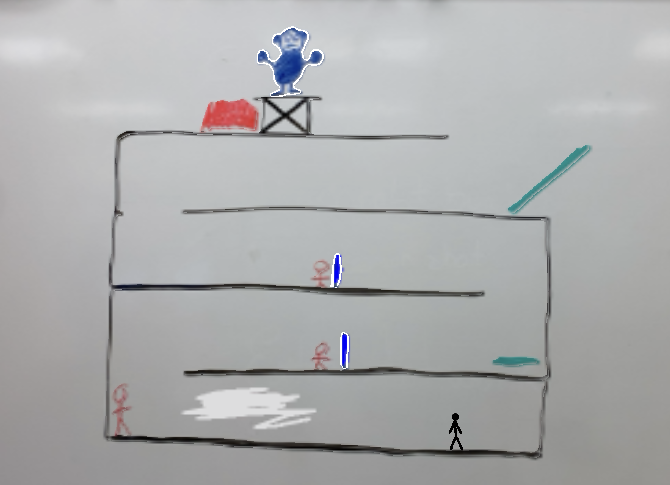
The next step was to design the actual game. Here we used a free mobile/tablet app called Draw Your Game. This particular tool was perfect since students were encouraged to design and develop the games using paper and markers. Prior to beginning this project I surveyed the students about access to non-school issued devices (since were hybrid and remote). 98% of the students reported they had access, the remaining were able to use an ipad in school during their in-school hybrid days, and if all else failed, games can be launched by anyone with the app so students were encouraged to share them with me to review. Here is my Donkey Kong Game created on my whiteboard:
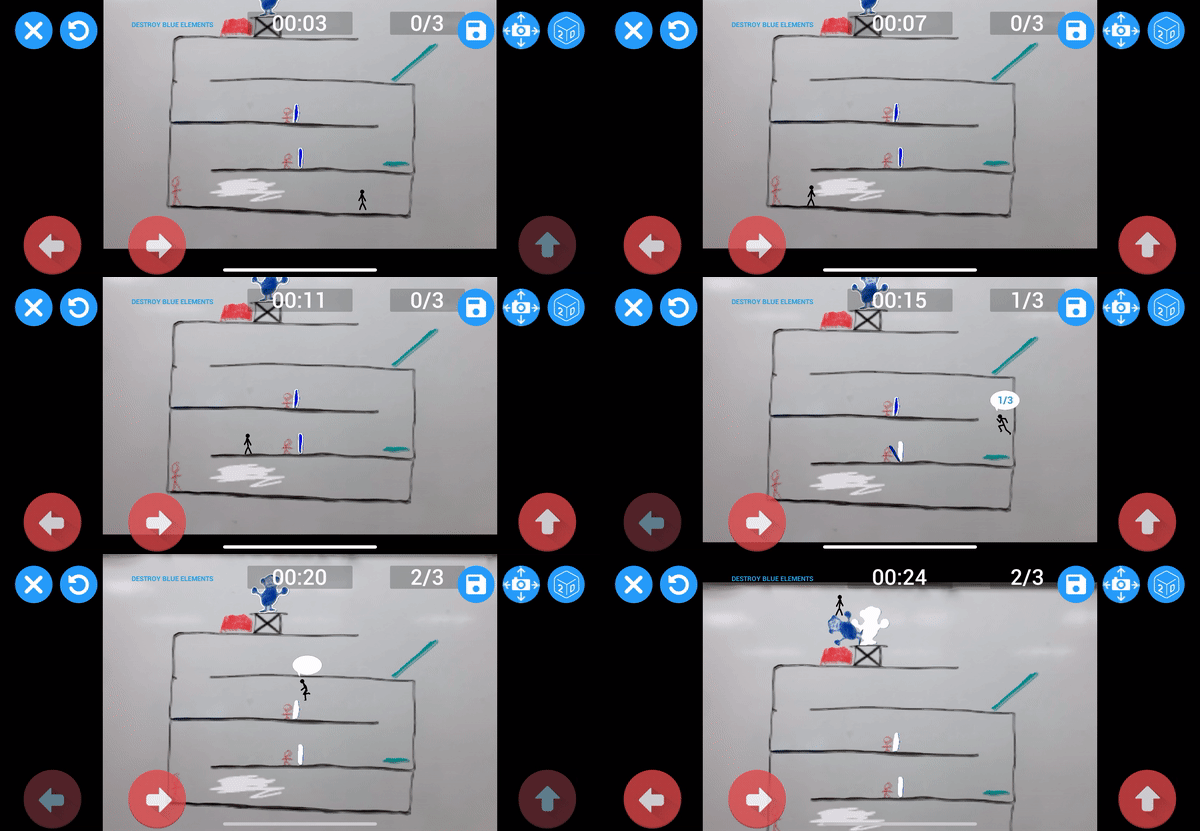
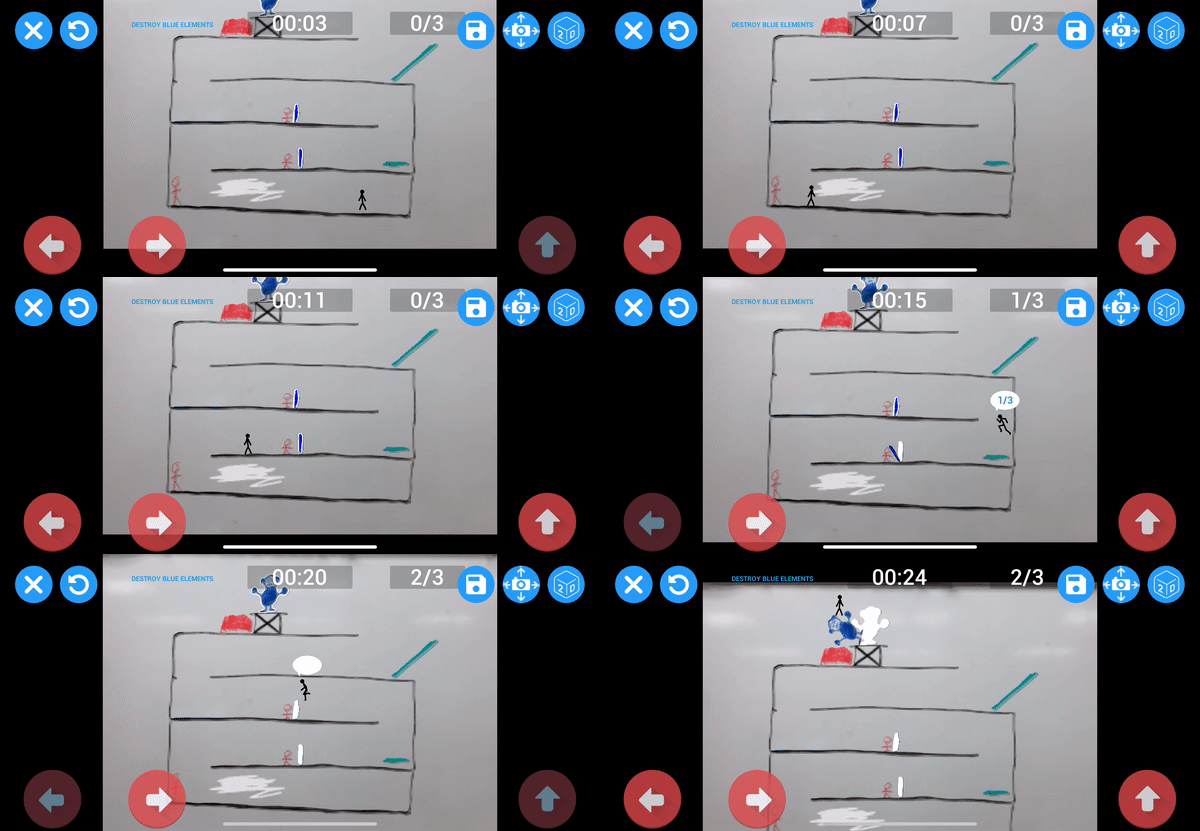
Obviously, I took some creative license here and I am no graphics designer. My art was the source of humor for the class, but it got the point across. Below is the actual game play. Keep reading for some detailed direction and pro tips for creating your own (lives will likely be changed).
I went through and played all of my students’ games and recorded my game play. This allowed the students to provide feedback to each other either by playing each other’s games or by watching me struggle through the various levels.
One of the good features Draw Your Game has is that if you want to share your game with other people, it must first be winnable. This is perfect for troubleshooting game experiences.
The next big teachable moment to discuss appropriate feedback and comments that can help others produce better work. In this case, we discussed the need to balance our analysis of game play with the character-plot relevance. One game, “Tess Sneaks and Attacks” earned feedback that was unique to the plot and character:
I liked the tank and area where you had to jump up blocks. I also liked that the plot was about a girl instead of a guy and that it gave backstory, it was different and interesting.
I like the bravery and courage that Tess has!
I liked the challenge to it along with that there was more of a story about Tess and the objective.
The feedback demonstrated value in not only the plot and gameplay connections, but that students felt a girl hero was underrepresented in games and that the game designer had successfully crafted a story around Tess.
Here is what my students had to say to each other regarding some of the other games:
It’s really fun, though it’s easy to get stuck on the platform section. It should be easier to get up. Like if it was built more like stairs.
I think she could improve on putting more detailed drawing into the game like maybe snow since she said there was a rough winter storm during her war.
I think that the game was created very well. I also think it had just enough challenging obstacles as well as easier ones. It was very fun to play. The only thing I think that could be changed it the amount of space you have in between jumps.
Amazing plot, good detail in the game, could have been a little more challenging, but overall great game!
I think your game is great! It looks fantastic and has a great connection to your story! I would say to just make it a little bit easier to complete.
Great game best I have played so far. I liked how his game matched the plot very well, honestly not much he needs to improve.
I really liked the game plot, I thought it was creative. The game was very straight forward and looked fun and easy to understand and play from the video.
I think the plot matched the game very well. I liked that the game was more than one page and the design was very clean. I liked the concept of rolling the dots onto the red areas too. The only thing to maybe improve was that in the video, it looked a bit hard to roll the dots, so maybe there could have had more space behind the dots to be able to roll them better.
To be honest nothing. Make it longer, make more things colored in blue, AND you said that it was the longest battle but the game was the shortest game that I saw so far.
I think your game is awesome! I love how well you connected your story to your game! I think the trees being the main obstacle in the game is super creative and fun! I don’t really have many things you can improve on, I think you did a great job!
I love your game! I think the plot and game connect very well! I also think your game was super creative with adding the Eiffel Tower as an obstacle and the car! I don’t really have any critiques, I think you did a fantastic job!
Very well made game my favorite so far. The game design was very good and related to the plot well. Not much to improve at all.
I think your game is really awesome! I love the connection between the story and the game, making the main goal to destroy the bombs! My one piece of advise is to add a more to tie the plot and game together a little further. In your game description, you talked about how the battle was in the woods, so maybe add some trees or something like that? Great job!
I loved her game so much! It was definitely my favorite! It was challenging, and it showed her game plot super well! My only tip would be to add more history in the game plot about WWI, but otherwise, it was amazing!
In summary, this was a good experience for my students in how we speak to each other online (comments and feedback) and more importantly I hope it empowered them to be more analytical about the games they play each day in a manner that will promote social good. Here are a few Draw Your Game Pro Tip Videos to help you get going:
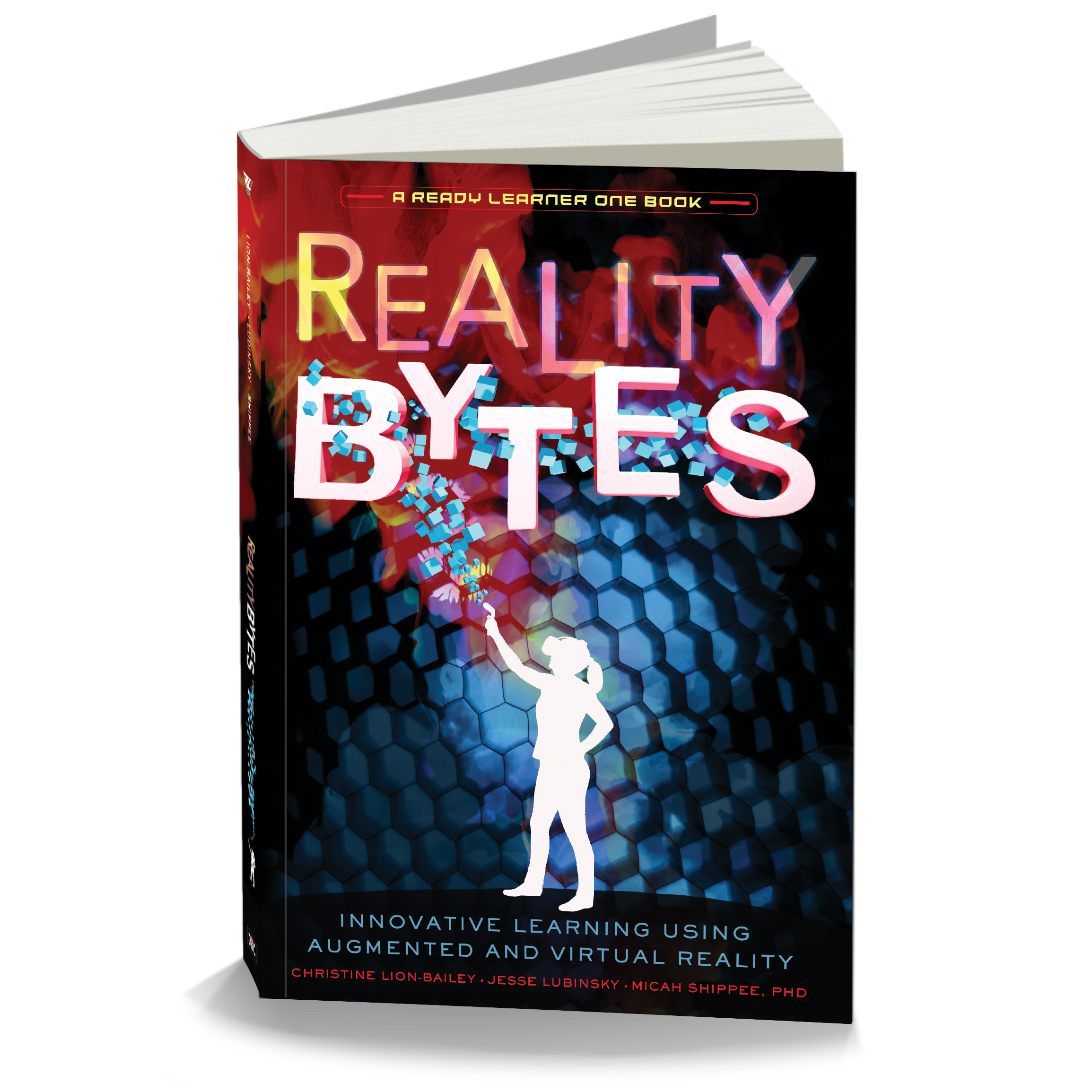
Transform teaching and learning with AR and VR in your classroom.
We’re at the dawn of an incredible transformation in education. Augmented reality and virtual reality–technologies that were once the province of science fiction and fantasy–are faster, better, and more affordable than ever. These tools have the potential to not only inspire students but to redefine how we teach and collaborate. But widespread adoption of AR and VR in K-12 classrooms requires taking risks, investing money and time, and training educators.
Reality Bytes makes the case for taking this leap by showing how educators are using these amazing technologies, and it provides a powerful framework to help anyone, in any school, join them. The innovative educators profiled are already designing learning experiences using AR and VR that supercharge student motivation, encourage creativity, and make otherwise impossible educational adventures accessible to all. You can do the same, using easy-to-implement resources that will revolutionize how you approach instruction. Equip your students with the skills they’ll need in the future–today.