Blog

  • Access to Agency #edchat #wanderlustedu #FOW

    What do problem solvers, go-getters, and DIYers have in common? AGENCY

    Teaching with emergent technology is NOT about Teaching with emergent technology. When we figure things and/or get things done, we tend not to feel as though they simply happen to us, instead we feel as though we are in charge. The sense of agency refers to this feeling of being in the driving seat when it comes to our actions (1). In an age where we see the best moments of people’s lives through social media, we must be more transparent with our learners about the real-ness of life and the sticktoittiveness necessary to get things done. We need to provide access to our agency.

    The Power of ACCESS

    We all know that access to a home library can have a powerful effect on children. My mother would frequently take us to the library to pick out whatever books we wanted. A parenting strategy she learned from her mother. These books provides me with access to dynamic places and opened doors for imagination, creativity, and critical thinking.

    A new study finds that simply growing up in a home with enough books increases adult literacy and math prowess.

    • A child growing up in a home with at least 80 books will have greater literacy and numeracy in adulthood.
    • A home library can promote reading and math skills more than college alone can.
    • Growing up in a pro-learning home leads to a lifetime of knowledge-seeking. (2)

    Access to books amplifies our capacity to learn.

    But access does not stop there in education, access to emergent technology is very important. Our approach to emergent technologies in learning is very important. We don’t talk about integrating reading into our teaching, we have adopted reading as a meaningful part of teaching. It’s part of our teaching practice. The word “integration” connotes coercion without choice, whereas, the word “adoption” conveys agency and choice. We need to be cognizant of adopting emergent technology rather than simply integrating it. This conscious choice directly relates to the type and quality of access we provide our students to these tools. 

    We know that closing the digital divide means providing access to emergent technologies, and the SKILLS to leverage them, for our students and their future.

    My dad always had computers around the house. I was never told I needed to learn coding or embrace this as the work tool of the future. I just had access. And that access has led to increased comfort around using computers on a daily basis.

    We understand the benefits of having access to the internet as well, it increases educational and career opportunities. However, we still need to work to provide access to more people in what we call the “digital divide.” While the digital divide continues, it has, by all indications, decreased in recent years. Measuring the number of people without access to computers and the Internet does not fully describe the digital divide. Many researchers are now shifting from focusing merely on access to focusing on digital literacy. (3)

    Access to emergent technologies amplifies our SKILLS.

    But access is not enough to bring about the paradigm shifts necessary to change education for the better. 

    Early research that compared traditional classroom-based instruction to technology-supported instruction and found no significant benefit from adding technology to instruction (4). This might seem counterintuitive to our arguments for the educational benefits of new technology, but a deeper dive into the research reveals important, productive insights: A particular technology used in classrooms is not as important as other instructional factors, such as pedagogy and course design…This is telling us what we already know, the importance of the teacher and that good teaching comes first. As teachers, our responsibility is to better understand emergent technologies as tools to improve learning and amplify good teaching practices.

    It is in the adoption, rather than integration, of emergent technologies that we will start to see a meaningful shift in practice. Simply integrating new technology will not change our practices. It’s adopting a positive approach to innovation, and providing our learners with meaningful access to it, that will lead to a paradigm shift to better meet the needs of students in the future. 

    AGENCY

    The benefits around access to books and closing the digital divide are clear. But there’s more for us to do. Teaching with emergent technology is NOT about teaching with emergent technology. We need to guide our students to a A SENSE OF AGENCY by providing them with access to our own agency in action.

    Agency is about having a desire, making plans, and carrying out actions. The sense of agency plays a pivotal role in cognitive development, and includes the ability to recognize oneself as the agent of a behavior and as an empowered independent. Agency is defined as the capacity of individuals to act independently and to make their own free choices. Agency is one’s independent capability or ability to act on one’s will. (5)

    Each of us exercises the power of agency when we look up how to do things. We use YouTube videos to figure out how to repair a refrigerator or dishwasher. This is us embracing our own sense of agency.

    Agency is the attitude that you can figure things out. Psychologist’s work in positive perceived self-efficacy sheds light on the concept of Agency by illustrating that we can LEARN to not be concerned with the number of skills that we have, but with WHAT WE BELIEVE WE CAN DO with what we have… under a variety of circumstances. (6)

    • People who doubt their capabilities
      • shy away from difficult tasks.
      • give up quickly.
      • have low aspirations.
      • dwell on deficiencies
      • focus on negative consequences of failure.
      • thus, they undermine their efforts by
        • diverting attention from effective thinking.
        • being slow to recover from setbacks.
        • falling easy victims to stress and depression.
    • People with strong belief in capabilities
      • approach difficult tasks as challenges to be mastered.
      • set challenging goals and maintain commitment to those goals.
      • have high effort.
      • thus they:
        • think strategically.
        • attribute failure to insufficient effort.
        • quickly recover after failure.
        • reduce stress.(6)

    Positive Perceived Self-Efficacy toward our abilities is Agency.

    Growing up, I would help my dad repair the family cars, everything from changing the breaks to swapping out engines. My role was to hand my dad the correct tools. We would sweat and toil together trudging through all kinds of grease and oil… yes, there are different kinds. I would not say that this taught me HOW to repair a car, but I learned that it could be done. I learned, through ACCESS to my Dad’s AGENCY, that I can use the skills I had to get things done I could read a repair manual, I could use a tool… I learned that I CAN DO IT.

    An increased sense of Agency will foster an ethic of self-sufficiency, promoting the idea that anyone is capable of performing a variety of tasks for themselves.

    ACCESS TO OUR AGENCY will amplify our students preparedness for THEIR Future of Work (#FOW)

    We do not know all of the jobs that will exist for our students even in the relatively near future. We should not train our students to replicate our tasks that may soon be irrelevant. In fact many of our more mundane task are soon to be automated. The automation of tasks takes a lot of control out of our hands, simple things like auto-correct for typing and complex things like self-driving cars are examples of control headed toward automation. Automation raises concerns over agency, if we adopt technologies that automate, we are choosing to give up some control.(7) This is a bit scarier than you may think, for example one area where automation is well-established is aircraft control, much of the pilot’s work is carried out be a computer. One research study into the different levels of automation and the effects on pilots found as automation increased, the sense of agency decreased (thankfully the research was done is flight simulators) (8). Studies like this remind us to be cognizant of our agency as it relates to future automation and to teach our future to be prepare. How?

    Teach Agency in our own efforts to adopt emergent technology. As professional educators, we want to deliver polished lessons where “nothing can go wrong,” in effect, we are trying to deliver a social-media, picture-perfect lesson. The design of these lessons often leads us to a state of analysis paralysis actually prohibiting us from trying new things. We must be transparent with our learners about the real-ness of life and the sticktoittiveness necessary to overcome obstacles and challenges in our ever day (even our teaching). We need to provide access to our agency.

    In an age where trying to master the latest and greatest is nearly impossible, our new norm is to innovate regularly. And this process must take place transparently in order to teach our students to prepare for a future that we can’t even fully conceptualize. Trying new technology, investigating the relevance of a new tool, and having reflective dialogue around the value of what we are doing, must all be transparent. Teaching with emergent technology is NOT about Teaching with emergent technology… it is about providing students with Access to Agency. So that through vicarious experience and hands-on effort they will learn Agency and amplify their preparedness for their future.

    Sources

    1. Moore JW. What Is the Sense of Agency and Why Does it Matter?. Front Psychol. 2016;7:1272. Published 2016 Aug 29. doi:10.3389/fpsyg.2016.01272. Web. 11 Dec. 2019. <https://www.ncbi.nlm.nih.gov/pmc/articles/PMC5002400/>

    2. Berman, R. Big Think. “A home library can have a powerful effect on children.” Big Think. 13 Oct. 2018. Web. 11 Dec. 2019. <https://bigthink.com/mind-brain/mind-brain-home-library-benefits>

    3. Wharton Public Policy Initative. “Bridging the Digital Divide.” Wharton Public Policy Initative. n.d. Web. 11 Dec. 2019. <https://publicpolicy.wharton.upenn.edu/live/news/2420-bridging-the-digital-divide/for-students/blog/news>

    4. Johnson, S. D. and Aragon, S. R. “An Instructional Strategy Framework for Online Learning Environments,” New Directions for Adult and Continuing Education 2003, no. 100, 31–43, https://doi.org/10.1002/ace.117. Wiley Online Library. 20 Nov. 2003. Web. 11 Dec. 2019. <https://onlinelibrary.wiley.com/doi/10.1002/ace.117>

    5. Wikipedia Contributors. “Agency (sociology).” Wikipedia, the Free Encyclopedia. Wikimedia Foundation, 8 Dec. 2019. Web. 11 Dec. 2019. <https://en.wikipedia.org/wiki/Agency_(sociology)>

    6. Banduar, A. “Self-Efficacy: The Exercise of Control – Chapter 2.” Uky.edu. 15 Feb. 2013. Web. 11 Dec. 2019. <https://www.uky.edu/~eushe2/Pajares/effbook2.html> Reviewed by Valiante, G.

    7. Moore J. W. (2016). What Is the Sense of Agency and Why Does it Matter?. Frontiers in psychology, 7, 1272. doi:10.3389/fpsyg.2016.01272. Web. 11 Dec. 2019. <https://www.ncbi.nlm.nih.gov/pmc/articles/PMC5002400/>

    8. Berberian B, Sarrazin JC, Le Blaye P, Haggard P.”Automation technology and sense of control: a window on human agency. – PubMed – NCBI.” PLoS One. 2012;7(3):e34075. doi: 10.1371/journal.pone.0034075. Epub 2012 Mar 30. Web. 11 Dec. 2019. <https://www.ncbi.nlm.nih.gov/pubmed/22479528>

  • How to organize class project groups to support our students’ future of work #WanderlustEDU #FOW

    Introduction

    Innovation goes beyond a simple new tool, innovation infers application, capability, and methods of accomplishing a task… a better workflow. The Future Of Work will demand people are prepared to solve complex problems, interact with clients/colleagues, and be able to adapt to new tools and workflows. Over the next twenty years, we are likely to see a significant disruptions to the workforce and work as we know it in recent memory.1 54% of the US workforce says they are not confident their job would still exist in 20 years2… a scary self-reflection that must inform our instructional practice. Where is all of this change coming from? 

    The demographic and socioeconomic trends of the past decade, like rapid urbanization and globalization, coupled with even faster advances in technology from mobile internet to increased automation and machine learning have caused a disruption like never before.1 Are we preparing our students to be ready for this shift in the workplace?

    A trend toward a gig economy has begun. A study by Intuit predicted that by 2020, 40 percent of American workers would be independent contractors.3 A gig based economy is defined as a way of working that is based on people having temporary jobs or doing separate pieces of work, each paid separately, rather than working for an employer.4 Contractors developing their own brand in a feast-or-famine work atmosphere must understand collaboration, resilience, perseverance… good ol fashioned sticktoittiveness!

    Asynchronous working teams

    In a gig-based economy our students will find themselves working on asynchronous teams in different geographies, different times, and with different cultures. How then can we prepare them for this workflow? Traditional, synchronous, “group work” has us creatively organize students in, what we believe will be effective working teams. I have been delegating these types of groups for twenty years as well as allowing students to pick their own teams (groups). I have also helped organize my students into teams and assign specific tasks to each person in the team. This makes a student the team “expert” in a given area on the project. But I ask myself: How often is this type of teams work going to happen for my students in their future? The keypoint being their future rather than organizing them according to my past. 

    Asynchronous working teams are more likely what our students will be working in more often, in their future. Recently, I arranged my five social studies classes into asynchronous teams. We were working on a community-based project to document our local cemetery. The Liverpool Cemetery project has always been a favorite of mine, since the history found just a half-mile from my school relates directly to the content I teach. Each year we iterate on the following years work and ask my students to improve and grow our documentation of this local treasure by assigning groups of students specific gravesites to investigate and provide a relevant historical narrative for the people buried so close to our school.

    This year I took the 30 or so sites and assigned them in everyone of my five classes. A student in my first class might be investigating site #4 and #5 and a student in my other four classes would also be assigned those sites. 

    Each class was given a specific job that they needed to complete as the expert. In each class I would provide the necessary support for how to use various tools to complete the jobs. The common tasks for each class were: 

    • to identify sources by keeping a research notebook 
    • to use a shared Google Drive on our school iPads to take pictures of the sites.
    • Share a Google Slide deck of all the work being completed to track progress and communicate needs

    The project included a walk to the cemetery with each of the classes during one of our 80 minute blocks.

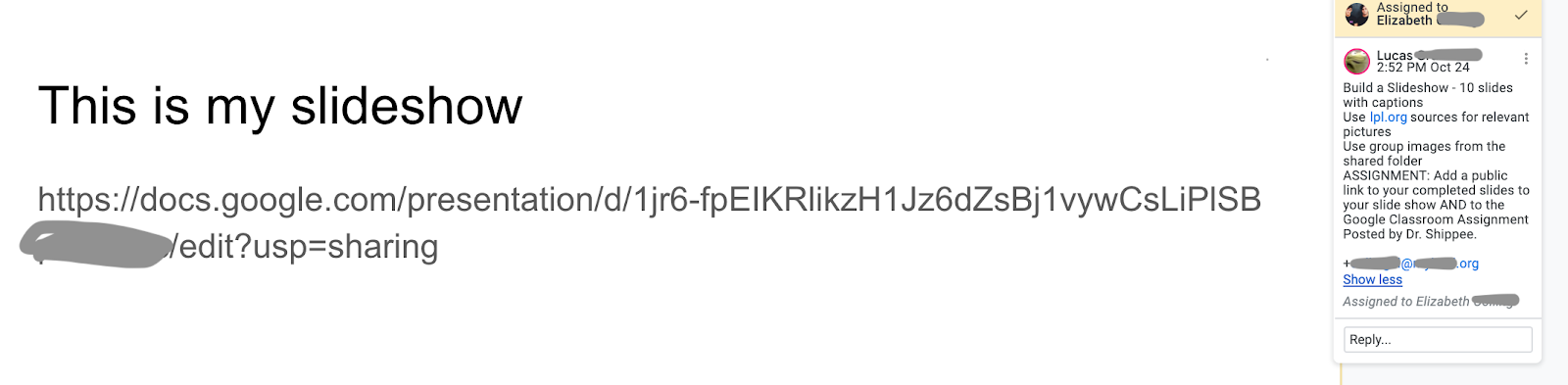
    In class, students were organized and given direction by their project managers (in a different class). The project managers, and I, would review the work completed on the Google Slide deck and use the comment feature to assign work that needed to be completed. 

    Class PeriodStudents studying site(s) #4 and #5Job
    1……Timeline: 10 events that occurred during the person(s) life.
    3……Biographical sketch: A narrative of what life was like for the person(s) in our community.
    4……Slideshow: What the person(s) would have seen while they were alive 
    7……Movie: Create a 45 second Adobe Spark Video about your person.
    9……Project Manager: Assign tasks and details to keep the other students working efficiently

    The project managers were coached on specific kinds of productive feedback (see “Assigned to” boxes below:

    The completed task components were compiled on a website we built. My plan is to continue to iterate on this website with my future classes.

    It was interesting to hear from the students following this new group dynamic. Here’s what they had to say: “The biggest thing I learned about this type of group work is….”

    • “you have to rely on all your classmates. If your classmates didn’t do the work properly it affects you because you don’t know the answer. And you have to be in communcation with all your team members so you understand fully what each teammate expects from each other.”
    • “you rely on your parterns a lot and when they don’t do their job like you did yours it’s disappointing and throws the whole project off.”
    • “how people can indirectly help you on certain things, creating this chain of other peoples work helping someone else’s work to create something special.”

    A heavy focus of student responses was on the value of communication and transparency. Students wanted to hear from each other and be able to see each other’s progress… more than actually seeing each other. Dissenting opinions were expressed as well: “I did not like not seeing my partners.”

    Perhaps most insightful was a more descriptive student response:

    “The biggest thing I learned is it can be AGONIZINGLY PAINFUL when only one person does their work. All I got from everyone but Sam was nothing. I got a timeline after it was due and wasn’t able to put it on the website. Julie was sick, so I can cut her some slack. However I never got wind of any slideshow(s). I can understand why teachers get so angry when we don’t do work. It is so frustrating and makes me want to scream! Sam was the exception turning in all his work to me and doing a great job at that.”

    Ah, middle school… refreshing honesty through empathetic experience!

    Conclusion

    Clearly a technology-driven shift education is upon us and will greatly impact the future of work for our students. This shift demands a different approach to the knowledge and skills we have relied on in the past. Our need to adopt emergent technology, and meaningfully pedagogy to leverage it, has never been this high. 

    Our shifts must transcend simply integrating new technology in our instruction. We must have adopt innovativeness (a mindset that embraces change) in order to prepare our students for a future with a gig-based economy and it’s demands for new productive workflows. Helping our students understand the importance of embracing a constant state of change will help them ride out the dark valleys knowing successful mountaintops are coming. 

    More on this topic can be found in my book WanderlustEDU – Chapter 8: OnwardEDU “The Future of Work and the Gig-based Economy”

    Sources

    1. Tunkel, A. “Three Trends On The Future Of Work.” Forbes. 13 Aug. 2018. https://www.forbes.com/sites/forbesbusinessdevelopmentcouncil/2018/08/13/three-trends-on-the-future-of-work/. Accessed 8 Dec. 2018.

    2.  Inc., Wonolo. “Data on the Gig Economy and How it is Transforming the Workforce.” Wonolo. 15 Feb. 2018. https://www.wonolo.com/blog/data-gig-economy-transforming-workforce/. Accessed 8 Dec. 2018.

    3. Rouse, M. “What is gig economy? – Definition from WhatIs.com.” WhatIs.com. https://whatis.techtarget.com/definition/gig-economy. Accessed 8 Dec. 2018.

    4 “GIG ECONOMY | definition in the Cambridge English Dictionary.” Dictionary.cambridge.org. https://dictionary.cambridge.org/us/dictionary/english/gig-economy. Accessed 10 Jan. 2019.

  • Cultural Curators: Shaping Positive School Culture #wanderlustEDU

    I have always found the work of history museum curators to be fascinating. They are tasked, in many cases, with selecting artifacts of our ancestors and displaying them in a way that allows people to make connections with the past. Do they always get it right? Do they always represent a culture with 100% accuracy? – Of course not. But there are take-aways, for us in education as we explore the concept of culture change.

    Just a quick reminder from a previous post: Culture is defined as the beliefs, social forms, and material traits of a social group. These attributes are agreed upon and shared by that social group. There are five key tenets of culture:

    1. Culture is learned
    2. Culture is shared
    3. Culture is based on symbols
    4. Culture is integrated
    5. Culture is dynamic

    To curate is to collect, select and present information, artifacts and/or experiences. School culture is curated by defining who we are from our collective shared experience. Shaping a positive cultural norm takes purposeful, diligent effort in collecting, selecting, and presenting experiences in our schools. 

    Culture curation requires we are cognizant of the context in which we are working. Are we trying to shape our classroom culture with students? Or are we trying to shape our school building culture? Or is it an entire school district/board that we are looking to shape?

    A little more direction on this might be helpful… here is the N-S-E-W Positive Culture Shift practices:

    • Nothing to Lose – you have to start somewhere, why not now? Showing a little bit of vulnerability now and then can go a long way. We often want to help everyone else with their stumbling blocks, but getting that help ourselves is less natural. We need to demonstrate that we, too, are learners and receive help from anyone as it comes. 
    • Share – promote positivity in the way you speak. With colleagues, one conversation we can talk about is: why we became teachers to begin with! With students, share how your background may be related to theirs.
    • Empower – give a voice to others. For many teachers speaking is easy, listening is equally as important. Train yourself to listen as much as you speak… easier said then done for some.
    • Walk in Their Shoes – make an effort to better understand their experience more intimately. Some people are more empathetic than others, but with some effort, we can all have a better sense of empathy. Begin to refer back to the experiences of students and colleagues in your conversations with them. 

    Shaping positive school culture is possible through cultural curation. Move forward, speak positively, give voice, and work to understand each other… it is from here that we can begin to grow together.

    Looking to change your school culture? Check out WanderlustEDU: An Educator’s Guide to Innovation, Change, and Adventure.

  • Lucky Iron Fish and Dynamic Equilibrium

    Culture is defined as the beliefs, social forms, and material traits of a social group. These attributes are agreed upon and shared by that social group. There are five key tenets of culture:

    1. Culture is learned
    2. Culture is shared
    3. Culture is based on symbols
    4. Culture is integrated
    5. Culture is dynamic

    Understanding culture is paramount in leading positive change. Take for example the story of the Lucky Iron Fish:

    In 2008, a Masters student travelled to Cambodia for a research project. While there, he was shocked at the high rates of iron deficiency anemia and anemia in the region. He decided to dedicate his future research to developing a safe, and affordable solution.

    The student was Christopher Charles, now Dr. Charles. He was inspired by previous research which showed that cooking in a cast iron pot increased the iron content in food. He developed an iron ingot that could be boiled in soups or drinking water. But not everyone was ready to throw a block of iron into their drinking water. It was clear that Dr. Charles had to better understand the culture in which he was working.  

    After doing more research on the culture, he realized what he needed to do in order to persuade people to use the ingot, Dr. Charles cast the ingot into the shape of a fish that was considered to be lucky in Cambodian folklore. As explained in his thesis “the concept of a lucky iron fish design did not pander to superstition”, but created a cultural relevance for a solution based on science. To make the fish more attractive to the users, he gave the fish a smile. He called this prototype the ‘Happy Fish’. He went on to show that almost everyone used the fish and results from his research showed that regular use of the Happy Fish decreased anemia by 46%. In 2013, his thesis Happy Fish: A Novel Supplementation Technique to Prevent Iron Deficiency Anemia in Women in Rural Cambodia was published. (1,2)

    To promote a positive culture that is ready to change we must work to create a dynamic equilibrium with dialogue and shared understanding driving our decisions. Dynamic equilibrium is when a culture accepts change and is able to adapt. This occurs when the rate of change in culture is at a rate that is related to the culture’s ability to cope with it. The ability to cope is not fixed. We can change it for the positive or the negative. With purposeful intent and action, we can grow our togetherness, become more resilient to change, and be more capable of accepting change as a constant. In other words, we can promote a real culture of innovation and start a positive culture shift.

    If you liked the Lucky Iron Fish Story, you will LOVE the Ax Story found in Chapter 5 of WanderlustEDU: An Educator’s Guide to Innovation, Change, and Adventure.

    Sources:

    1. “A Randomized Control Trial Using a Fish-Shaped Iron Ingot for the Amelioration of Iron Deficiency Anemia in Rural Cambodian Women” https://www.longdom.org/open-access/a-randomized-control-trial-using-a-fishshaped-iron-ingot-for-the-amelioration-of-iron-deficiency-anemia-in-rural-cambodian-women-2329-9088-1000195.pdf Accessed 12 Sep. 2019.
    2. “Why an iron fish can make you stronger – BBC News.” 17 May. 2015, https://www.bbc.com/news/health-32749629. Accessed 6 Sep. 2019.

  • Finding Your PLN #WanderlustEDU #Teacher #Change

    If you are feeling lonely in your teacher journey… you are doing it wrong. Teaching is about sharing, collaborating, and growing. The concept of closing the door and focusing only on your own teaching in your own space is not what our profession is all about.

    As a second-year teacher, I remember the excitement that ran through me about leading my students to participate in a certain project-based learning activity. I bolted down the hall with great enthusiasm to share my excitement with a veteran teacher I greatly respected. Unfortunately, the teacher’s reaction was cold and even negative. He seemed offended I was trying a strategy he did not believe was worth the time it took. As I thought about it further, I realized this teacher would be the only one not using this new strategy, and perhaps he felt a loss of solidarity as I crossed over to “the dark side.” That encounter taught me a couple of things. First, I realized out-of-the-box thinking can be received in two ways: with fervor or hostility. Each response depends on the person we are sharing the new idea with. I realized the same goes for enthusiasm. While some colleagues find the enthusiasm to be infectious, others perceive it as a threat.

    The colleagues that we see face-to-face, I like to think of as our Professional Learning Community (PLC). Our PLC can be a powerful group to grow and change with, but change takes time. Sometimes we need to find a group more in alignment with who are in the moment, social media provides us with the venue to customize our very own Professional Learning Network (PLN). These are people you can connect with at any time about some very unique teaching strategies and concepts that are most meaningful to your growth in-the-moment.

    Who are the people in your PLN? Compose a post on you favorite social media site (Twitter, Facebook, Instagram, etc…) and tag your top 5 PLN members. Use #PLN and #wanderlustEDU to share with other readers. Here are a few of my favorite PLN members (there are MANY more).

    Understanding who you are in the change process is important. More about you PLC and PLN can be found here… better yet check out Chapter 4: Helping Others Along and Finding Your PLN in WanderlustEDU: An Educator’s Guide to Innovation, Change, and Adventure.

    Let’s Do This!

  • Who are you? #WanderlustEDU #edtech #teacher #change

    Sounds like the makings of a 70’s rock song… 

    Well, who are you? (who are you? who, who, who, who?)
    I really wanna know (who are you? who, who, who, who?)
    Tell me, who are you? (who are you? who, who, who, who?)
    ‘Cause I really wanna know (who are you? who, who, who, who?)

    …but I digress. 

    You can take a personality test, a learning style inventory, or even a which-character-are-you quiz, but I would argue the power of meaningful self-perception. Perhaps a better title for this post would be “Who do you think you are?” It is extremely important that we recognize our strengths and weaknesses in our professional practice, such recognition can lead to real, positive growth. While you may take up the role of champion as a general way of perceiving your fit within your school system, we may find ourselves identifying with one adopter category or another when discussing emergent technology. We call these categories: Innovators, Early Adopters, Early Majority, Late Majority, and Laggards. Adopter categories can be illustrated on a bell curve on the basis of innovativeness.

    If you were to identify yourself as an adopter of innovation, where do you think you would fit in?

    Image originally illustrated in Rogers, E. M. (2003). Diffusion of innovations. New York: Free Press. 

    Make a mental note about what you think your “adopter category” is.

    Now let’s try one of those tests. Think about your overall approach to innovation or change, compare all five words in each row and rank the words from 1 to 5.

    1 = not me at all
    2 = not very much like me
    3 = sometimes like me
    4 = often like me
    5 = most like me

    You may want to do this on a piece of paper and list out A – DD. Then tabulate your responses in the “TOTALS” row… and keep reading for the interpretation of your results.

    Now that you have gone through this check the results here.

    Understanding who you are in the change process is important. More about each of the categories and understanding people involved in change can be found here… better yet check out Chapter 3: Who Are You? in WanderlustEDU: An Educator’s Guide to Innovation, Change, and Adventure.

    Let’s Do This!

  • Navigating a successful teacher journey #WanderlustEDU #teacher @edtechteam

    Let’s be honest, there are times in our teaching careers when we feel anxiety, frustration, trapped, and/or apathetic. These are hardly the hallmarks of a successful, well-loved career. So then what can we do to navigate our teacher journey successfully? First, we need to understand what is going on… and lucky for us there is a field of study that can directly address our needs: human performance technology. I know sounds a bit nerdy or overly scientific-y (that’s a word, right?), but from this field, Dr. Joe Harless developed the Performance Success Model, that I have framed this way:

    Charting the impact of each of these areas is the first step in understanding more about how we work and what we need to be the best version of ourselves. There’s more on the topic developed here… better yet check out Chapter 2: Setting Up Your Journey For Success in WanderlustEDU: An Educator’s Guide to Innovation, Change, and Adventure.

    Let’s Do This!

  • Why did you become a teacher? #WanderlustEDU #teacher #Change

    Now is the perfect time to reflect on this very important question…

    Why did you become a teacher? Or why did you get involved in education?

    Perhaps it was a person that made a difference in your life. Or maybe you just really like working with children or young adults. Take a minute and just think about your WHY (it’s a really big deal).

    Equally important is to identify what it is that keeps you teaching day to day. 

    Once you feel good about your answer(s), SHARE them with the world! Go to Twitter and tweet your response using these two hashtags: #whyiteach #wanderlustEDU

    I will tweet nice things back to you… better yet, will you join me in commenting on what others have to say about this?

    Let’s Do This!

  • Education is changing because the world is changing. Are you ready for change? #WanderlustEDU #innovation #teacher #change #edtech @edtechteam

    WanderlustEDU: An Educator’s Guide to Innovation, Change, and Adventure is the perfect book to guide you in change.

    Our journey in education is one of constant iteration, managing change both personally and professionally is what we have to do because the world is changing. WanderlustEDU is a book about that change. In WanderlustEDU we learn to appreciate the journey we are on in education by revisiting our core purposes for doing what we do, and by learning about what lies ahead. Navigating change is difficult for anyone, but when it comes to navigating those changes on behalf of our students’ future there is a special onus to do it right. WanderlustEDU is a great read for anyone who works in this state of change as a teacher, a coach, or as an administrator. This book focuses on the most important aspect of change: the people… who together form a culture perfectly capable of innovating. No matter the scale, successfully innovating means understanding the effects of change on ourselves and those around us. Without a clear understanding of what change does to people, we can end up surrounding ourselves in an anxious, frustrated, trapped, and apathetic school culture. We must understand that to successfully innovate, it is always about the people who have to embrace a new situation and carry out the corresponding change.

    Let’s Do This!

  • Adopter Quiz Results: What Each Adopter Type Means

    Everett Rogers’ Diffusion of Innovation theory sorts people into five groups by how readily they take on something new: Innovators, Early Adopters, Early Majority, Late Majority, and Laggards. In WanderlustEDU, Dr. Micah Shippee frames that same journey through four attributes every educator carries — Motivation, Environment, Skills, and Knowledge — and argues that growth starts with recognizing which adopter pattern is already yours.

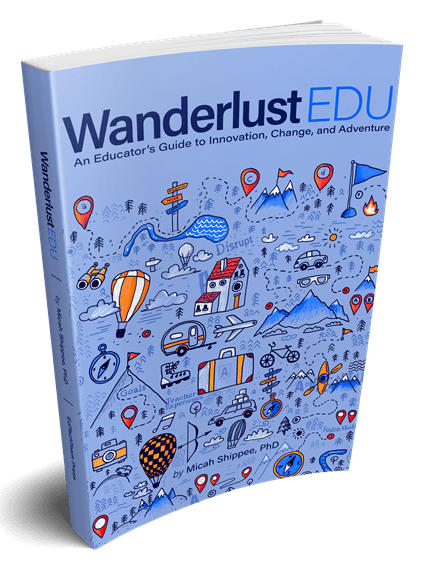
    WanderlustEDU book cover

    From the pages of WanderlustEDU

    The Five Adopter Types

    Haven’t taken the quiz yet? Find out which one describes you.

    Adopter Type 1 of 5

    Innovator

    Innovators are interested in new ideas from outside of the established local social system. They’re able to understand and apply complex technical knowledge, and they can cope with a high degree of uncertainty about an innovation at the time of adoption. Innovators are risk takers — they learn from failure rather than being stopped by it.

    WanderlustEDU growth edge: Environment. Build spaces, routines, and support structures sturdy enough to hold your experiments, so your boldest ideas survive contact with a real classroom.

    Adopter Type 2 of 5

    Early Adopter

    Early Adopters are invested and respected in the local school community. They’re cautious, and they want their efforts informed by research, if not best practices. Early Adopters aren’t known for risk taking, but they’ve earned a reputation for well-thought-out execution of emergent technology — change agents seek them out as a local, trusted voice for speeding the adoption of innovation.

    WanderlustEDU growth edge: Skills. Pair good judgment with structured strategies for piloting ideas, so influence turns into lasting change, not just early buzz.

    Adopter Type 3 of 5

    Early Majority

    The Early Majority adopt just before the average person, making them an important link in seeing the adoption process successfully take off. They want to employ best practices based on the experiences of Innovators and Early Adopters — they’ll make the necessary changes, but they don’t want to go first.

    WanderlustEDU growth edge: Knowledge. Deepen understanding of why an innovation works, not just that it works, so careful adoption becomes genuine expertise others can lean on.

    Adopter Type 4 of 5

    Late Majority

    The Late Majority adopts just after the Early Majority, sometimes due to economic pressure, peer pressure, or both. They need to see an innovation already succeeding before they adopt it. You might call the Late Majority our “team players,” since they’re willing to join the other adopters once they realize it’s for the greater good — they may not be especially excited about technology of any particular kind, but they make the change for the benefit of their school community.

    WanderlustEDU growth edge: Motivation. Find a reason to engage with change a little earlier, rather than waiting for peer pressure to make the decision.

    Adopter Type 5 of 5

    Laggard

    Laggards are near-isolates in the school community. Their point of reference is past practice and past perceived successes, and they need to be positively certain a new idea won’t fail before they can adopt it — they’re concerned about being blamed if the innovation fails to yield expected results.

    WanderlustEDU growth edge: All four pillars at once — Motivation, Environment, Skills, and Knowledge — working together to turn healthy skepticism into intentional, well-timed growth.

    No single adopter type is “the good one” — WanderlustEDU makes the case that schools need all five working together. The goal isn’t to become an Innovator if you’re not one; it’s to recognize your own pattern, and grow the attribute — Motivation, Environment, Skills, or Knowledge — that will carry you furthest from here.

Search the blog

Past posts

October 2026
M T W T F S S
 1234
567891011
12131415161718
19202122232425
262728293031