Tag: teaching

  • AI in Education: a focus on pedagogy

    Introduction

    AI is here to stay. The promise of streamlined workflows, a shorter workweek, and overall convenience in our daily lives has solidified AI’s place in our world. In education, we strive to backwards design curriculum and the codification of necessary skills from the future world our students will find themselves in. Preparing our students for their future is the critical focus of education and has always been our North Star.

    Assessment

    The growth of AI tools is both challenging the processes by which we engage our students and providing opportunities to effectively and efficiently scale well-established instructional practice (pedagogy). Instructional assessment processes, that is, how we measure knowledge and skill acquisition, have always been a central component of education. Traditionally, educators have worked to balance summative assessment and formative assessment.

    The goal of summative assessment is to evaluate student learning at the end of instruction, often leveraging pre-existing benchmarks. This is an end-product, rather than process focused, area of assessment. What does this matter for AI? One example that illustrates AI’s relevance is if the summative assessment in a class is a take-home essay, can an educator truly trust who, or what, is doing the work? When responses were copy/pasted off of a website educators learned how to flag the work but AI tools are increasingly unique responses that are challenging to identify for authenticity.

    The exciting contribution AI brings to assessment is in the formative assessment realm. Here the goal is to monitor ongoing student learning and to provide meaningful feedback. It is difficult for an individual educator to give this type of ongoing feedback consistently for large groups of students. AI can be a powerful tool to personalize learning for students with rapid, in-the-moment feedback to nurture their comprehension during their learning process.

    Instruction

    AI, like all technology, is an amplifier, in an educational setting, AI amplifies both good practice and strategies that need improvement. The Apprenticeship Model, at it’s core, is arguably the most natural, effective form of teaching and learning, and has remained amongst modern humankind’s greatest scalability challenges.  We have filled auditoriums with eager learners, designed self-paced courses, and explored countless feedback systems, all to replicate the painfully obvious: a human touch in learning is incredibly powerful but horribly unscalable. Here an expert works individually with a learner to model, guide, provide feedback, challenge, and validate the learners progress. 

    Although apprenticeship can differ widely from one context to another, they typically have some or all of the following features1:

    • MODELING – the educator carries out the task, simultaneously thinking aloud about the process, while the learner observes and listens.
    • COACHING – as the learner performs the task, the educator gives frequent suggestions, hints, and feedback.
    • SCAFFOLDING – the educator provides various forms of support for the learner, perhaps by simplifying the task, breaking it into smaller and more manageable components, or providing less complicated equipment.
    • ARTICULATION – the learner explains what they are doing and why, allowing the educator to examine the learner’s knowledge, reasoning, and problem-solving strategies. 
    • REFLECTION – the educator asks the learner to compare their performance with that of experts, or perhaps with an ideal model of how the task should be done.
    • INCREASING COMPLEXITY AND DIVERSITY OF TASKS – as the learner gains greater proficiency, the educator presents more complex, challenging, and varied tasks to complete. 
    • EXPLORATION – the educator encourages the learner to frame questions and problems on their own, and in doing so to expand and refine acquired skills.

    While this tried and true method of learning is effective in a 1:1 scenario, it has historically proven a challenge to scale to a larger student audience. AI has the potential to make the apprenticeship model a highly effective pedagogical practice. The ai-apprenticeship model finds the educator MODELING a task for their students (while explaining their thought process) then directing their students to a self-guided, AI-powered, series of tasks which are responsively-enabled to appropriately challenge the learner to achieve expertise (COACHING, SCAFFOLDING, ARTICULATION, REFLECTION, and INCREASING COMPLEXITY AND DIVERSITY OF TASKS). The educator has been enabled to work 1:1 with students requiring support beyond what the AI is offering. Finally, with developments in AI students now have a new set of tools that they can use to produce AI generative products, via question prompts, that represent their content-area expertise (EXPLORATION).The entire time an authentic discourse is imperative to humanize the process with front of classroom check-ins and student led summary dialogue.

    Further, we are hearing of innovative educators modeling AI applications through transparent examples with their students, identifying the pros and cons of the technology as it exists today. The modeling approach, where the educator speaks openly about how they use AI, and even explain their reservations, is a life-skill lesson on having grit, or agency, to persevere in overcoming a new challenge. By demonstrating a level of stick-to-it-tiveness that we all need in life, educators are using AI as a use case that has provided opportunities for their students to have clear access to the skill of agency in action.

    Safety and Security

    AI is not a replacement for teachers. Teachers are essential for providing students with the guidance and support that they need to succeed. AI can be a valuable tool for teachers, helping them scale good practice and effectively reach more students. But we need to proceed with care when deploying emergent technologies into schools, here we are appropriately hyper-sensitive on how these technologies will impact our students. Regarding AI, the pedagogy will get worked out, teachers are masters of change, that’s not to undermine the significance of the instructional shift, but it can be done. The challenge we need to resolve is centered on safety and security. Data privacy is a fundamental concern that has to be resolved and better understood. Learners need to ask questions, work through problems, and create less than perfect solutions, all of which are not meant for the public stage, their privacy matters and must be protected.

    Change is uncomfortable and sometimes scary but change whether forced (ex. COVID teaching), or by choice, has the potential to guide us to make the world a better place for our children.


    Also published: Shippee, Micah, AI in Education: a focus on pedagogy (November 30, 2023). SSRN: https://ssrn.com/abstract=4649752 or http://dx.doi.org/10.2139/ssrn.4649752


    Sources

    • Collins, A. (2006). Cognitive apprenticeship. In R.K. Sawyer (ed.), The Cambridge handbook of the learning sciences (pp. 47-60). Cambridge, England: Cambridge University Press.
    • Collins, A., Brown, J.S., & Newman, S.E. (1989). Cognitive apprenticeship: Teaching the crafts of reading, writing, and mathematics. In L.B. Resnick (Ed.), Knowing, learning, and instruction: Essays in honor of Robert Glaser (pp. 453-494). Hillsdale, NJ: Erlbaum
    • Ormrod, J. (2019). Human learning (8th ed.). Upper Saddle River, NJ: Pearson.

  • You CANNOT be replaced… a lesson I learned from trophic cascades. #WanderlustEDU #EdChat

    You CANNOT be replaced… a lesson I learned from trophic cascades. #WanderlustEDU #EdChat

    One of my first years teaching I was told that we could all be replaced… this was not a threat, nor was it directed at me personally, but offered as an insight into a perspective on the teaching profession. Young and full of energy, I fought this mentality believing it untrue and that I had to simply work harder to make a tangible difference. As I got older I began to resign myself to this fact: I was a replaceable cog in a machine. I could still be a good cog, maybe even a great cog, but alas… a cog. What I failed to realize was the complex level of interconnectedness each of us has. I recently had a lightbulb moment when learning about connectivity as it relates to a scientific phenomenon called a trophic cascade.

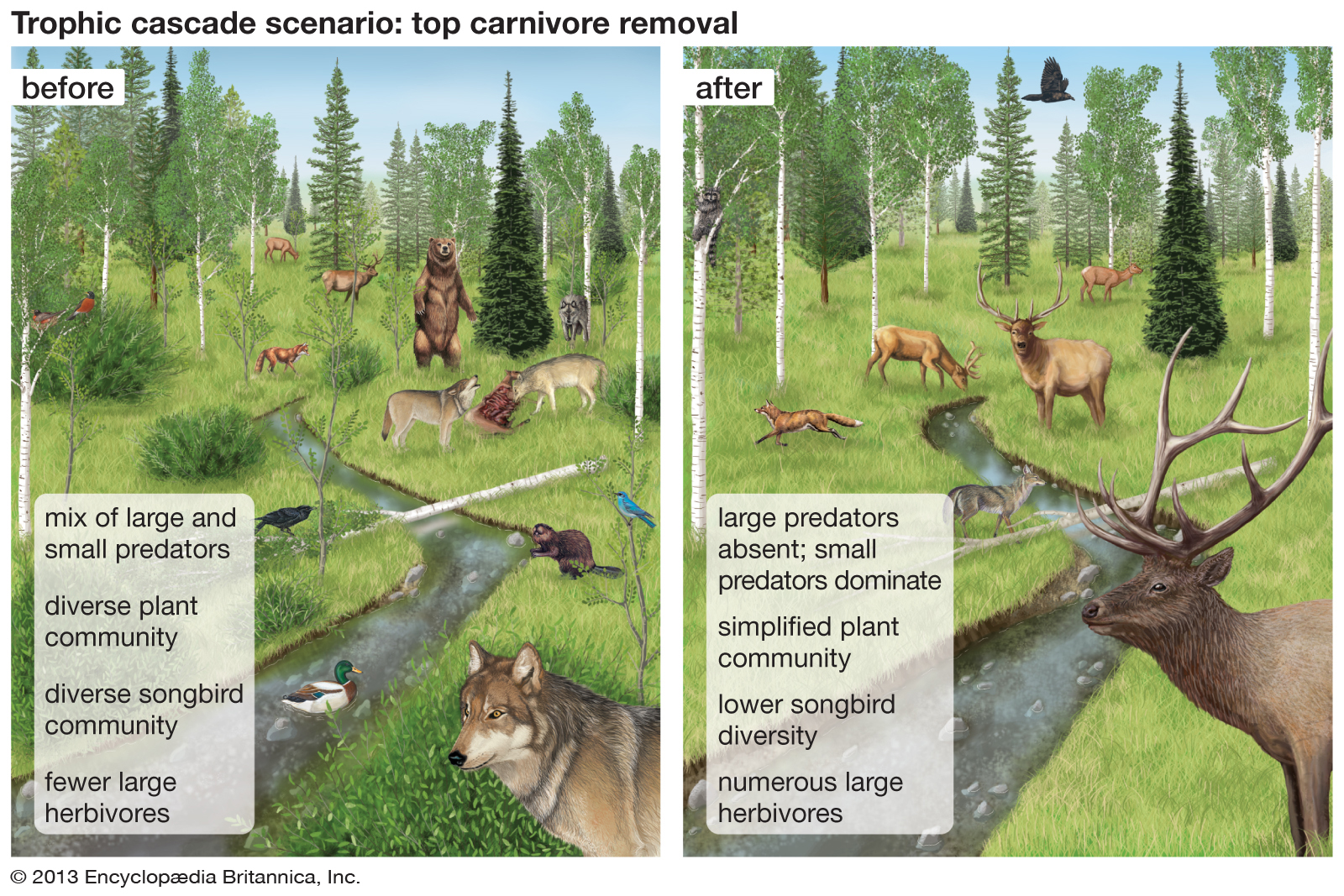
    American zoologist Robert Paine coined the term trophic cascade in 1980 to describe reciprocal changes in food webs caused by experimental manipulations of top predators. A trophic cascade is an ecological phenomenon triggered by the addition or removal of top predators. This removal often results in dramatic changes in ecosystem structure and nutrient cycling. In a food chain, an increase/decrease in carnivores causes a decrease/increase in herbivores and an increase/decrease in primary producers such as plants and phytoplankton.

    Look closely at all that is missing when the top carnivore is removed (after) (1)

    For example, in North America the removal of wolves has been associated with an increase in white-tailed deer. Leading to a decline in plants eaten by the deer. In Yellowstone National Park, the loss of trees has been linked with the removal of grey wolves. From the 1880s-1920s wolves were the target of extermination from Yellowstone National Park. The decrease of wolves led to an increase in eating tree saplings by herds of deer and elk. A ripple effect occurred in Yellowstone leading to a decrease in trees, loosening the soil on river banks, meaning less trees for beavers to dam the rivers, meaning less pools where fish had lived… an exemplar trophic cascade. But all hope is not lost. Over the past decade, grey wolves have been re-introduced to Yellowstone National Park. The grazing patterns of elk have been re-altered allowing more saplings to grow, allowing for more trees to grow and thrive in Yellowstone.(2) (3)

    Some would like to ruin my overly-romanticized view of the ecosystem’s symbiosis and how the re-introduction of wolves positively impacted Yellowstone, but we cannot deny that there is a real level of interconnectivity going on. While I do not propose each of us is a predator in the educational system, I will say we are having a real impact on those around us.  Sometimes the impact is intangible and unseen, perhaps even seeming unmeasurable, but eventually these connections manifest themselves in many ways: the social media poke we get from a student we had in class decades ago or a direct message asking for help and/or reminding us of our shared experience (Sept. 11 reminders always strikes a powerful cord with me). All of which stem from a level of connection we cannot see in the moment, a level of meaningful connection which says YOU CANNOT BE REPLACED.

    Perhaps you have gotten into a slump resigning yourself to a cog-like mentality (I have been there too). You may not feel relevant, appreciated, or that you are making a difference. Now the time to re-introduce yourself to your WHY. You matter, your work matters!

    Also, please know, you are NOT ALONE! Wolves live and hunt in packs, these social animals cooperate and are known to roam large distances (4). Our PLN’s too are the embodiment of social cooperation that extends to the entire world! Reach out, share, collaborate… 

    Let’s Do This!

    WanderlustEDU: An Educator’s Guide to Innovation Change, and Adventure.

    Sources

    1. trophic cascade | Definition, Importance, & Examples | Britannica. (2021). In Encyclopædia Britannica. https://www.britannica.com/science/trophic-cascade
    2. ‌Silliman, B. R. & Angelini, C. (2012) Trophic Cascades Across Diverse Plant Ecosystems. Nature Education Knowledge 3(10):44 https://www.nature.com/scitable/knowledge/library/trophic-cascades-across-diverse-plant-ecosystems-80060347/
    3. Wolf Restoration – Yellowstone National Park (U.S. National Park Service). (2011). Nps.gov. https://www.nps.gov/yell/learn/nature/wolf-restoration.htm#:~:text=Much%20of%20the%20wolves’%20prey,late%201800s%20and%20early%201900s.
    4. Wolves 101. (2019). Animals. https://www.nationalgeographic.com/animals/mammals/facts/gray-wolf#:~:text=Wolves%20live%20and%20hunt%20in,do%20not%20eat%20in%20moderation.
  • Who are you? #WanderlustEDU #edtech #teacher #change

    Sounds like the makings of a 70’s rock song… 

    Well, who are you? (who are you? who, who, who, who?)
    I really wanna know (who are you? who, who, who, who?)
    Tell me, who are you? (who are you? who, who, who, who?)
    ‘Cause I really wanna know (who are you? who, who, who, who?)

    …but I digress. 

    You can take a personality test, a learning style inventory, or even a which-character-are-you quiz, but I would argue the power of meaningful self-perception. Perhaps a better title for this post would be “Who do you think you are?” It is extremely important that we recognize our strengths and weaknesses in our professional practice, such recognition can lead to real, positive growth. While you may take up the role of champion as a general way of perceiving your fit within your school system, we may find ourselves identifying with one adopter category or another when discussing emergent technology. We call these categories: Innovators, Early Adopters, Early Majority, Late Majority, and Laggards. Adopter categories can be illustrated on a bell curve on the basis of innovativeness.

    If you were to identify yourself as an adopter of innovation, where do you think you would fit in?

    Image originally illustrated in Rogers, E. M. (2003). Diffusion of innovations. New York: Free Press. 

    Make a mental note about what you think your “adopter category” is.

    Now let’s try one of those tests. Think about your overall approach to innovation or change, compare all five words in each row and rank the words from 1 to 5.

    1 = not me at all
    2 = not very much like me
    3 = sometimes like me
    4 = often like me
    5 = most like me

    You may want to do this on a piece of paper and list out A – DD. Then tabulate your responses in the “TOTALS” row… and keep reading for the interpretation of your results.

    Now that you have gone through this check the results here.

    Understanding who you are in the change process is important. More about each of the categories and understanding people involved in change can be found here… better yet check out Chapter 3: Who Are You? in WanderlustEDU: An Educator’s Guide to Innovation, Change, and Adventure.

    Let’s Do This!

  • Navigating a successful teacher journey #WanderlustEDU #teacher @edtechteam

    Let’s be honest, there are times in our teaching careers when we feel anxiety, frustration, trapped, and/or apathetic. These are hardly the hallmarks of a successful, well-loved career. So then what can we do to navigate our teacher journey successfully? First, we need to understand what is going on… and lucky for us there is a field of study that can directly address our needs: human performance technology. I know sounds a bit nerdy or overly scientific-y (that’s a word, right?), but from this field, Dr. Joe Harless developed the Performance Success Model, that I have framed this way:

    Charting the impact of each of these areas is the first step in understanding more about how we work and what we need to be the best version of ourselves. There’s more on the topic developed here… better yet check out Chapter 2: Setting Up Your Journey For Success in WanderlustEDU: An Educator’s Guide to Innovation, Change, and Adventure.

    Let’s Do This!

  • Why did you become a teacher? #WanderlustEDU #teacher #Change

    Now is the perfect time to reflect on this very important question…

    Why did you become a teacher? Or why did you get involved in education?

    Perhaps it was a person that made a difference in your life. Or maybe you just really like working with children or young adults. Take a minute and just think about your WHY (it’s a really big deal).

    Equally important is to identify what it is that keeps you teaching day to day. 

    Once you feel good about your answer(s), SHARE them with the world! Go to Twitter and tweet your response using these two hashtags: #whyiteach #wanderlustEDU

    I will tweet nice things back to you… better yet, will you join me in commenting on what others have to say about this?

    Let’s Do This!

  • Education is changing because the world is changing. Are you ready for change? #WanderlustEDU #innovation #teacher #change #edtech @edtechteam

    WanderlustEDU: An Educator’s Guide to Innovation, Change, and Adventure is the perfect book to guide you in change.

    Our journey in education is one of constant iteration, managing change both personally and professionally is what we have to do because the world is changing. WanderlustEDU is a book about that change. In WanderlustEDU we learn to appreciate the journey we are on in education by revisiting our core purposes for doing what we do, and by learning about what lies ahead. Navigating change is difficult for anyone, but when it comes to navigating those changes on behalf of our students’ future there is a special onus to do it right. WanderlustEDU is a great read for anyone who works in this state of change as a teacher, a coach, or as an administrator. This book focuses on the most important aspect of change: the people… who together form a culture perfectly capable of innovating. No matter the scale, successfully innovating means understanding the effects of change on ourselves and those around us. Without a clear understanding of what change does to people, we can end up surrounding ourselves in an anxious, frustrated, trapped, and apathetic school culture. We must understand that to successfully innovate, it is always about the people who have to embrace a new situation and carry out the corresponding change.

    Let’s Do This!

  • Storytelling with Text Messaging

    Storytelling with Text Messaging

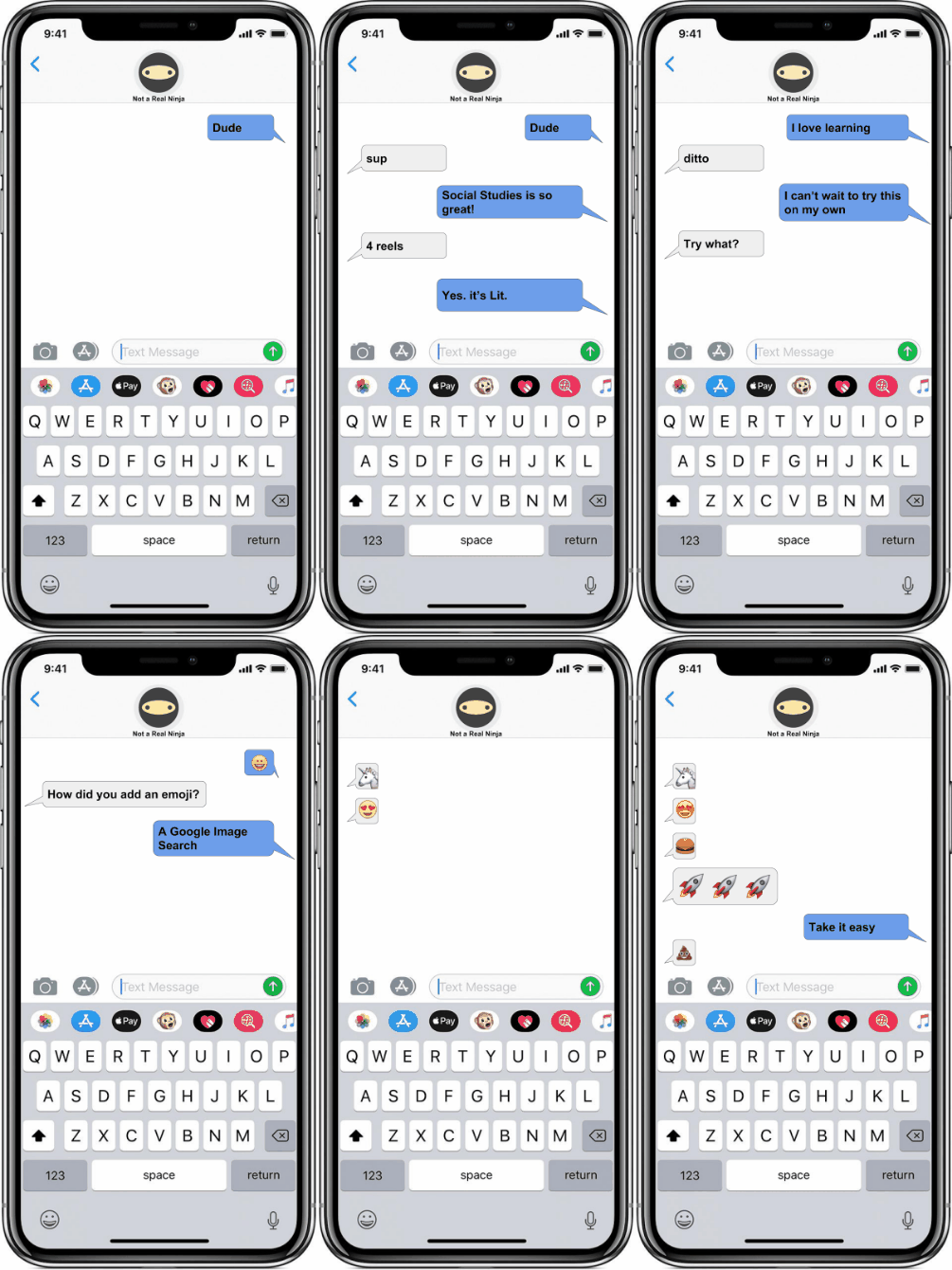
    Teaching students to recognize both sides of an argument, and/or have structured conversations centered around class content, regularly finds its place in our classrooms. We teach argumentative essay writing, debate protocols, conversational cues (in all languages), etc… These lessons can be completed through traditional classroom strategies, through podcasting…. and perhaps through texting.

    There are a number of websites that let you create a fake text message but I have found many are loaded with questionable (and clickable) advertisements or are just plain blocked in school. To circumvent these roadblocks, I have created a Google Slides deck using an iPhone X frame for inserting text messages in.

    The process is relatively easy, you just copy and paste the appropriate shape to keep the conversation going. One of my students called me out on the fact that there is a green iMessage arrow but I made my conversation bubbles blue… thanks Brady, I fixed it for class!.

    Students can check their work by previewing the slideshow and clicking the next arrow. One bubble at a time should appear on each slide if they have done it correctly.

    Once completed, students can make the slideshow run itself with the following steps in Google Slides:

    1. Click “File”
    2. Select “Publish to the web”
    3. select “auto play” with 2 second transitions
    4. A link will be created that can be shared.

    For a bit more of an extension to this activity you can upload the slides to Tall Tweets to create an animated GIF like the one I used.

    Our students are texting and communicating via social media on mobile devices quite regularly, perhaps activities like this will provide us with teachable moments in the classroom.

    Have fun!

    Micah

  • Augmented Reality – The Art of BYOD in the Classroom

    There are times in a school year when we are able to try things out with students with less risk (meaning failure is ok). For me, one of those times is often found at the end of the school year and final exams are finished for the content goals and objectives are complete, it’s at these times I like to try out something new.

    Recently, I asked my students to bring whatever devices they had access to from their homes to school if their parents would allow it. Being 7th graders I wasn’t too sure how many of the students would be allowed but nearly 70% came back to school with the devices. So we set out to employ BYOD (bring your own devices) with augmented reality.

    I started by asking the students to download several apps including Merge Cubes’ Galactic Explorer and Google Expeditions. I realized employing students own devices in an activity of this nature would bring to the surface very quickly any problems one might have with multiple (different) types of devices and operating systems. My student phones ranged from iPhone 5, 6, 6s, 7, 8 and 10 to HTC, Samsung, Pixels etc… Admittedly there was a lot of troubleshooting going on in my classroom during this augmented reality and virtual reality experience. I found that with my own Pixel to lead with Google Expeditions I needed to go into airplane mode so that my students with various devices could join. I also realized a key problem: that several students did not have an updated AR Kit (iOS) for AR Core (Android) which would allow them to really engage In the augmented reality experiences being offered.

    NOTE: Having class-set of common devices (like an iPad cart) can allow you to quickly troubleshoot and set up for more successful engagement.

    Merge Cube’s Galactic Explorer

    Galactic Explorer by Merge VR

    Galactic Explorer by Merge VR allows students to very quickly experience augmented reality in very impressive ways. This is a target based form of augmented reality meaning the Merge Cube needs to be in the sight of the phone’s camera in order to initiate the augmented reality experience. Galactic Explorer is an experience that shows students the solar system. Students can rotate the cubes and rotate their phones to see different celestial bodies from different perspectives and view an information pop-up about the planet they were viewing. I recorded a little bit of the experience my classroom and when I re-watched it I was excited to hear my students say “Oh, wow!” as they saw the different celestial bodies pop-out of the Merge Cube for the very first time. All I could think about was how cool it would be to have student created oral reports in a science class based on the solar system since students in Merge Cube are also able to record their experience so they could have a video of themselves talking about a planet while they hold it in their hand.

    My colleague Ray Finney (@FinneyRaymond) posing with the Universe

    Google Expeditions

    Google Expeditions

    Google Expeditions has traditionally been a virtual reality platform that allows teachers to lead students on 360-experiences with content from all over the world. Most recently Google has released an update with Expedition’s that allows for augmented reality views of new content. In this AR experience, teachers can use targets around their classroom to lead students in the exploration of 3D, computer-generated models. All while leveraging one of the most powerful aspects of Google Expeditions… the shared experience. A whole class can have a conversation about what they’re all seeing together.

    In my most recent use of Google Expeditions AR experiences, I brought my students outside and connected all of our devices together through a wireless router.* Outside, my students examined Leonardo da Vinci’s machines. I was struck by how the context of our learning really contributed to what they were seeing, meaning that my students were able to see natural resources everywhere trees, dirt, sand, grass, etc… and then look at da Vinci’s three-dimensional computer-generated models that were created Buy DaVinci using this very same natural resources. What struck me is that students were given an in-the-moment experience that was related to their immediate surroundings and allowed for them to retain a sense of mindfulness and awareness of the environment in which the great Renaissance Inventor, Leonardo da Vinci, was able to invent over 500 years ago.

    Helping students to understand the power of technology, that many have access to, is a step towards preparing students for their future. While not every student has access yet, we can be assured that costs will come down and power will go up… see Moore’s Law. I believe an ancillary, teachable moment, in classroom experience I have described here, is perseverance… Yes, it needs to be taught. Yes it’s ok if students see us fail and troubleshoot. They need to know adults do have to figure stuff out and sometimes we are not as put together as we may appear 😉

    *NOTE: I’m using a wireless router to connect to devices not through the internet but through a Wi-Fi connection. We often use the word Wi-Fi as a synonym for internet when actually Wi-Fi is a communication tool similar to Bluetooth that allows devices to communicate with each other. So using an old router and a phone charger with a brick I’m able to have our Devices connected by Wi-Fi.

  • Applied Digital Skills – Guide to an Area: World War 1 Lesson Notes #AppliedDigitalSkills #growwithgoogle @GoogleForEdu

    I love maps. There are tons of great mapping resources out there: Google Earth, Maps, and Streetview to name a few. Google MyMaps is another one that allows us to annotate pretty significantly. 

    Screen-Shot-2018-12-20-at-9.59.22-AM.pngWhen I first rolled out MyMaps to my middle school social studies classes, one student went home and immediately traced out the 50 states!

    Wow, I wish I had that kind of time and energy!

    MyMaps has been well received as a useful tool in my social studies classroom for increasing our understanding of geographic factors on historical events. As you have probably gathered, I could go on and on about MyMaps… but this post focuses on using these awesome Geo tools in a little different way supported by Google’s Applied Digital Skills program.


    This school year I have been using Google’s Applied Digital Skills program to teach my Social Studies students. I began with the If-Then Adventure Story Lesson and remixed it with a geeky-process of creating our own app about the Ellis Island Immigration Process. Next, I taught students about researching with trusted content by using the Research and Develop a Topic Lesson.


    When my classes studied World War 1, I used the Guide to an Area Lesson to pre-teach the content. Rather than guide a random area of interest, this lesson was remixed to support research and a geographic understanding of Places and Events that were significant to our study of World War 1. We used Lesson 1 and Lesson 4 to gather data in a spreadsheet (Lesson 1) and import the data into a Google MyMap (Lesson 4). Lesson 2 and 3 are great but time was an issue and I needed to modify the accordingly.


    Here are the particular steps I gave my students to adopt the Applied Digital Skills Lesson as a relevant resource in my classroom.

    To begin have students…

    1. Go to the Applied Digital Skills website.
    2. Log in
    3. Select “I am a Student”
    4. Enter this course code: __________
    5. Begin the “Guide to an Area Lesson”

    Lesson 1

    Students completed Videos 1 and 2 and when they got to video 3 they modified their spreadsheet using my notes.

    Video 3 NOTES

    1. TITLE your Spreadsheet: “Guide to an Area: World War 1 Places and Events”
    2. Column Headings: Location/Event Name, Address, Description, Category, Date, Source 1, Source 2, Google Maps URL
    3. YOU NEED  to identify information for the locations/events provided in class, with a MINIMUM OF ONE EVENT PER YEAR FROM 1914-1919. Use your Prentice Hall: America History of Our Nation (textbook) pages 706-711, the map on page 719, and page 724. For example, page 707 starts with the “Assassination of Archduke Franz Ferdinand.”
    4. Continue to find detail about each location through a Google Search. Keep track of your sources in the Sources columns. Every event must have two sources.
    5. Continue to Lesson 4 in Applied Digital Skills.

    Completed steps for Video 3 look something like this:

    Screen Shot 2018-12-20 at 10.13.15 AM
    I had to have conversations with my students about spreadsheet cells and how text is “hidden” when not wrapped. Students then followed the steps in Lesson 4 about how to “Make a Custom Map” which explained the process of importing the spreadsheet into Google MyMaps.

    Screen Shot 2018-12-20 at 10.35.12 AM


  • Understanding School Culture

    Understanding School Culture

    “The productivity of a work group seems to depend on how the group members see their own goals in relation to the goals of the organization.”

    – Ken Blanchard


    Schools are a funny thing. No really. Have you ever stood in front of a class of students and thought, “I am glad they do not realize that there are way more of them than me” or “Oh no, I’ve lost control, what do I do now?” I have found it is best to keep these as inside-thoughts. Where else do you have a small authoritarian rulership (administrators and teachers) oversee a body of free people (students) with little to no voice in decisions, who vastly outnumbered their oppressive rulers, yet we find relatively few uprisings? Sounds like the making of a dystopian young adult novel… super meta.


    In education, we plan very hard to organize and arrange our careers, content, and clientele into a predictable structure of choices and consequences. Our preloaded, university-education-based decisions are not always very realistic. Our best-laid plans do not always work out. The Teacher Experience (TX) we gain on our journey prepare us more than almost anything else. A map of our journey that clearly lays out all possible outcomes for classrooms and schools, frankly, does not exist. The teacher journey better reflects a “Choose Your Own Adventure Story” where we keep trying for the best outcome.


    We have learned to organize our schools and our school days to maximize learning potential in the most effective and efficient ways possible… or at least that’s what we tell ourselves. The way we think about schools in terms of a hierarchy can, of course, support certain levels of efficiency, but it is important that we do not allow this structure to define us and box us in declaring “That’s the way we’ve always done it.” Our most basic school organizational structures we have reporting lines that operate with certain levels of interaction between school administrators, teachers, students, parents, and our communities.

    Screen Shot 2018-04-12 at 4.02.13 PM

    (1)

    These interactions, particularly the lateral ones do little to support or encourage interdisciplinary instruction and therefore support one of the greatest detriment of modern education, silos. Silos, or cross-content barriers, illustrate industrial revolution thinking around preparing an individual for a certain task in a certain place. Think of a traditional assembly line where a worker adds one single widget to one machine, they do this as they have been trained to with no real comprehension of all of the moving parts. This training and preparation for tasks can be seen in the lack of interdisciplinary instruction we often see.


    Conway’s Law

    According to Conway’s Law, the lines by which we explain our interactions with each other can tell us about ourselves (2). An organizational system built on sharing and collaboration will look very different than that of which fosters a competitive atmosphere. Take for example this satirical look at Amazon, Microsoft, Facebook, and Google.

    conwayslaw.png

    (3)

    Would a review of our school hierarchical structures match conversations with teachers and administrators over the same communication structure? Would we be Google or Apple… or Microsoft? Would we see instructional silos which limit our collaboration? Would an exploration of our school building schedules reveal an even worse case of ubiquitous isolation? If so, we have just identified a barrier in growing a culture of innovativeness, we have to spend time with each other to develop and establish our shared cultural norms, our shared beliefs about school.

    The Activity System

    In education, we develop school-wide vision statements that explain our educational focus and mission statements (which explain how we are going to get there). The process of developing these should take into account all the activity that goes on in our schools and communities. While accurately reflecting who we are. The word “activity” represents a cultural phenomenon (4) which is unique to each school context. We cannot automatically generalize our context-specific activities to other settings when we discuss school culture we want to be as specific as possible about what “school” we are talking about. Analysis of a school building will yield a more intimate result than of a school district. Therefore, we must first decide on the school to be explored.


    With our specific school in mind, we need to understand how all the actual moving parts are connected we call this an Activity System. Our understanding of the Activity System can go a long way in increasing our understanding of how our school cultures work and more importantly how to help us toward innovativeness. The Activity System illustrates how we engage in achieving organizational goals (school vision). The system points out that we must seek to describe the subject(s), object, outcome, tools, community, rules, and division of labor and how they are interconnected, in order to understand the full picture of our school culture at work. This provides us with a critical lens, a context-template, to investigate the unique activity of innovation adoption within our school culture. In short, we can better understand our rich journey by exploring it with this magnifying glass called the Activity System (5).

    Activity system

    (1)

    The many moving parts each dynamically contributing to the school vision (GOAL) we hope to achieve. In the case of this book, the quest for innovativeness, let us frame the “vision” as a school culture that embraces innovativeness. To making full use (and sense) of the Activity System we must then describe the various components involved (see School Culture Analysis Chart).


    Here’s how to think about all the components:

    • Goals – are the vision statement which explains your school’s focus to embrace innovativeness.
    • Community – comprises people that share in the same general mission. They consist of people that share a set of social meanings relevant to their context.
    • Object – for our quest for innovativeness discussion, is TPACK, a mission for a school to embrace innovativeness. TPACK illustrates that the teacher experience (TX) is dynamically formed and reformed by the interconnectedness of content, pedagogy, and technology.
    • Rules – refer to the regulations, norms, and conventions that constrain actions and interactions within the activity system. Economically speaking, these are the financial opportunities and limitations that inform a school’s activity process.
    • Division of labor – refers to the work requirements to be fulfilled by the subjects. The functionality of a school’s hierarchical structure is a school’s own cultural phenomenon.
    • Tools – can be methods employed and/or the devices (technology) used by the subjects toward fulfilling their work requirements. We not only use tools, we also continuously renew and develop them, whether consciously or not, further we not only obey the rules, we also mold and reformulate them while we work. The tools are as dynamic a part as any to the Activity System.
    • Subject – describe Faculty and Staff as Adopters (Innovators, Early Adopters, Early Majority, Late Majority, Laggards), literally we need to list who fits within these categories when framing our understanding around innovation.

    Thinking through the components of the Activity System (1,5) (before moving forward) can help us to frame powerful insights into our school culture. Recreate and complete the School Culture Analysis Chart before moving on:


    School Culture Analysis Chart


    Goal Vision – What will be produced? Innovativeness
    Community How would you describe your school community? Locally? Regionally?
    How are they connected?
    Building(s) –

    District –

    Region –
    Organizational Hierarchy –

    Object What types of interventions might work to help create a culture of innovation? TPACK
    Rules Content area requirements?
    Diploma fulfillment requirements?
    Financial opportunities and barriers to adopting emerging technology?
    Technology deployment strategy?
    Division of Labor How does your school’s organizational hierarchy look?

    (Who are people accountable to?)

    Tools What technology-based solutions are available? (hardware and software)
    What learning environments are available?
    Devices (hardware)
    Apps/Extensions (software)
    Open Rooms/Flexible Spaces
    Subjects Who are the people in your school? Innovators –

    Early Adopters –

    Early Majority –

    Late Majority –

    Laggards –


    Once you identify the different components of your school culture, it is time to dive into what is going on. Perhaps the most important piece to this cultural analysis puzzle is how each part interacts. The arrowed-lines that connect each of the components are meant to force us to investigate more than just who or what is in place. Looking at the lines, ask yourself the following (4,6):


    • Does the Community actually inform Tool adoption and expectations?
    • Do Subjects have the ability to take risks and try new things or are they confined to their job as described in the Division of Labor? What are the approval channels for Faculty and Staff to innovate?
    • Can Subjects inform the adoption of specific Tools? How?
    • Do the Rules and Community allow/want Subjects to adopt emergent technology?
    • Do the actual activities of Adopters match up with the Division of Labor? Are their reporting gaps?
    • Tools change over time… What funding is in place to support this? What funding can be pursued?
    • Who has a voice in the decision-making process?
      • Parents?
      • Teachers?
      • Students?
      • Administrators?
      • School Board?
      • The Workforce?
    • Whose voice is not heard?


    Contradictions

    We then can summarize our school culture in terms of how are we achieving TPACK as individuals and as a school culture. We must also discuss the contradictions between how we defined the components and how they actually work. Do not regret having contradictions, they are very important to the innovation adoption process. Contradictions are the moving force, the disruption necessary, for the change and development of the system (1). As the contradictions come to the surface, we can expect, some of our Adopters to begin to question and deviate from our established norms5 which is just the change we often need. Contradictions can escalate into collaboration and a deliberate collective change effort (5).

    The Activity System illustrates how the multiple variables in our schools are involved in the success or failures of our Vision. The Activity System provides a critical lens to investigate the activity of innovation adoption within an organization. The Activity Aystem reports on our living/breathing school culture as best it can, as a snapshot in time. School is not stagnant, not totally predictable. Reiteration, Reformation, and Redefining are tenants to design and development of school cultures embracing innovativeness (4). As educators if everything went as planned, every time, we would likely question what we did wrong or what we missed. But the discussion around the activity at our school centers on an in-the-moment analysis. A more clear understanding of where we have been and where we are going can be found by exploring the process on which we embark on this epic disruptive saga.

    Image Credit: Chris Stein, a superstar Teacher, and illustrator Extraordinaire!

     Source Notes (in order of use)

    1. Engeström, Y. (1996). Developmental studies of work as a testbench of activity theory: The case of primary care medical practice. In S. Chaiklin & S. Lave (Eds.), Understanding practice: Perspectives on activity and context (First., pp. 64–103). New York, NY: Cambridge University Press.
    2. Amrit, Chintan, Jos Hillegersberg, and Kuldeep Kumar. “A social network perspective of Conway’s law.” Proceedings of the CSCW Workshop on Social Networks, Chicago, IL, USA. 2004. https://www.utwente.nl/en/bms/iebis/staff/amrit/SocialNetworksConwaysLaw_latest.pdf
    3. Cornet, M. (A reimagined illustration based on the work of Manu Cornet). Featured in the New York Times, Business Day section July 12, 2013. 
    4. Jonassen, D. H., & Rohrer-Murphy, L. (1999). Activity Theory as a Framework for Designing Constructivist Learning Environments. Education Technology Research and Development, 47(I), 61–79.
    5. Engeström, Y. (2001). Expansive Learning at Work: Toward an activity theoretical reconceptualization. Journal of Education and Work, 14(1), 133–156. doi:10.1080/13639080020028747.
    6. Engeström, Y. (1987). Learning by Expanding: An activity-theoretical approach to developmental research. Helsinki: Orienta-Konsultit. Retrieved from http://lchc.ucsd.edu/mca/Paper/Engestrom/Learning-by-Expanding.pdf